
Begin With the Design, Not a Patent Claim
The 1843 Utility Designs Act created a route for registering useful, non-ornamental designs. The National Archives holds representations in BT 45 and registers and indexes in BT 46, chiefly for registrations from September 1843 to June 1884. This is a design-registration record trail, not a guarantee that a machine was patented, manufactured, commercially successful or invented by the registered proprietor.
A Victorian advertisement may claim a family member created a novel object. The practical first question is whether an identifiable useful design was registered, with what number and under whose name. A published design representation establishes what was submitted; the paired register helps connect the number to the proprietor, address and registration date.
This subject differs from ornamental design searches using BT 43 and BT 44 diamond-mark codes. Diamond marks pertain to the ornamental system described by the archive, not a universal lookup key for BT 45. If an object bears a mark, identify which registration system it belongs to before decoding it.
Follow the Number Across Two Record Types
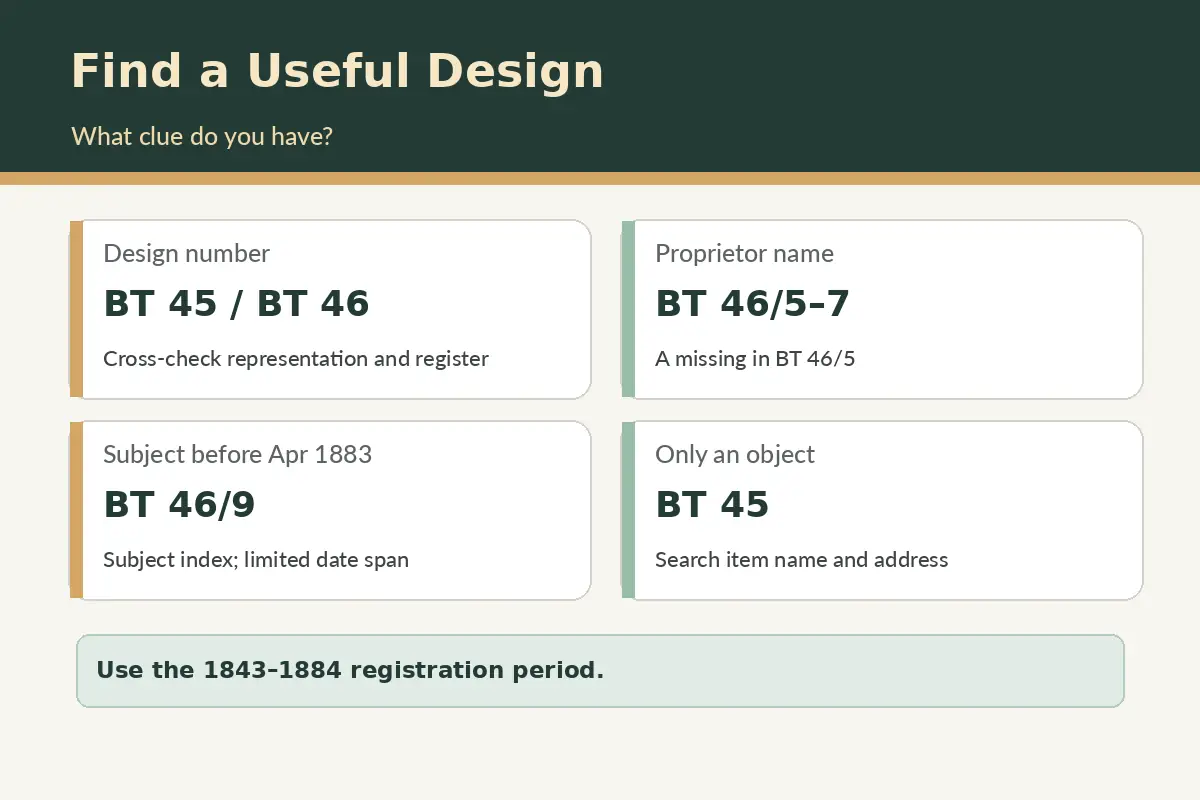
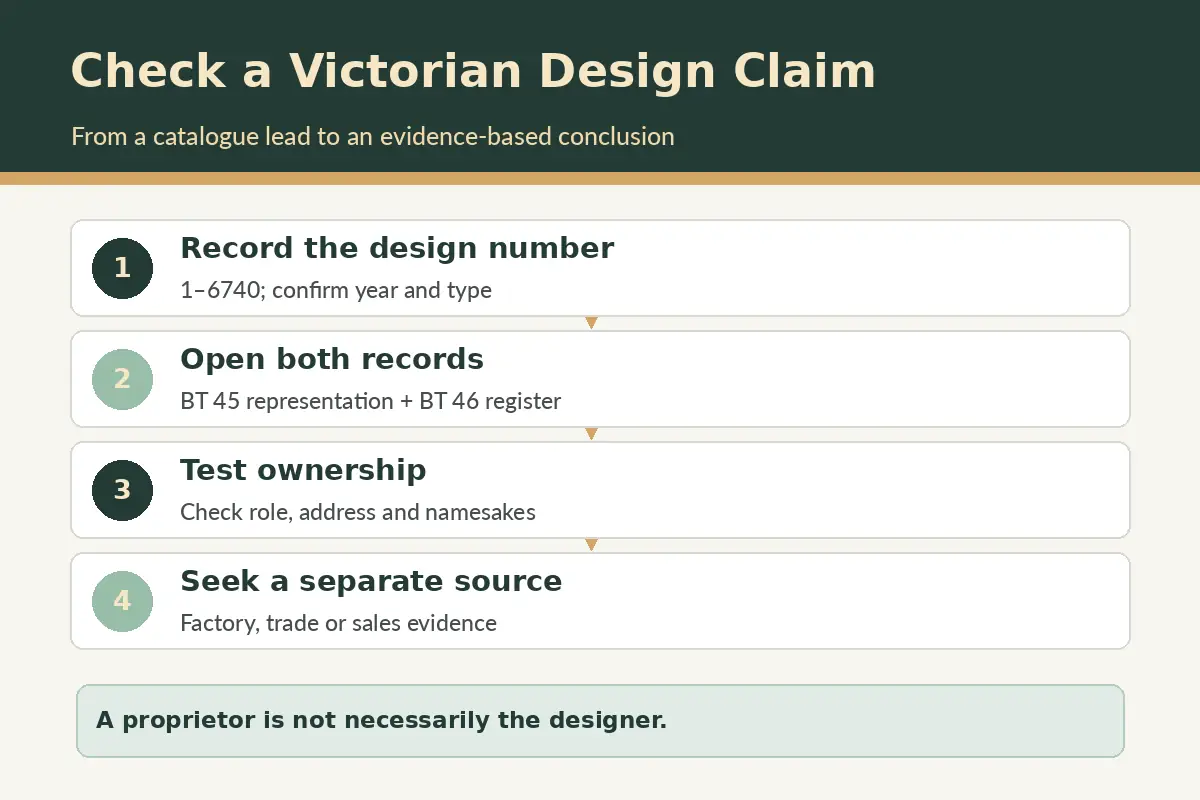
The archive gives the useful-design number range as 1–6740 for registrations dated 1 September 1843 to 30 June 1884. Representations are in BT 45/1–30 and the paired registers are in BT 46/1–4. Use a registered design number to move between a visual or physical design submitted and the details entered in the register.
Do not treat a piece number such as BT 45/29 as the registered design number. In the National Archives guide, a pictured 1878 luncheon casket is identified as BT 45/29/6105, demonstrating the distinction between archive hierarchy and registration identity. Cite the full reference and the registration date separately.
Object names are variable. Search the catalogue by item description, proprietor, address and design number as the archive suggests. Try period synonyms rather than guessing that an object appeared under today’s retail category. A representation’s picture can support identification of a form but cannot show the number of objects produced.
Know the Two Indexes and Their Gaps
If a registration number is unknown, consult the proprietor indexes in BT 46/5–7 or the subject index in BT 46/9. The National Archives notes that the letter A is missing from the index in BT 46/5. A missing A-name there therefore cannot be read as evidence that no such proprietor ever registered a useful design.
The subject index BT 46/9 is described for registrations from 1 September 1843 through 12 April 1883. That ending is earlier than the complete useful-design register span in 1884. Search the catalog directly or by number for later registrations instead of silently extending the subject index’s coverage.
Index entries serve as pointers, not substitutes for the actual representation and register. Copy the exact index term and reference, then verify the design number and proprietor in the relevant record. An ambiguous surname or industrial term may point to several objects; distinguish them using number, date and address.
Separate Proprietor, Designer and Maker
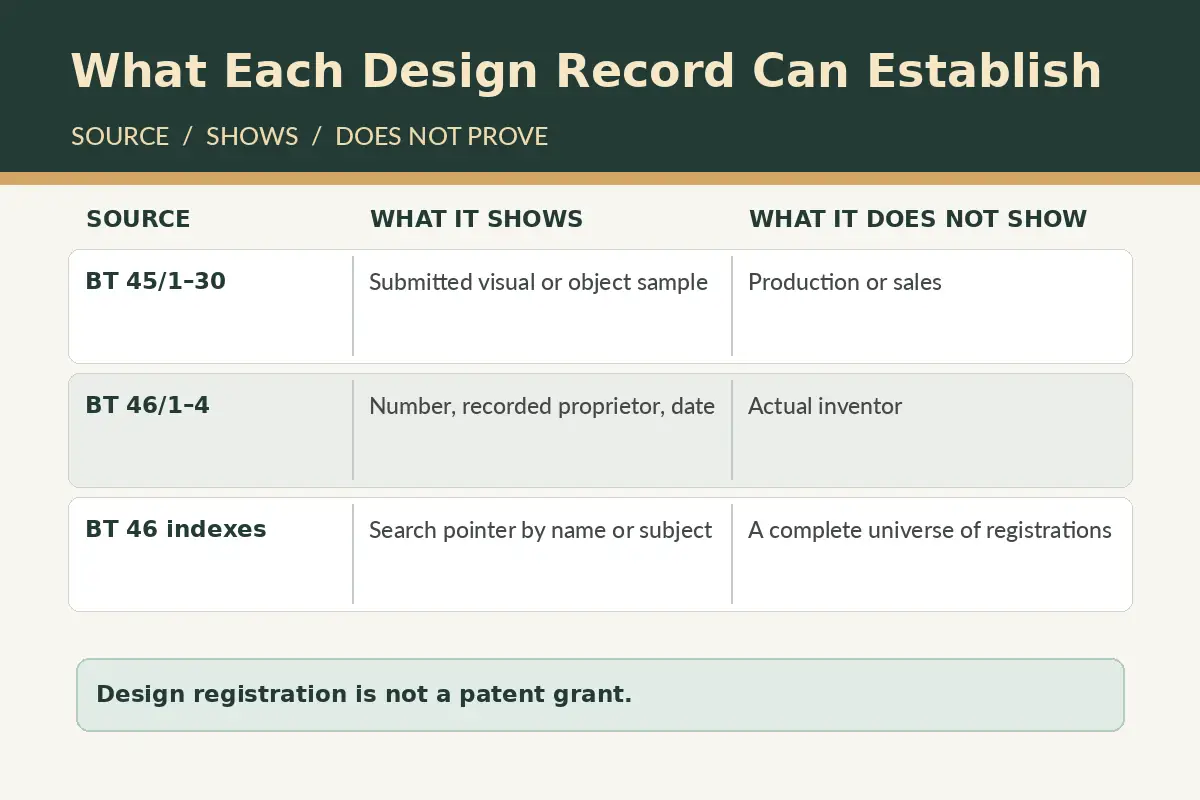
The design register can state a proprietor’s name and address, but the archive cautions that in registered-design records proprietors were commonly manufacturers or retailers rather than designers. In useful designs the proprietor was often the designer, but this is not guaranteed. Do not turn “registered by” into “invented by” without separate documentary support.
Imagine a hypothetical corkscrew registered by a firm called Hart & Sons. Its representation establishes that an object design was filed, and the register can establish the recorded owner. It does not establish that the elder Hart conceived the mechanism, that a specific son made it, or that the firm sold a particular quantity of the product.
For household or trade history, pair a proprietor address with dated directories, rate books, census records or partnership documents where available. Addresses can refer to a business office or registration contact rather than a home. Use historical maps and street-number changes to test a location claim instead of treating a single address as evidence of personal residence.
Account for Registration, Production and Survival
Registration can protect a design’s appearance without proving that the product entered mass production. A sample, drawing or painting is evidence of a design submitted to the registry. Sales, surviving stamped objects, trade catalogues and workshop accounts are separate kinds of evidence. Compare their dates with registration rather than assuming continuous manufacture.
The National Archives warns that some registration numbers lack corresponding surviving records and that some numbers were not used. If a number lookup fails, verify the correct date, design class and series, then report what cannot be found. Reused numbers elsewhere in the designs system make a class and period check essential.
A responsible case note reports the exact registered number, stated proprietor, address, date, description, and which physical representation or register was viewed. A second line records any proposed inventor or manufacturing claim and the independent source needed to establish it. A failed search without a complete number and index check is not negative proof.
More House and Local History Guides
How We Research Useful Designs
Our crosswalk follows the National Archives registered-designs guide, particularly its section on the 1843 Utility Designs Act. We use the Royal Navy research-and-development guide to confirm the separate subject-index route and distinguish design registration from government inventor awards.
Hart & Sons is fictional, and the pictured archival luncheon-casket reference mentioned above comes from the archive’s published guide, not an object we independently inspected. A real case should preserve the exact BT piece and design number, the representation’s appearance, register wording, access date and any gaps in the indexes.
For copy fees or third-party research consult our affiliate disclosure. No supplier relationship is implied. Begin by choosing one design number or a documented proprietor and test it against both the representation and its register entry.
BT 45/1–30 for the 1843–1884 useful-design registrations described by The National Archives.
In the corresponding registers in BT 46/1–4, using the registration number to cross-reference.
Try BT 46/5–7, noting the A index is missing from BT 46/5.
No. The subject index is listed only through 12 April 1883.
No. Registration, authorship, manufacturing and sales require separate evidence.