
A Victorian diamond mark can date a registered design, but not the manufacture of an individual heirloom. Find its picture in BT 43 and owner entry in BT 44. Begin with the official archive research guidance and read our affiliate disclosure before using any access service.
A Diamond Mark Dates Registration, Not the Object Itself
A Victorian registration diamond on pottery, glass, metal or another manufactured article is a route to a registered design rather than a certificate of the object’s production date. The National Archives describes the 1842–1883 ornamental system and its two principal documents: the picture or sample of the design and the legal register entry. The diamond encodes a material class and registration date. It cannot show when this particular cup, chair or piece of metalwork left a factory or first entered a household. A later product may carry a design that was registered years earlier.
First photograph the complete object, its underside and the mark without rubbing or destructive cleaning. Record whether the mark is a diamond or a later registration number; preserve uncertain characters rather than guessing them. Write down the material, decoration, any maker name, and an approximate manufacturing context from independent sources. The 1839–1842 registration system, useful designs from 1843 and registrations after 1883 use different documentary routes, so begin with the record-creating law, not a search for every BT series at once.
Read the Material Class and the Two Diamond-Code Eras
The upper part of a registration diamond uses a class numeral: I for metal, II wood, III glass, IV earthenware, V wallpaper and VI carpets, with further categories covering fabrics. Other positions encode day, month, year and a bundle or parcel designation. Crucially, the layout of letters and numerals changed in 1868. Consult the two separate conversion tables in The National Archives guide, rather than applying a modern alphabetic sequence or assuming a letter always means the same year.
For marks from 1842 through 1867, the year letter sits on the left of the diamond; for 1868 through 1883 it sits on the right. This orientation is a decisive check when two dates look equally plausible. Transcribe each field in a small grid before looking up the codes. The correct output is a proposed registration date, material class and any unresolved symbol. Photographing the stamp under angled light may reveal a faded character, but an unreadable mark must remain partly uncertain.
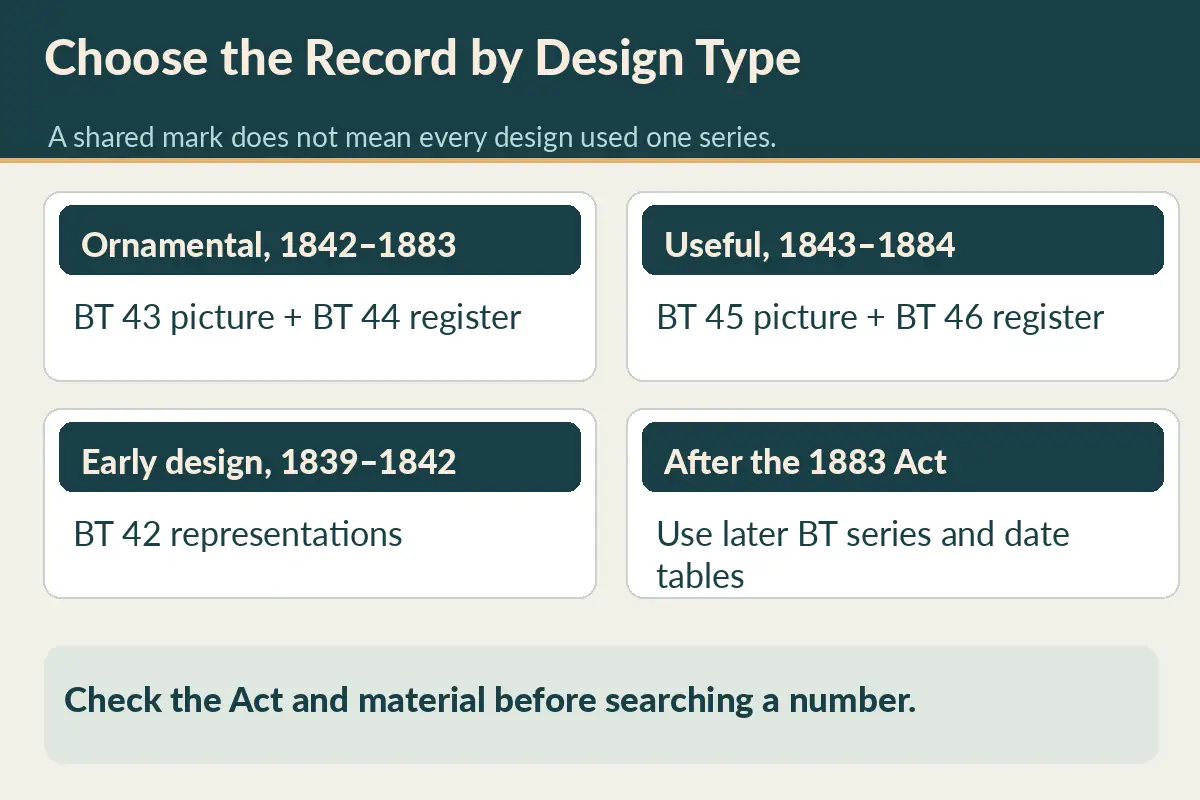
Connect a BT 43 Representation to Its BT 44 Register Entry
For ornamental registrations under the 1842 Act, BT 43 holds representations: submitted drawings, product samples or other pictures arranged by material class and design number. BT 44 holds the corresponding registers, organized within class and number ranges. The same registration number provides the bridge. Search Discovery using an object description, proprietary name, address or known number; then consult the class-specific ranges listed in the official archive guide. A full object description may not be indexed for every entry.
When a candidate appears, record its exact BT 43 piece, registration number, depicted form and class. Locate the relevant BT 44 register volume for the same registration number and verify its registered date, proprietor name, address and any description. Keep the representation and register as two separate citations. A catalogue result may merely point to a bound volume, and a copy or visit to Kew may be required. Never treat a picture with similar decoration as a verified match without number and date agreement.
Identify the Proprietor Without Inventing a Designer
The registered proprietor was usually the firm, manufacturer or retailer that owned rights in the design. The person who drew or engraved it is often not named. An address in BT 44 is the proprietor’s listed business or contact location, not automatically the home of an ancestor. A family name could belong to a trading partnership rather than a single relative. Distinguish the owner named on the registration from the craftsperson, factory workers and later sellers.
To test a business connection, compare the registration name and address with dated directories, company documents, census occupations, trade advertisements and surviving invoices. Note how business names can be reused and premises can move. If an ancestor worked in a related industry at the right time, that creates a research hypothesis, not authorship proof. Put each assertion—registered proprietor, likely producer, employee, designer and object owner—on its own evidence line and identify which document supports it.

Know When BT 42, BT 45 or Later Series Is the Better Path
BT 43 and BT 44 are not a universal archive for every antique design. The early 1839 Act’s representations are in BT 42 and lacked the later register arrangement. Useful, non-ornamental designs registered under the 1843 Act follow BT 45 for representations and BT 46 for registers. The guide also names provisional registrations in BT 47 and BT 48. Records after the 1883 legislation lead to different BT series, with many later representations and registers in BT 52 and BT 53.
A useful search log should therefore include design type, estimated registration window, correct Act, appropriate series, class, number and search result. Record inaccessible or missing volumes separately from unsuccessful name matches. Sometimes a registration number was unused or a record did not survive. For post-1884 cases The National Archives points researchers to the British Library’s Official Journal of the Patent Office as another dated source. The same-looking printed numeral cannot safely be interpreted without checking period and category.
Prove the Heirloom’s History With Independent Evidence
The design record establishes a dated application for legal protection, not the biography of one household object. A family story that grandmother purchased the item in 1872 needs receipts, probate inventories, photographs, dated letters or other independent evidence. Compare marks, manufacturing techniques and later editions before assuming a piece made with a registered design is contemporaneous with its first registration.
Build an object timeline with registration, possible production, dated ownership, family transfer and current custody as separate columns. Cite the archival representation and legal entry, and identify what each establishes directly. If only the design date is proven, write “design registered by” followed by that date, not “object made in” that year. Preserve high-resolution photographs of the mark and your uncertainty notes so another researcher can repeat the identification without relying on an attractive but unsupported family legend.

How We Research Victorian Registered Design Marks
We establish material and registration-era gates first, decode every visible part of the diamond against the official year and month tables, and follow the design number across the BT 43 representation and BT 44 register. We then independently research the listed proprietor and date any actual family ownership. We log unmatched classifications, missing numbers and the difference between a protected design and a surviving manufactured piece.
More Records and Archives Guides
Original Archives and Evidentiary Boundaries
To reproduce this investigation, consult the principal official series guide (Explains diamond marks, ornamental design classes, series BT 43 representations and BT 44 registers and proprietary identity.). Independently compare the secondary archive reference (Shows actual nineteenth-century ornamental designs and describes industry and rights ownership.). Neither an archive catalogue title nor a later database index proves the full historical event without examining the underlying record and its context.
No. It records a design registration date; manufacture and later sale require separate evidence.
For ornamental designs under the 1842 system, look in the material-class representation volumes in BT 43.
Use the linked BT 44 register entry, but remember that the proprietor may be a retailer or firm.
No. Early, useful and later designs can belong in BT 42, BT 45 or subsequent BT series.
Keep the reading provisional and verify the class, full date and registration number against originals.