
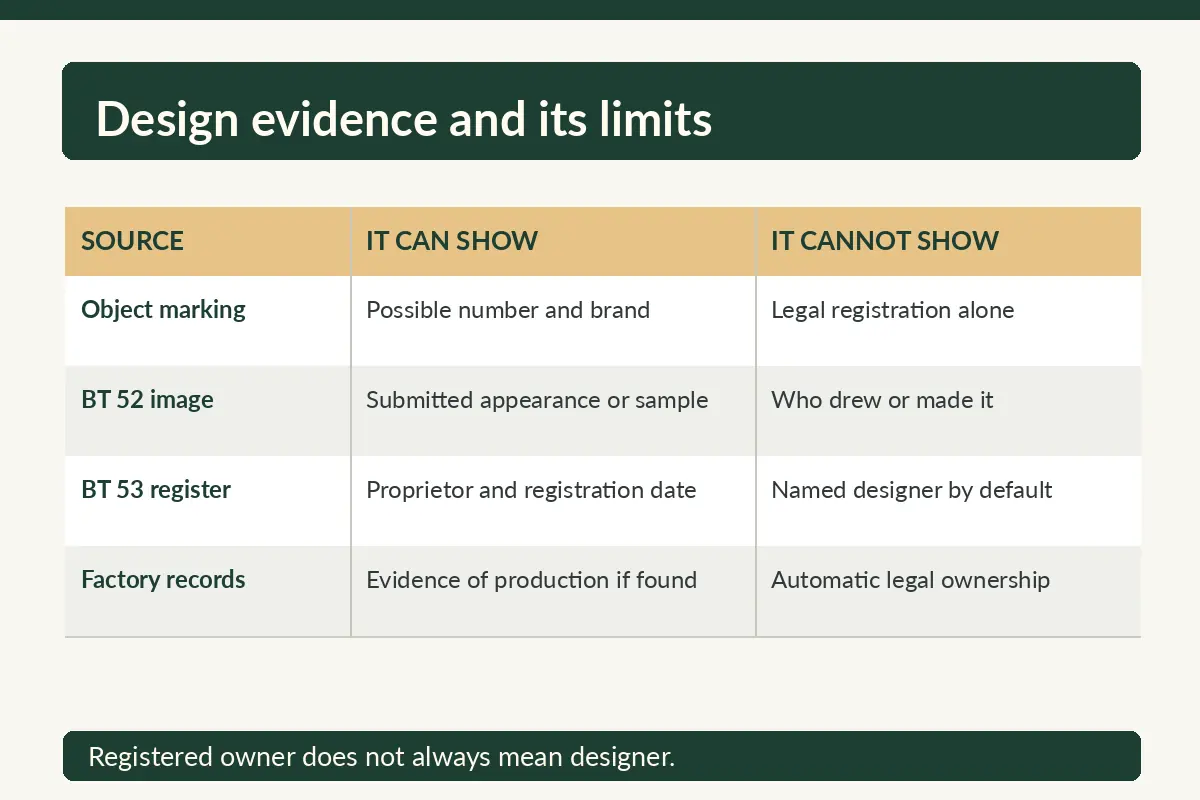
For many twentieth-century British registered designs, The National Archives preserves a picture or sample of what was registered in BT 52 and a separate register entry in BT 53. These two record types share a design number. The register can identify a proprietor—the person or firm claiming rights in the registered design—but that proprietor was frequently a retailer or manufacturer rather than the individual who created the design. A marked kettle, patterned fabric or glass object is therefore a starting clue, not a complete designer biography.
The Archives’ guide divides 1908–1991 searches by textile versus non-textile class and by changes in registration-number ranges. The correct route depends on both. A missing representation, a wartime interruption or an unexplained gap in numbering is not automatic proof of a counterfeit object. This workflow makes the number, class, legal record and physical item separate pieces of evidence.
Identify whether the evidence begins with an object or a design number
Examine the object without damaging it. Photograph every registered-design mark, number or label, including the position and orientation of the inscription. Record material, construction and any manufacturer branding separately. Some textiles, paper goods and components lost their original labels when cut or reused. The number may therefore be absent even if a similar design appears in BT 52. Avoid reading an ordinary model number, patent marking or retail stock number as a confirmed registered-design number without corroboration.
If you know the proprietor or the likely registration year but not the number, the archive guide explains that some catalogue descriptions are searchable in more detail than others. Search the class, address, proprietor and object description where supported. If the individual description is sparse, move to number and date ranges for the relevant books. Preserve alternative spellings and company forms; a shop label could represent a trade name rather than the registered legal proprietor.
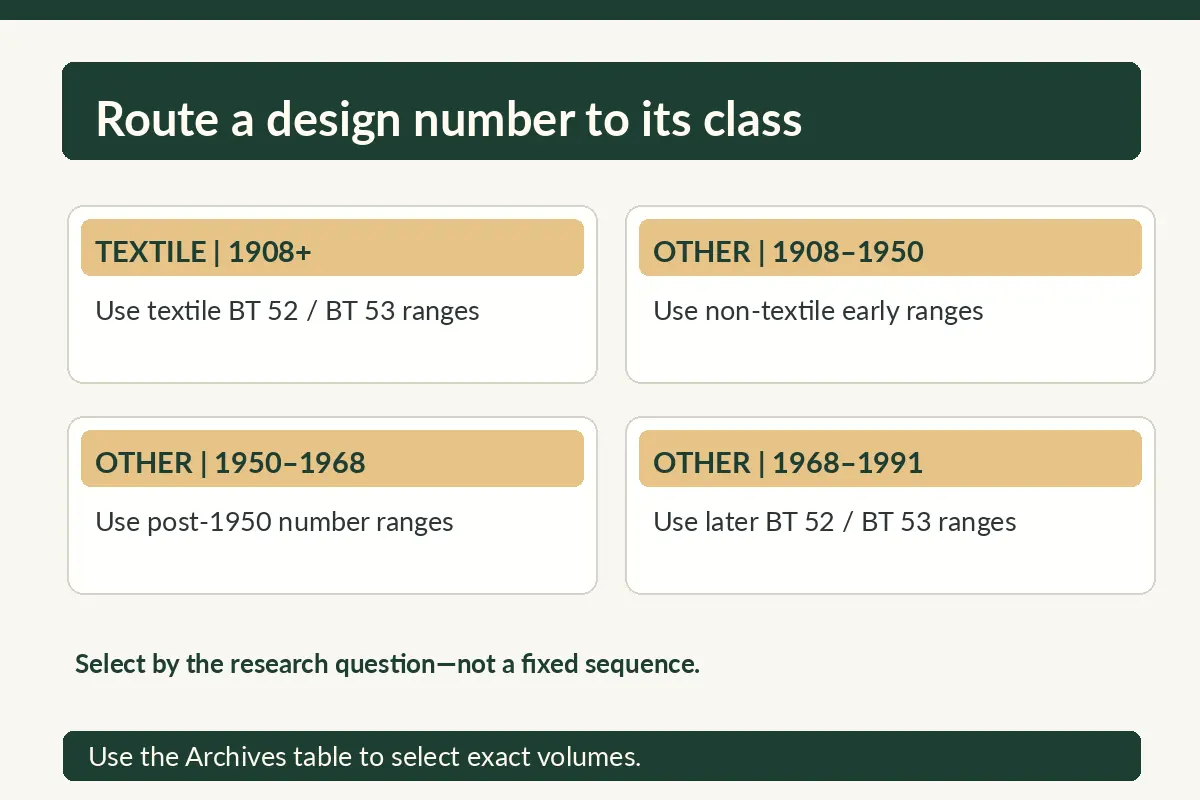
Choose the correct textile or non-textile path
BT 52 holds representations for much of the twentieth-century period, but the books do not form one uninterrupted, uniformly indexed sequence. The Archives’ tables distinguish early textiles in 1908–1910, later textile material beginning in 1908, and non-textile groups for 1908–1909, 1909–1950, 1950–1968 and 1968–1991. Use the exact range in the archive guide for the suspected number and object type. Do not treat these categories as successive steps every searcher must complete.
The BT 53 register ranges change with the representation ranges, so a citation from a representation book cannot be substituted for a corresponding register entry. Some earlier transitional records also refer to BT 51, and the Archives identifies additional register material and classified summaries in BT 53. Once you have a plausible number, consult the guide’s table before requesting a particular volume. An attractive picture in the wrong class is not a valid match.
Use the shared registration number to compare records
A representation records the submitted visual design: a drawing, photograph or sample, sometimes including material or form. A register can record the design number, name and address of the proprietor, date of registration and sometimes a description. Copy these fields from each original record with page or folio information. Check that the number and object class agree. A similar-looking design in a book is insufficient when the identifying number belongs to another registration.
An address in a proprietor register identifies the registered party at that point, not necessarily the factory where an article was produced, the household where a designer lived or the date when an individual item was sold. Use trade directories, product catalogues, factory records and advertisements to test production or sales claims. If the register names a company, do not replace its corporate identity with an assumed founder solely because a family surname appears in the business name.
Recognize wartime and survival limits
The Archives’ registered-design guide explains that there were no representations filed during the First World War period and only brief register particulars for some wartime records. Other specific series contain missing volumes, unused registration numbers or numbers for which a corresponding record no longer survives. These are archival and administrative limits. They are not a reason to create a sketch of a supposedly missing design or invent a proprietor to fill a blank field.
For each gap, record which part failed: number not found, register located but image missing, image present but owner entry inaccessible, or unclear class. Those are four different results. Check current viewing arrangements: many original volumes or items require a visit or a copying request rather than an instant image download. The archive’s online catalogue is an aid to finding records, not a guarantee that every drawing is digitally viewable.
Write an attribution that separates four different roles
Your finished description should distinguish registered proprietor, probable retailer, possible manufacturer and named designer. For example, “The register lists Company A as proprietor of registration number X; the corresponding representation depicts a patterned glass bowl.” That statement is stronger and safer than “Company A designed and manufactured this bowl.” If another signed drawing or design employment file identifies the artist, cite it separately and assess whether it represents the same registered design.
Conclude with a crosswalk showing object mark, number, class, representation reference, register reference, proprietor and independently confirmed production evidence. Include the date each archive entry was checked. If the provenance ends at registration, say so. A collection of nearly three million designs is remarkable material for object and business history, but registration documents cannot replace the evidence needed to connect a specific manufactured item to a named worker.

More House and Local History Guides
How We Research and Verify These Records
This guide uses the record-series descriptions and the boundaries explained in The National Archives guide Secondary archival guidance. The sources identify the kinds of documents, their arrangements and possible access routes; they do not certify any particular ancestor, institution or map as independently inspected. Check each original item and the current catalogue access status before quoting a detail as a documentary finding.
We separate a catalogued lead from an original document, an administrative statement from an event, and a possible identity from a proven link. Historical names, jurisdictions and date ranges can be uncertain; missing entries are not negative proof. Reader information is editorial, not a claim of professional archival representation. Review our affiliate disclosure before following any commercial material on the site.
BT 52 primarily contains design representations, while BT 53 contains registers and related summaries for specific number and date ranges.
Not necessarily. The proprietor was usually the rights holder and could be a retailer or manufacturer rather than the designer.
A number is useful, but you should still check the applicable object class and date-range tables.
No. Many records require consulting the original or requesting copies; catalogue detail is uneven.
No. Unused numbers, losses, wartime record limitations and indexing differences can affect the result.