
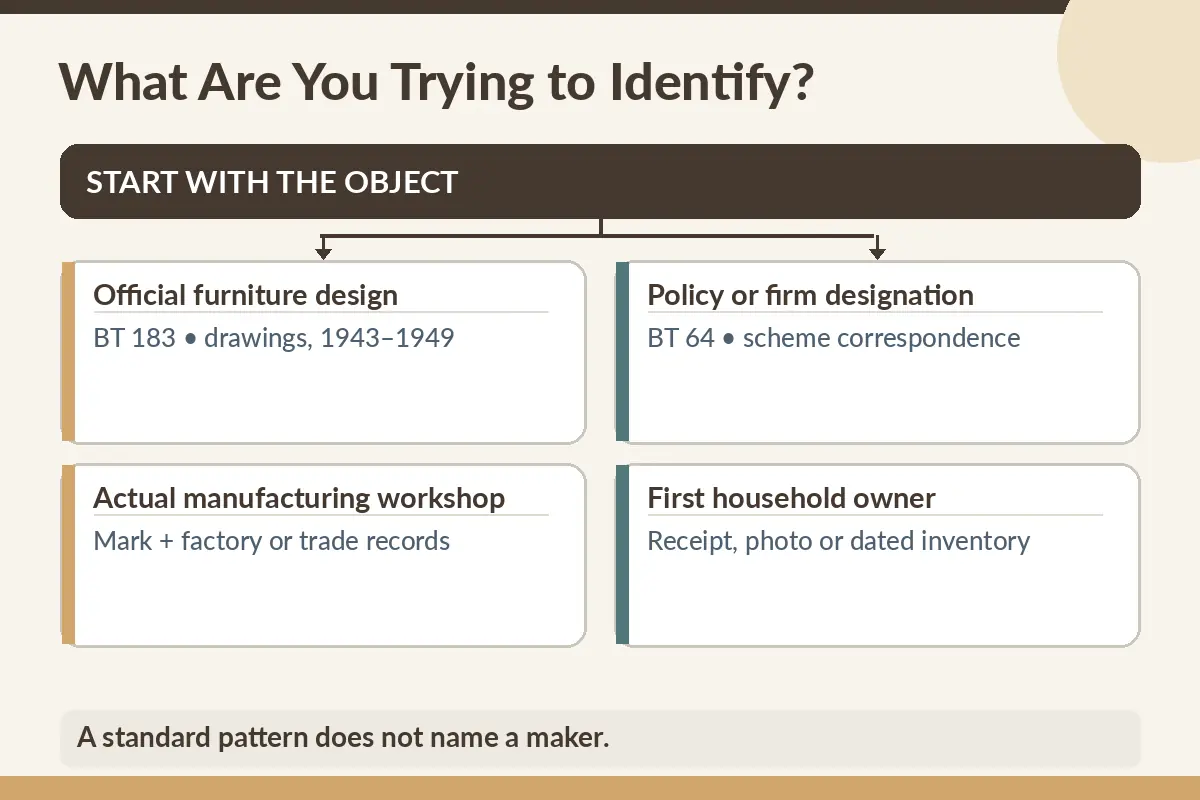
BT 183 preserves files and drawings for Britain’s Board of Trade Utility Furniture Scheme in 1943–1949. A drawing can help identify an official design, but it does not automatically identify the factory that produced a particular object or the family that first bought it. Use the three-way distinction between pattern, manufacturing evidence and household provenance.
Begin With the Object, Not a Claimed Designer
The National Archives identifies BT 183 as Board of Trade Utility Furniture Scheme files, 1943–1949, containing large numbers of drawings relevant to the furnishings of buildings. These are useful evidence for the official development of wartime and early postwar furniture designs. They are not, by themselves, a household inventory, universal factory output ledger or proof that a particular chair in a family photograph was made by one named workshop. Start with the object’s observable structure and the time period you need to test.
Record its overall silhouette, joinery, measurements if safely obtainable, leg shape, seat and back details, wood or other materials, any surviving stamp, and where the family says it came from. Separate observations from inherited descriptions such as “wartime government chair.” Many simple furniture forms resemble one another. A close visual match to a published standard drawing may establish a design family, but an attribution to a maker requires additional contemporary evidence.
Understand What the Official Scheme File Contains
BT 183 belongs to the administrative record of the Utility Furniture Scheme rather than to the old Victorian registered-design sequence. Its date span of 1943–1949 refers to the files described by The National Archives, not the lifetime of every physical item based on a utility design. A dated sheet can illustrate the model, changes to specifications or a proposed arrangement; the exact purpose must be read from its caption, labels and surrounding correspondence.
Review the official architectural drawings guide to locate BT 183 and identify which record might hold the relevant drawing. Search by article type, model description and date when possible, and browse the series when no object name is indexed. Catalogue metadata is not full text. A file titled “chair designs” may contain many sheets, some revised, and a name appearing on an envelope may belong to a department or correspondent rather than a maker.
Separate the Drawing From Manufacture and Sale
A specification shows what an approved or proposed item should be like. That does not establish that every authorised factory manufactured it, that production occurred at a particular time, or that a family purchased it from a particular retailer. This is the central attribution problem. If a drawing matches a chair, write “consistent with this design” rather than “manufactured by company X,” unless production records, a legible maker’s mark or other independent evidence support the stronger claim.
Research on the Utility Furniture Scheme cites Board of Trade materials in BT 64 concerning manufacturer designations and policy, including BT 64/1816 and BT 64/1835. Those records address different questions from a BT 183 drawing. A list of firms designated to produce Utility furniture can show official participation in the scheme, not which named firm built your individual object. For the latter, examine dated labels, factory catalogues, purchase receipts or workshop records where they survive.

Read Revisions and Material Clues Carefully
An object may have been repaired, repainted or altered long after manufacture. Compare structural details that tend to survive ordinary refinishing: joints, screw placement, leg angles, rail proportions and the underside of seating. Avoid removing surfaces, prying off labels or aggressive cleaning for the sake of identification. An owner’s old finish or repair may be more valuable as documented history than a polished surface that no longer preserves manufacturing clues.
When comparing a drawing with the object, note the revision date and whether the document describes a proposed specification, later amendment or finished pattern. Do not infer the year of the household purchase from the first issue date of a design. A model could continue in use after the design was introduced, and similar forms could appear outside the scheme. Use photographs with reliably dated room interiors only as supporting context, not proof of a particular factory.
Look Beyond BT 183 for a Household Story
If your question is why a family acquired a certain piece of furniture during wartime, administrative drawings are only one part of the story. The wartime scheme responded to constraints on production, material supply and distribution. Research into the scheme draws on Board of Trade policy and manufacturing papers, while separately held documents, such as the 1946 Furniture Working Party report catalogued by the University of East Anglia, offer a broader view of postwar debates about furniture standards and industry.
A family narrative requires evidence closer to the household: a dated photograph, receipt, shop advertisement, moving inventory, insurance schedule or oral account with a clear speaker and date. A claim that furniture was issued or bought under restrictions should be verified from the scheme rules applicable to that particular place and year. A standardized design does not tell you the buyer’s entitlement, purchase price, address or reasons for choosing the object.

Write an Object-to-Archive Attribution Report
Make a four-part report that a future family historian could reproduce. First, document the object with overall and detail photographs, measurements and inscriptions without altering it. Second, identify the BT 183 sheet, date, title and exact archival reference, noting every meaningful difference from the object. Third, look for production evidence in appropriate Board of Trade files or manufacturer records. Fourth, document the chain of possession with independent household sources.
Close the report with graded statements. “A chair resembles the official Utility Furniture pattern shown in a 1940s BT 183 drawing” is a useful finding. “The chair was made in 1944 by a named factory and purchased by my grandmother” is three additional claims requiring their own evidence. If there is no legible maker’s mark and no surviving receipt, it is reasonable to leave manufacture and first ownership unresolved. That uncertainty is not a failure; it is the honest limit of the record.
More House and Local History Guides
How We Research and Check the Archival Evidence
We checked the archival descriptions and record-family boundaries against these sources: The National Archives; supporting archival research; University of East Anglia; The National Archives. The cited guides support the series and period statements but cannot authenticate an unknown item, family relationship, particular named worker or undocumented file that we have not examined. A catalogue result is a finding aid. Read the original where access permits, record the full reference, and cite each separate factual claim at the level of its actual evidence.
Our evidence rule is simple: quote a source for what it records; label any deduction as a deduction; and leave gaps visible until an independent record resolves them. These guides are informational and do not imply that records are online or free in every case. Commercial relationships, when applicable, are explained in our affiliate disclosure; none of the research routes above requires an affiliate purchase.
No. The series documents the Board of Trade Utility Furniture Scheme, including many drawings, not private household ownership.
No. A standard specification can be used by different authorized producers; look for maker marks and production or commercial records.
No. A drawing or revision date is not a household purchase date. Seek receipts, photographs or inventories.
Research on the scheme uses Board of Trade BT 64 administrative files, which answer different questions from BT 183 drawings.
No. Document the piece non-destructively first and seek professional preservation advice before any intervention that could damage evidence.