
BT 226 Bankruptcy Case Files: Trace a Railway Failure Without Inventing Debts is an evidence-first guide to BT 226 bankruptcy case files, not a promise that one archival item can reconstruct a complete biography. Start with the archive’s stated scope, record the exact entry and date, and separate the administrative act from the larger historical conclusion. The National Archives series guidance establishes the first search route; a related official research guide explains the next evidentiary checks. Use the route below to find what a record actually says before inferring a person, voyage, estate, or event.
Identify the Debtor and the Legal Proceeding
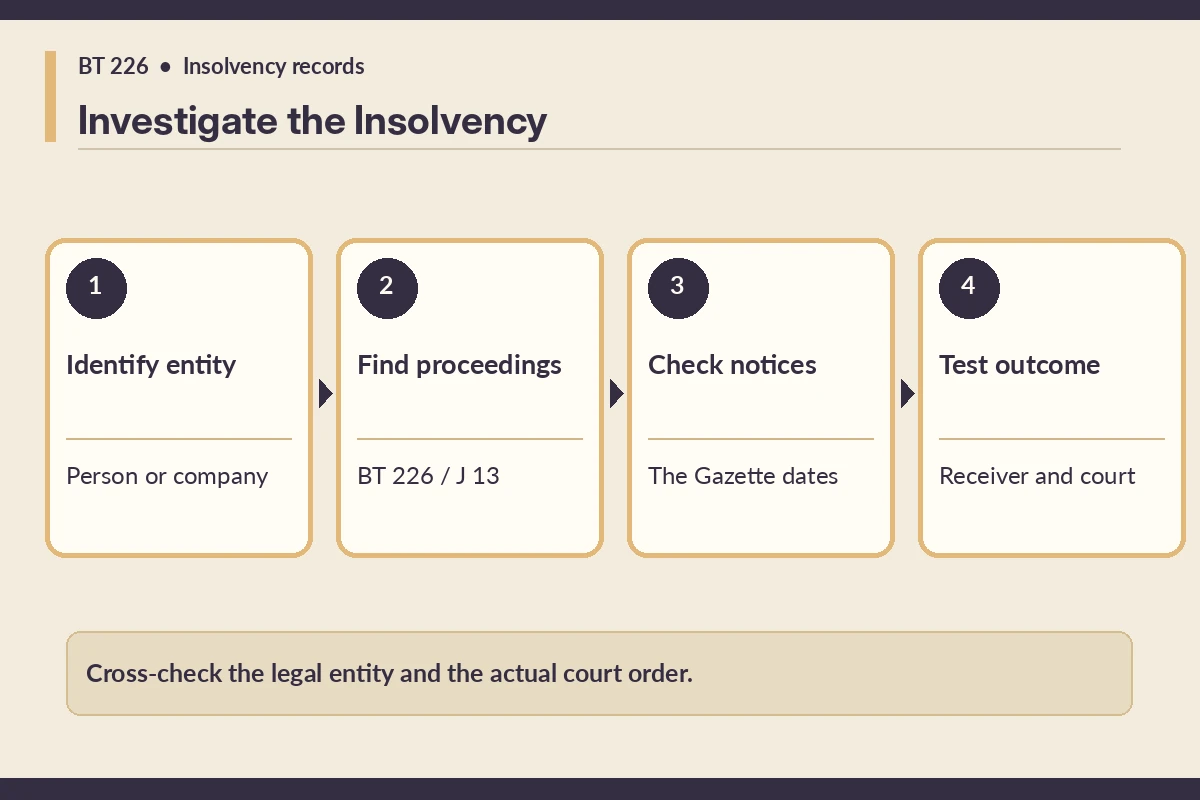
The National Archives lists BT 226 among Board of Trade official receiver case files. The series may assist research into the bankruptcy of firms, including railway businesses, but it is not a universal register of every failed company or a replacement for court proceedings. Begin with the legal name of the debtor, approximate date, place of business and whether the problem involved an individual trader, a partnership or an incorporated company.
Historic railway names can be particularly confusing because companies reorganized, merged, leased routes or changed trading names. A bankrupt contractor serving a railway is not necessarily the railway company itself. Check the legal entity named in a notice or file against contemporary company directories and incorporation records before treating the financial event as a failure of an entire line.
Use BT 226 With Its Survival Limits
The National Archives’ bankruptcy guide identifies official receiver case files in BT 226 and notes that from 1914 onward only samples are included, with indexes in BT 293. This is a crucial retention limit. A missing post-1914 case file cannot establish that a company was solvent or that proceedings never started. An index might also identify a historical case even if the detailed file is absent.
Search by legal name and name variants, then record the catalogue description and piece reference before making a claim about the case. Check the date of the petition and other milestones independently. Older file dates and later filing dates may overlap, and an index entry can refer to a proceeding spanning several years.

Compare Bankruptcy Files With Winding-Up Papers
Corporate winding-up and individual bankruptcy have related but different procedures and archives. The official railway research guide directs researchers to J 13 for filed papers relating to winding-up orders, as well as other related J series, while the company guide places BT 226 among Board of Trade bankruptcy records. Use the procedure named in the actual document to select the search route.
If a Gazette notice says that a petition for winding-up was presented, it does not mean an order was made. If an order exists, that does not by itself reveal how much creditors received or which property was sold. Put each document next to the stage it can actually prove. Do not merge a petition, order and distribution into one simplified “bankrupt on” date.

Read Claims and Assets Without Inventing Figures
Case papers may include reports or correspondence concerning assets, creditors, proceedings and the official receiver’s role. The exact contents vary. A stated claim can be disputed, withdrawn, reduced or only partly allowed. Distinguish a company’s reported liabilities from allowed claims and from sums actually distributed. If the file reports only a total, do not create a named list of creditors.
Use a simple ledger headed “document,” “figure stated,” “date,” “status of figure” and “proof still needed.” A valuation of railway rolling stock is not proof that every locomotive was sold at that value. A creditor’s petition cannot by itself establish fraud. Compare later accounts, official receiver statements and court results where the question warrants it.
Use Gazette Notices as a Dated Public Trail
The Gazette can provide public notices of bankruptcy and company liquidation. These are valuable for setting out procedural dates, official names, and courts or offices involved. But the text may describe an intended hearing, appointment, creditor meeting or other administrative step. Read the notice heading, publication date, named entity and action verb before treating the item as an accomplished event.
When a newspaper reports that a railway closed after insolvency, separate the corporate case from the cessation of passenger or freight service. A receiver may keep operations running, a route may be transferred, or a different company may take over assets. Timetables, transport ministry records and company minutes are potential independent checks of what happened on the ground.
Investigate a Railway Company Example
Imagine a family archive containing a share certificate in a minor railway and a clipping about a bankruptcy petition. First verify the company’s legal name from the certificate. Search BT 226 for case files, then use J 13 or a Gazette notice to establish whether there was a formal winding-up order. Keep a separate entry for the shareholding because a share certificate does not show the holder was repaid.
If a BT 226 file is missing after 1914, record the sampling policy rather than declaring the bankruptcy a rumor. Consult any surviving receiver index, company registration record or official notice. The most defensible conclusion may be that a petition and order are confirmed while final distributions and the shareholder’s personal loss remain unknown.
Distinguish Company Loss From Personal Genealogy
A person named as a shareholder, director, manager or supplier has a particular recorded connection to a company, but not every relationship implies responsibility for its debts. A director’s signature may show authorization of a document rather than knowledge of every liability. A creditor claim need not establish that money was paid. Match each role to its own contemporaneous evidence.
If a distant relative appears in two successive railway companies, use appointment documents or dated share registers to establish continuity; do not infer that the person transferred when a route changed hands. Physical stations, lines and locomotives may survive corporate dissolution. Property and business history are not identical, and neither automatically documents an individual’s employment.
More House and Local History Guides
How We Research Bankruptcy Evidence
We identify the legal debtor and proceeding first, then keep each step—petition, hearing, order, receiver report and distribution—in a dated evidence ledger. The archive’s post-1914 sampling limits remain explicit. For railway cases, we distinguish corporate proceedings from operational history and verify company identities before using a financial notice as family evidence.
We link official research guides rather than treating catalogue summaries as case outcomes. Any commercial relationships on the site are explained in the GenHis affiliate disclosure.
It contains case files of the official receiver and is cited by The National Archives as a source for bankruptcy of firms.
No. From 1914 onward BT 226 is described as a sampled collection; absence is not proof no proceeding occurred.
Not automatically. The legal process and appropriate series differ; J 13 holds winding-up order papers.
The official railway guide points researchers to BT 226 for railway bankruptcy files, alongside separate court series.
No. A notice publicizes a stage of proceedings; distribution and discharge require additional records.