
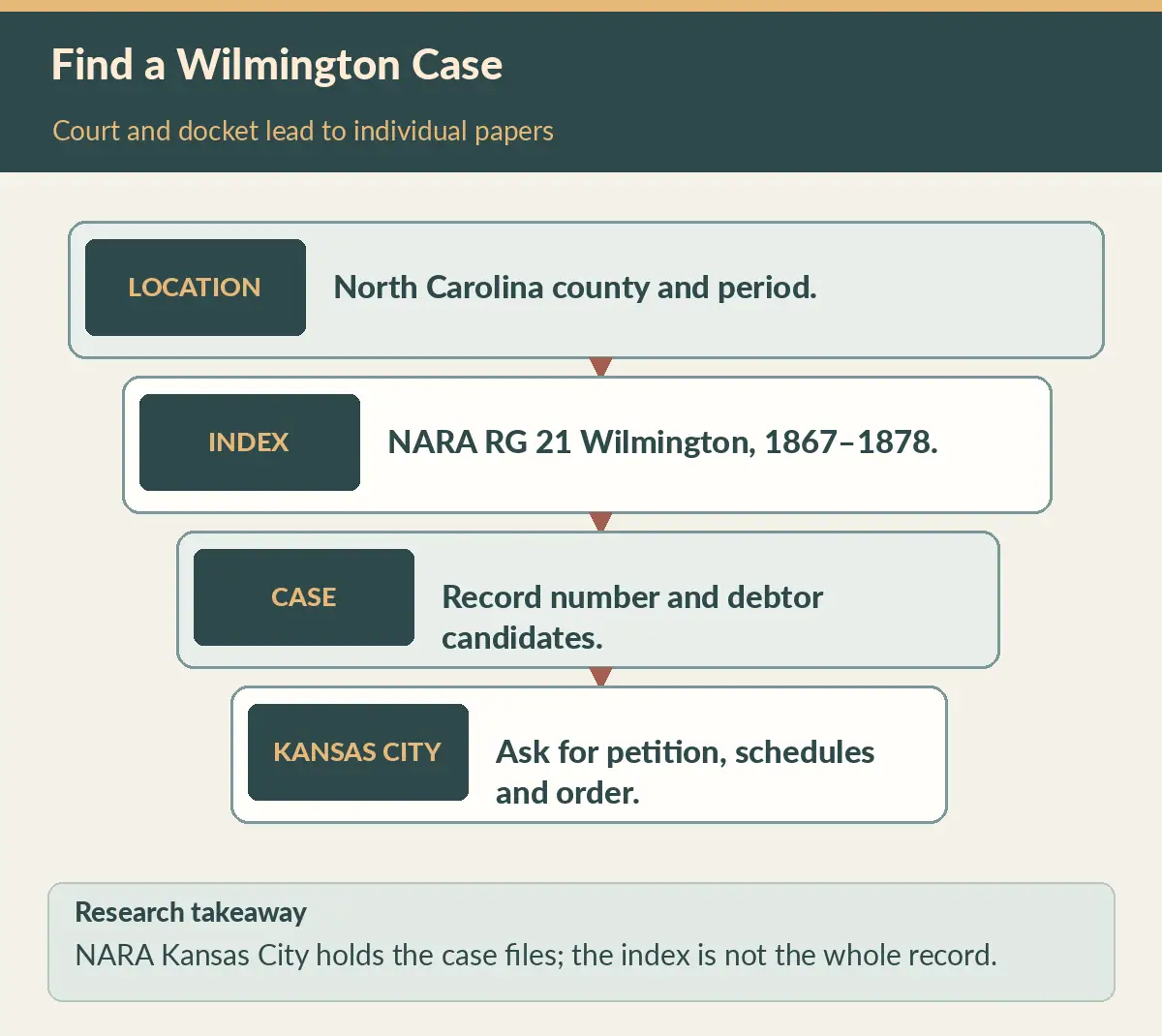
For Reconstruction-era North Carolina federal bankruptcy files, begin with the Wilmington RG 21 case index and case number, then read the petition, debt schedules and court’s disposition separately. The NARA finding aid describes cases dated 1867–1878 and notes that the physical files are now in Kansas City. A petition shows a case was initiated; it does not establish that a debtor received a final discharge.
Locate the Wilmington Federal Court Collection
A federal bankruptcy filing should be searched by court and date rather than by a statewide surname assumption. NARA identifies RG 21 bankruptcy case files for the Wilmington federal court in North Carolina, 1867–1878, under National Archives Identifier 2519008. The finding aid includes case numbers, names, some counties and dates.
This local court collection is not a universal database of all North Carolina insolvencies. Establish the debtor’s documented county, approximate filing period and likely legal jurisdiction before selecting a hit. A person may have other state-court litigation or private debt disputes that never generated a federal bankruptcy petition.
Record the Case Number Before Reading Namesakes
Look up the original NARA list and record case number, listed debtor name, stated residence, filing date and any partner names. Business partnerships may appear under a firm style, while one case can generate several names in a table. Do not assume each row reflects a separate proceeding.
The same surname or initials can identify unrelated debtors in neighboring counties. Build a candidate table before merging a listed debtor with an ancestor in a census. If there are several similar names, prioritize dated local residence, trade and property details over a mere phonetic match. Cite the finding aid as a locator, not as a complete copy of the pleadings.
Separate Debtor Petition From Court Outcome
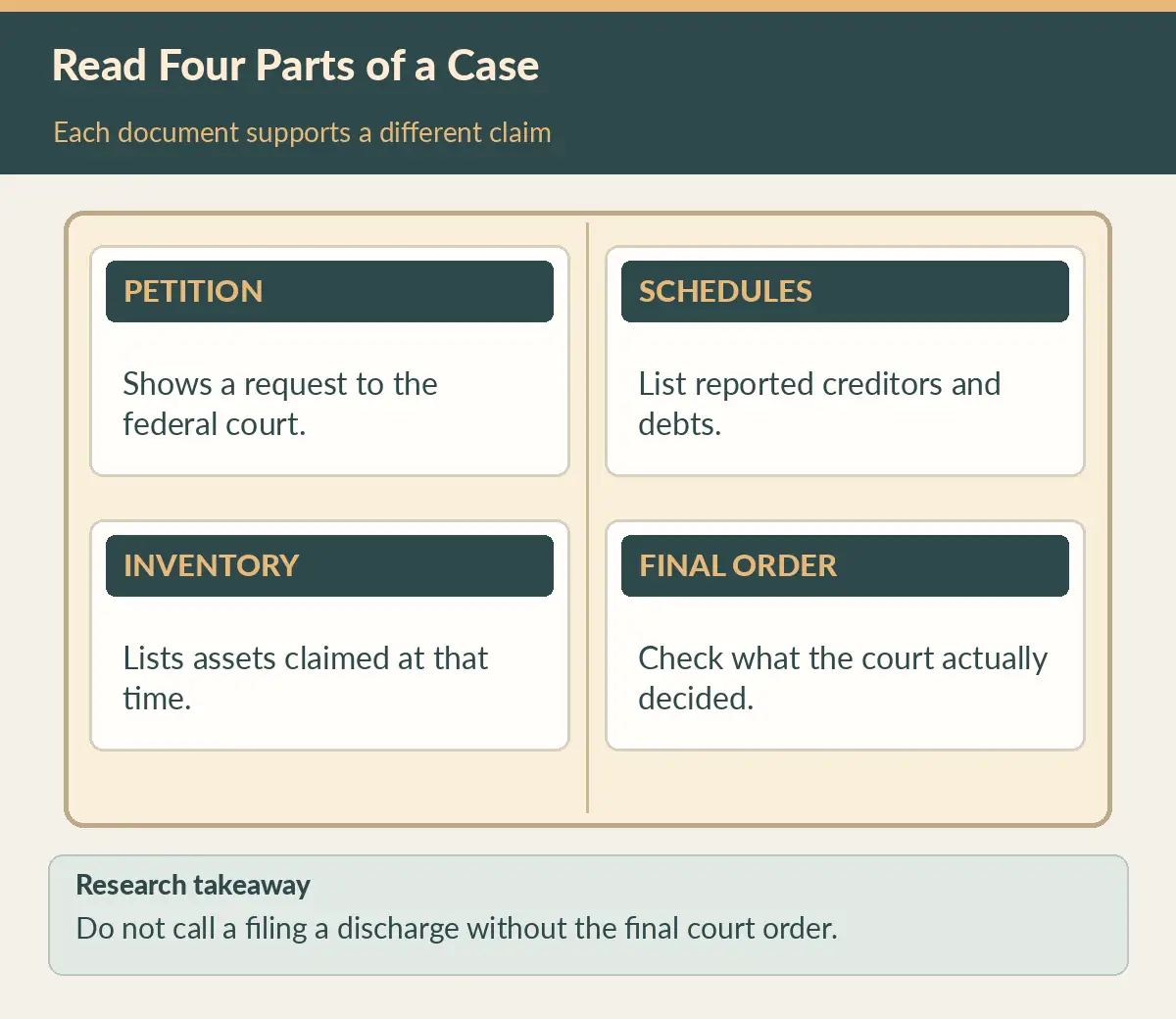
A typical case packet can contain the debtor’s initial petition, statements of debts, inventories, trustee papers, notices, petitions for discharge and eventual orders. These documents occurred at different procedural stages, and one does not guarantee that every later stage survives. A listed petition cannot prove the bankruptcy concluded with a discharge.
Likewise a list of debts does not establish that creditors were paid the amounts claimed. When reading the file, create separate dated rows for filing, notice, appointment, adjudication and final decree, citing the specific paper underlying each fact. Do not turn the word “bankrupt” in a modern index into a moral judgment about the individual.
Read Creditor Schedules Without Assigning Kinship
NARA describes schedules containing names and addresses of creditors, amounts due and the classifications of debts. A creditor and debtor may have been trading partners, lenders, employers or occasionally relatives; a transaction is not proof of family connection. Note the original role and amount exactly as written, including whether the claim was disputed, secured or unsecured if visible.
Compare addresses and dates with city directories or local deeds before making a contextual inference. One surname appearing twice can represent distinct people and legal entities. A creditor’s appearance in a bankruptcy file does not show they personally signed the petition or agreed with the debtor’s valuation.
Use Property Inventories With the Right Limits
Schedules can describe real property, personal property, notes, receivables, exemptions and business assets. These are court-administered representations for a particular legal purpose. Inventorying a tract of land does not automatically establish an unbroken ownership history or prove that the debtor lived there.
The date of assessment and the way property was claimed matter. Compare named lots and land descriptions against county deeds, property tax rolls and contemporary maps. For households affected by the postwar economy, do not assume every person listed on or associated with property held legal title. Record separately what was asserted in a schedule and what deed evidence confirms.
Find the Current Record Custodian in Kansas City
The Atlanta-era NARA finding aid for the Wilmington collection explicitly states the bankruptcy files have moved to National Archives at Kansas City. Use the detailed case number and National Archives Identifier when planning a visit or copying request, rather than assuming the records remain physically in Atlanta or Wilmington.
The available online finding aid is a guide to cases; it should not be mistaken for a digitized complete bankruptcy docket. Confirm present access, handling and reproduction arrangements through the current custodian’s instructions before travelling. Preserve both the historical creating court and present repository in the citation, because they serve different purposes.
Know What an Incomplete Case Can Still Show
Not every case packet has the same documents, and records may be omitted, misfiled or illegible. If the finding aid identifies a case but the final discharge paper is absent, report the missing page and examine associated order books where possible; do not declare the discharge happened or did not happen without proof.
Conversely, an indexed debtor name absent from a local census may reflect variant spelling, movement, death or enumeration error. Keep filing dates distinct from claimed debt dates. A process-focused timeline often reveals which independent search is worth doing next, such as a deed sale, newspaper legal notice or later federal court proceeding.
Build a Court-Ready Citation With Docket Detail
A useful citation identifies United States federal court records, Record Group 21, Wilmington bankruptcy case files, 1867–1878, National Archives Identifier 2519008, case number, debtor, specific paper and date, and current NARA Kansas City custody. For an online finding-aid entry, state that it is an index and include its database title or stable page link.
For an obtained scan or physical case, note sheet or image number. Name the exact form—petition, schedule, order—behind each claim instead of attributing all facts to the file generally. A related newspaper notice is an independent source and deserves its own citation.

How We Research North Carolina Federal Bankruptcy
We establish the debtor’s historical county and date, inspect the NARA Wilmington case list, and record each plausible case number without collapsing similarly named people. We then request or inspect the complete packet at the proper custodian and distinguish sworn claims, schedules and signed judicial orders.
Identity is tested against independently dated census, directory and deed evidence. We keep a specific field for what the record does not resolve, particularly discharge, property ownership and kinship. The affiliate disclosure explains our editorial policy; NARA’s court-record guidance controls source context.
More Records and Archives Guides
Turn a Debt Record Into a Better Family Question
Suppose a bankruptcy schedule mentions a storekeeper in another county who shares the debtor’s surname. That connection is a possible business clue, not yet a father or brother. Seek a contemporary partnership agreement, separate deed, tax record or court testimony explicitly describing their relationship.
For a real-property claim, locate the relevant county instrument and ask whether a court sale or lien appears later. For an uncertain discharge, request the final order rather than inferring it from the petition date. The resulting report should state precise verified observations, contradicted candidates and the next missing document. This gives readers a defensible account of an economic event without manufacturing a family story.
NARA’s finding aid says the physical case files were moved to Kansas City.
The specific Wilmington RG 21 bankruptcy series covers 1867–1878.
No. The petition and final discharge are distinct legal documents.
No. Creditor status identifies a claimed legal or financial role, not family relationship.
Case number, debtor name, date, National Archives Identifier and the original court.