
Search Canadian South African War records by surname, given-name variant or regimental number, then classify the hit as a service file, medal register or later land application. The Library and Archives Canada guide identifies 5,935 surviving individual RG 38 files, not a complete file for everyone who served. A shared surname or medal index entry cannot substitute for identity verification.
Choose the Correct Canadian War Collection
The South African War lasted from 1899 to 1902. Canadians served in contingents and other formations; a volunteer’s own administrative file is not the same kind of evidence as a medal-register line or a later request for a land bounty.
Begin with the person’s full name, likely province, estimated age and any regiment or service number mentioned in a dated family source. The official collection brings these classes of records together in one research environment, but their archival provenance differs. When a search result appears, write down its record class and original reference before making a claim about service, wounds or entitlement.
Find the 5,935 Surviving RG 38 Service Files
Library and Archives Canada holds 5,935 surviving South African War service files for Canadian volunteers in RG 38, volumes 1–116, microfilm T-2060 to T-2090. The files have been digitized. They commonly contain attestation papers, a physical description, service-history details, medical material and discharge papers.
The official page stresses that other files no longer exist. Do not infer that an ancestor never volunteered when a file is missing; this is a known survival limitation. Download or inspect all pages associated with a candidate, not merely the search-result summary. An undated note in an individual file needs contextual examination before assigning a precise event date.

Use Broad Name Searches and Number Clues
An exact full-name search may fail where a given name is reduced to an initial. LAC recommends starting with surname alone if necessary, and leaving regiment and number blank when unknown. Search alternate given names, initials and plausible spellings while keeping each result separately identified.
A regiment or regimental number can sharply distinguish common names, but numbers and units must be transcribed from the actual record. Save the query terms used, the resulting file reference and how the candidate was excluded or retained. Do not silently substitute a likely regiment based on family tradition or a modern automated name suggestion.
Compare Service Papers With Medal Registers
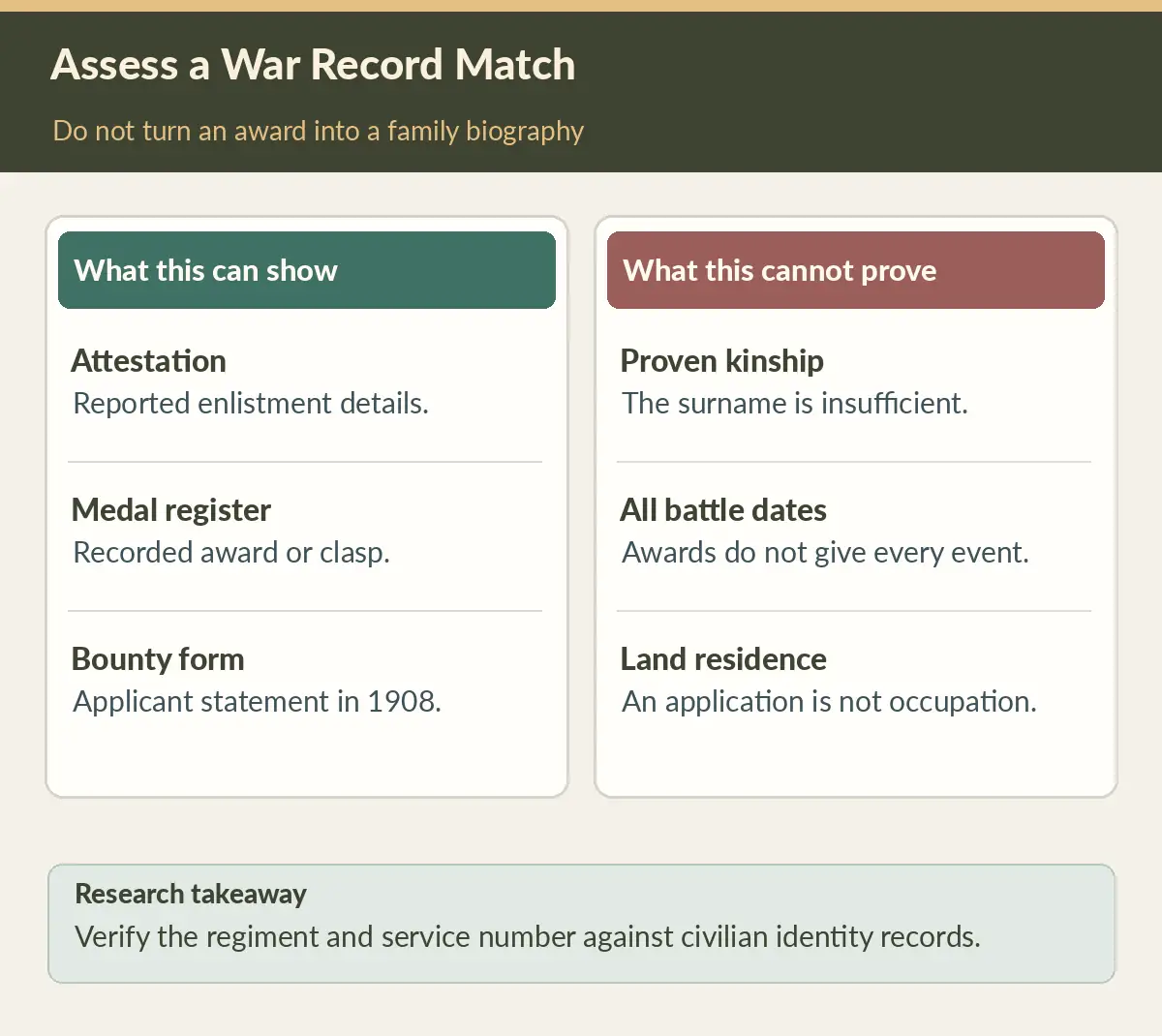
LAC holds registers for the Queen’s South Africa Medal in RG 9 II-A-5, volumes 13–15, on microfilm C-1863. Entries may record clasp entitlements and sometimes lack a regiment name; a clasp relates to qualifying campaign activity as officially recorded, not a complete itinerary of every movement.
The current Canadian archival guide also warns of excluded mounted-rifle units and separately held King’s South Africa Medal material. Compare regimental number, officer status and recorded initials with the actual attestation or discharge record. A medal-name match alone does not prove the entry belongs to the ancestor.
Separate the 1908 Land Bounty From Wartime Service
After the conflict, the Volunteer Bounty Act of 1908 provided a route to land entitlements for eligible veterans. LAC identifies RG 38, volumes 117–136 for these applications, with numbers running from 1 to 7370. These forms can give the applicant’s current address and a summary of claimed military service.
They are later applications, not contemporaneous enlistment returns and not proof that land was eventually occupied. The application may concern a veteran who served with a British unit or the South African Constabulary rather than a Canadian contingent. Record application date, stated regiment, the legal action requested and any actual disposition separately.

Handle the South African Constabulary Exception
Canadians served in the South African Constabulary, which was not recruited or paid by Canada. The newer LAC guidance identifies a nominal roll in RG 24, volume 6562, file HQ-903-1, but says Canadian repositories do not hold the related service files. Those files are with South Africa’s national archives.
Do not mislabel the absence of an RG 38 service file as documentary silence about such a recruit; it is a different custodian pathway. The same caution applies to people who enlisted directly in British formations. Determine the unit first and then ask which government created and retained the records. Nationality alone does not define the archive.
Read Medical and Attestation Statements Carefully
A service file may give a recruit’s age, physical measurements, religion, occupation, residence and reported next of kin. Treat these details as statements recorded for enlistment and administration, not all independently verified facts. Ages can differ between enlistment, marriage and death records, while an address may be temporary.
When the file contains medical observations, transcribe the exact date and description without diagnosing a condition retrospectively. A notation concerning disability or discharge does not establish how a later family event occurred. Compare birth locality, personal signature, age, employer and independent civil records before assigning a file to a family-tree person.
Keep a Three-Column Citation and Coverage Log
Set up rows for RG 38 service files, RG 9 medal registers and RG 38 bounty applications; include the archival volume or film, item or application number, image page and status of inspection. Record whether that class is digitized: service files and medal registers generally are, while the current guide indicates other application records may require separate consultation.
If a service search fails, consult nominal rolls, pay lists and unit histories where available rather than claiming a comprehensive negative. The catalogued file and the page inside it deserve distinct citations. A source citation should not obscure whether a page was actually opened.
How We Research Canadian South African War Evidence
We begin with a documented family identity, conduct variant surname and regimental searches, and open all surviving RG 38 pages for candidate records. Next we compare medal-register observations and ask if later land records belong to the same service number and person.
We mark which documents report first-hand enlistment facts and which record later testimony or administrative entitlements. We explicitly flag missing files and alternate custodians; no result in this index can eliminate all Canadian volunteers. The LAC historical guide sets the foundation; our affiliate disclosure identifies publication relationships.
More Records and Archives Guides
Document a Narrow Conclusion and Next Step
If a verified attestation and discharge record share an appropriate name, unit, age and number, a conclusion about recorded Canadian contingent service may be supportable. If only a medal or later bounty application survives, specify its evidentiary limit: an administrative award or applicant’s claim is not an entire service narrative.
If two similar names remain, keep competing candidates and seek civilian marriage, birthplace or parent details outside the military file. Finish with exact record references, search variants and a question that another archive could answer. This separates confirmed military facts from attractive but untested family legend.
No. LAC holds 5,935 surviving service files, and others no longer exist.
It includes digitized volunteer service files and later land-bounty application material in distinct volumes.
Yes. LAC specifically suggests broader surname searching when given names are incomplete.
No. Entitlement and clasps document administrative eligibility, not a complete personal itinerary.
LAC says Canadian files are not held there; the service material is held in South Africa.