
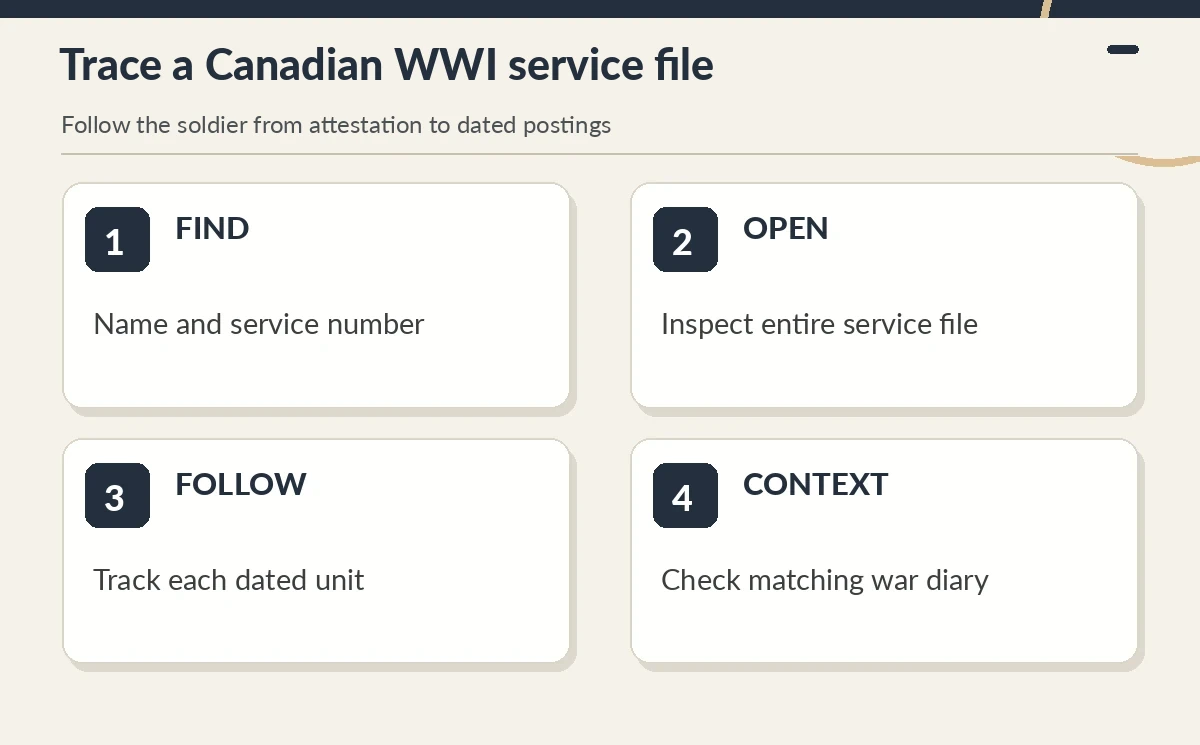
Library and Archives Canada holds extensive First World War personnel records, including roughly 622,000 Canadian Expeditionary Force service files. An attestation document is only the beginning: open the complete digitized file, follow the record-of-service and casualty forms to establish the person’s units and dates, then search the relevant unit war diaries for operational context. A diary describes a unit’s movement, not necessarily what one soldier did in battle. The key genealogical task is to join a precisely identified person to documented postings without turning a unit-level event into an unsupported personal experience.
Find the correct person rather than only an attestation
Start in Library and Archives Canada’s Personnel Records of the First World War search with full name, name variants, approximate birth date and service number if known. The official collection covers several groups, not only the CEF: non-permanent active militia, Newfoundland units, rejected volunteers at Valcartier and imperial gratuity cases appear in the broader database context. They do not all carry the same documents. Record the particular record group, accession, volume or box before comparing results.
An attestation paper can record occupation, birthplace, age and next of kin, but some items were completed by people who did not ultimately serve in the CEF. The official guide notes variations between volunteer, conscript and officer forms. Do not assume the same printed questions appear across all sheets. Check the signature and identifying particulars, then compare them with census, vital or residence records. A common surname plus a similar birthplace is not conclusive.
Open the whole service file and map its chronology
LAC explains that CEF service files may include record-of-service entries, casualty forms, medical sheets, pay papers, medal information, discharge notices and correspondence. Most are about 25–75 pages, though lengths vary. Many entries were derived from daily unit administrative orders, so an abbreviated notation may record a transfer, hospitalization or attachment rather than continuous front-line duty. Download or review the complete sequence instead of relying on a single attestation thumbnail.
Build a chronological table with the exact wording of each dated event, the unit at that point, source page and an explanation of any abbreviation. Preserve all rank changes or new numbers as written. If the next document seems to refer to another soldier, pause and check whether it belongs to the correct digitized file. Documents sometimes use slightly different given-name forms. Resolve discrepancies with the combination of service number, date and unit rather than silently standardizing the file.
Separate the personal record from a unit war diary
The federal archive states that ordinary CEF personnel files give units and postings in the United Kingdom but do not describe battles or locations in Europe in the detailed way a war diary can. To research field operations, identify the precise battalion or other unit from dated service entries and locate that unit’s war diary. The diaries are separate unit records, generally part of RG9-D-III-3 and related finding aids, and often record locations, movements and actions by date. Our guide “New Zealand WWI Personnel Files” goes into more detail.
Do not skip the unit-date intersection. If a fictional soldier joined the 45th Battalion only after a celebrated action, it would be wrong to list him as a participant. A war diary may mention few ordinary individuals by name. Write “his documented unit was at this location on this date” only if his service file places him with that unit then; even so, a temporary leave, hospital admission or detached duty could change his circumstances. Document exactly how the two sources were correlated.
| Source class | Supports | Does not by itself prove |
|---|---|---|
| Attestation | Reported personal details | Entire wartime career |
| Service file | Dated units and changes | Exact battle participation |
| War diary | Unit location and action | Every soldier was present |
| Medical entry | Recorded care or status | A retrospective diagnosis |
Read medical, casualty and separation terms cautiously
A casualty form can reflect movement to medical care, not only a battlefield wound or death. Separate terms for illness, injury, duty status, transfer and discharge using LAC’s own interpretation guides and the file’s context. Medical documents contain sensitive personal information about historical people and can affect living family members; share only necessary conclusions and avoid speculative diagnoses. A Medal Card might document an entitlement or administrative action, not every place the person served.
Some original pension and disability material was destroyed after the Second World War, according to LAC. Consequently a service file may not retain all correspondence once associated with the case. When a gap occurs, record it as a gap in the surviving file, not proof of no service. Search unit rolls, burial information or the relevant administrative context when a specific missing event matters. Do not fill the missing period with a narrative invented from a regiment’s general history.

Handle different Canadian and Newfoundland collections
The umbrella First World War search also describes Royal Newfoundland Regiment and Newfoundland Forestry Corps records, militia records and rejected Valcartier volunteers. LAC points to other custodians or different viewing arrangements for some items; an entry’s label matters. The database does not include every Canadian naval or flying service file. Some nurses served outside the CEF and may need British or civilian searches. A negative CEF result is therefore not evidence of no wartime service. Our walkthrough on how to find British military records by service branch, era, and record custodian sets out each step.
Review the current digitization notice before making an access promise. LAC explains that CEF files are digitized, while some other groups may require in-person access or a copy request. Avoid treating a dataset thumbnail as a complete file. If your ancestor’s exact service branch remains uncertain, search contemporary family correspondence, a military obituary or a published nominal roll to identify which record system applies, then consult the correct repository. Our guide “War of 1812 Service Records” covers a related question.
Cite individual and unit sources as separate evidence
A well-formed citation identifies the person, service number, archive record group and accession or box when supplied, plus the page in the digital service file. For a war diary, cite the unit, date, record group, diary volume or finding-aid locator and page or image. Keep these as two entries in the research log; they establish different kinds of facts. If one document includes a rank different from another, preserve the dates and wording rather than merging the statements.
Use a simple conclusion matrix: attestation supports reported identity and enlistment-related facts; the record of service supports dated postings; the war diary supports unit movements; independent civil records support the family connection. A soldier’s presence at a specific battle is a separate conclusion requiring the right unit on the right date and attention to absence or hospital records. When that intersection cannot be demonstrated, describe it as an unproven possibility, not an ancestor’s experience. Our guide “Australian WWI Service Records, 1914–1920” covers how to read AIF dossiers.

How We Research Canadian First World War Service Files
GenHis starts with the official archival description and distinguishes an index, the original record and any inferred family claim. For this guide we examined the repository instructions, stated date coverage, available search fields, documentary limits and relevant historical terminology. The sample identity checks are hypothetical and not records of identified ancestors. This is historical research guidance, not a guarantee that every record survives, is indexed or is free to obtain.
More Records and Archives Guides
Official archives and collection guides for Canadian WWI Files
LAC coverage, record groups, CEF service-file fields and digitization (canada.ca).
LAC guide to interpreting service and casualty forms (canada.ca).
Also, LAC war diaries and method for moving from a person to a unit record (canada.ca).
Editorial disclosure: This guide includes no paid recommendation or verified affiliate partnership. See the GenHis affiliate disclosure. Record holdings, image availability, access restrictions and prices can change. Verify them with the cited repository before ordering documents; protect information about living people and present uncertain family conclusions as hypotheses.
LAC reports that the CEF service files are digitized; access varies for other categories.
No. It must be followed by service and posting evidence.
Generally no. Find the dated unit and consult the relevant unit war diary.
Sometimes officers or particular cases, but ordinary personnel are rarely named.
Check other branches, Newfoundland collections or different service arrangements.