
British military records are not one continuous database. The correct route depends on whether the person served in the Army, Royal Navy, Royal Marines, Royal Air Force, or another force, and on the period of service. The Ministry of Defence (MOD) has been transferring large groups of historical files to The National Archives (TNA), so a search instruction that ignores current custody can waste time. Begin with branch, regiment or ship, service dates, and any number or rank independently documented. Then follow official archive guides and the appropriate service-record request process, keeping medal and casualty indexes separate from complete personal service files.
Establish branch, era, and identity before choosing a site
Write down what is already known and its provenance: name variants, place and date of birth, approximate enlistment period, corps, regiment, rank, ship, service number, or wartime address. A family story saying ‘served in the war’ does not distinguish a regular soldier from a reservist, sailor, airman, Home Guard member, merchant seaman, or civilian worker. The National Archives’ military and maritime overview groups sources by service and explains that operational logs, administrative files, medal rolls, and individual personnel records answer different questions. A name-search result alone is rarely enough to identify a specific ancestor. If you want the full process, read how to find a civil War ancestor using service and pension records.
A regiment can be renamed, merged, or attached to different formations; a uniform or badge in a photograph may give a useful but tentative clue. Compare dates, branch, location, and independently documented family facts before accepting a match. If two people share a name and an approximate birth year, keep both candidates until another record discriminates between them. Historical military records can contain sensitive disciplinary or medical information and may have restrictions; do not imply that everything listed in a catalogue is freely accessible to any researcher.
Choose the Army research guide for the service period
The National Archives provides separate British Army guidance for soldiers up to 1913, the First World War, and later service, because documentation and record survival vary. For a pre-1914 soldier, identify a plausible regiment and look for muster, pension, discharge, or related material suggested by the correct guide. For the First World War, a medal index or casualty listing can help build a service trail but is not necessarily the complete personnel file. A record class may preserve units or awards without confirming a same-named candidate’s parentage or home address. For the same kind of choice in another place, see our guide “New Zealand South African War Records, 1899–1902”.
When dealing with later Army personnel, avoid old blanket instructions to write directly to MOD. Current GOV.UK guidance distinguishes officers whose service ended after April 1922 and soldiers born after 31 December 1939 from other categories now routed to TNA. This is a custodian route, not a claim that every transferred file is fully indexed or open. Note whether the guidance is for a living person, the deceased, or someone born before a specified date. Check the current official service route on the day you make a request.
Route Royal Navy, Marines, and RAF records separately
A sailor’s ship and rating may be a more useful starting point than a supposed regiment; naval material can include service registers, ships’ logs, and muster-related sources for different eras. The National Archives military-and-maritime guide separates Royal Navy guidance from Army collections. The GOV.UK deceased-person route currently directs certain later Royal Navy and Royal Marines requests to MOD. In a research log, write ‘Royal Navy’ or ‘Royal Marines’ only when supported by a source, and preserve ship names, service numbers, and dates as given.
RAF service has different institutional dates and retention routes. The GOV.UK guidance distinguishes officers who served from 1920 onward and other personnel born after 31 December 1939 for MOD requests, with other cases routed through TNA as described by the official process. A wartime aircrew roll is a specific finding aid, not a substitute for a personnel record. For a possible RAF member, test full name, service number if known, birth evidence, and unit before ordering anything. Do not merge two military careers merely because the surname, rank, and broad theater overlap.
Check current MOD and TNA custody rather than using stale routes
The MOD describes an ongoing transfer of around 9.3 million service records to The National Archives, with transfer expected to finish in 2027. That programme does not mean the entire set is already catalogued, digitized, and openly searchable. A TNA guide may point to a record-search or information-request service; GOV.UK may still receive other categories of applications. Follow the latest branch-specific wording and identify which agency currently holds the file before deciding whether a record is absent. Custody and public accessibility are different questions.
For a deceased person’s service record, the official GOV.UK pathway asks for identifying details and may require supporting documentation; it warns that some information can be withheld for operational, medical, or disciplinary reasons. Only use the appropriate lawful request route. If a guide asks for proof of death or authorization, do not bypass that requirement by collecting a third party’s personal details from unofficial sites. For a living person, access to that person’s service data is not automatically granted to descendants. A research article cannot override the applicable privacy and disclosure procedures.
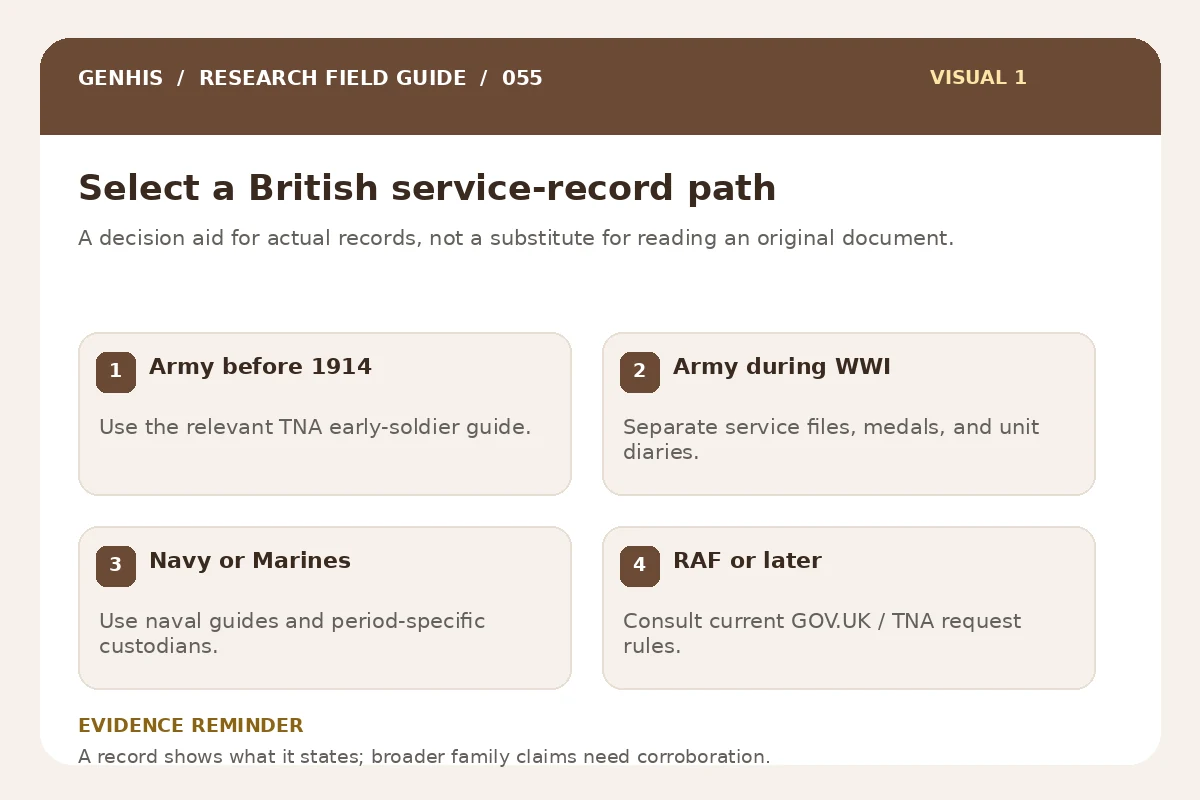
| Decision point | Recommended research action |
|---|---|
| Army before 1914 | Use the relevant TNA early-soldier guide. |
| Army during WWI | Separate service files, medals, and unit diaries. |
| Navy or Marines | Use naval guides and period-specific custodians. |
| RAF or later | Consult current GOV.UK / TNA request rules. |
Use medals, casualties, and unit histories as supporting evidence
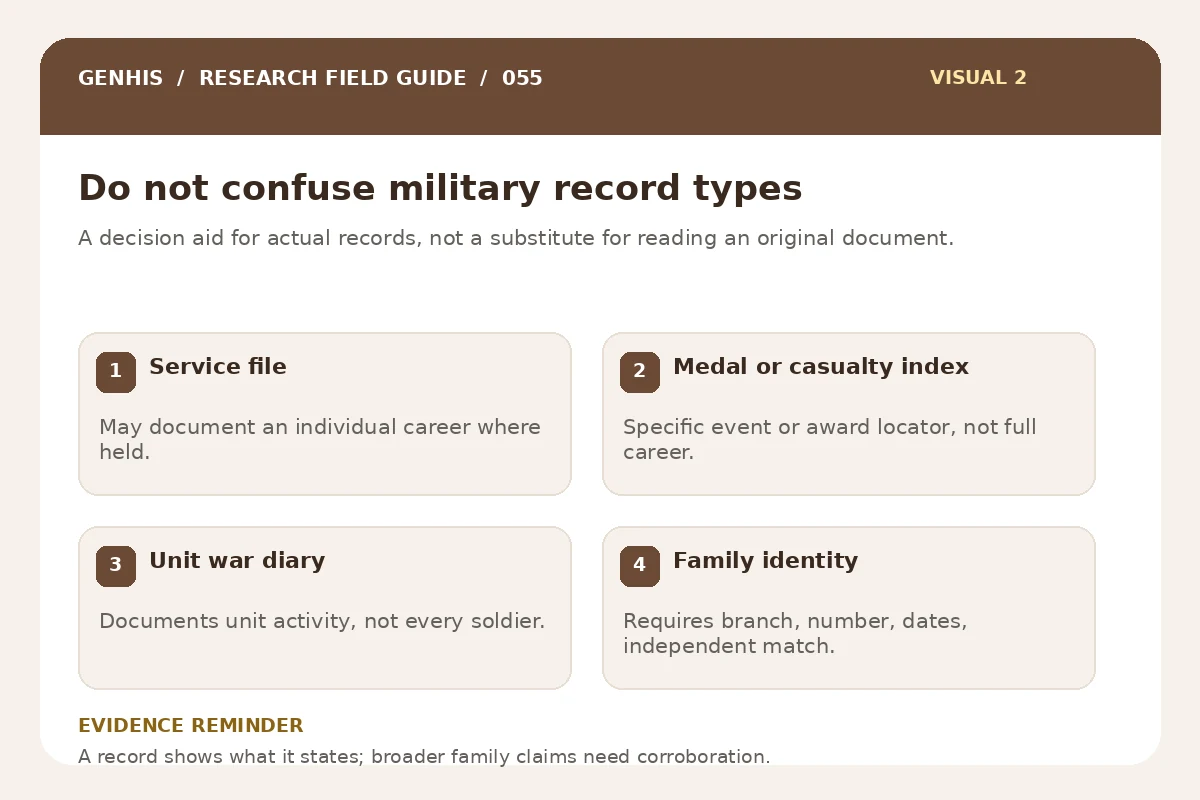
The National Archives overview identifies multiple classes of military and maritime records, but each supports a different conclusion. A medal card might establish an award-related service entry under a stated name, while a war diary usually describes a unit’s activities rather than documenting what every individual did on every day. A casualty record may document a specific loss, but the absence of a matching record does not prove that a person never served or that a service number was inaccurate. Compare branch, unit, date, name variants, and source context before attaching records to your family tree. For a comparable plan elsewhere, our guide “Australian WWI Service Records, 1914–1920” shows how to read AIF dossiers.
Consider a fictional William Evans said to have served in a Welsh regiment during the First World War. First verify a regiment or service number from a contemporary photograph, letter, or other independent source. If two medal index entries share the name, keep both and search for a discriminating detail. A later family address or a known relative’s name in a properly documented service file may help identify one candidate. A unit war diary can provide context for the regiment’s movements but does not automatically prove William fought in every engagement. State the distinction.

Build a reusable service-evidence packet
Create a worksheet with columns for person, birth details, branch, rank, regiment or ship, service number, service dates, document class, archival reference, access status, and unresolved identity questions. A useful citation identifies the repository, series and item, the page or image if inspected, and the date of access. Mark each claim as directly stated, inferred, or unknown. Keep medal-roll evidence separate from personnel files and annotate if a source is an index-only result. This prevents later readers from mistaking an archival pointer for a complete verified career. For the same kind of choice in another place, see our guide “Canadian WWI Service Files”.
Review the official custody page again before submitting a request, because MOD-to-TNA transfers change the route while individual catalogues are updated. Keep requests focused on genuinely historical individuals and comply with the relevant restrictions. If the service history intersects with sensitive historic conflict, use neutral and properly attributed descriptions rather than assigning motivations, ranks, awards, or acts to a person without record support. A well-supported military profile can be modest: documented branch and unit, known dates, and clearly identified remaining unknowns.
How We Research: map dates, documentary scope, and uncertain conclusions
We compared TNA’s service-specific military overview with the current MOD and GOV.UK requests for deceased personnel, including the continuing transfer programme. The named military examples are hypothetical and no unsupported service identity has been asserted.
Authoritative sources and collection-specific limitations
www.nationalarchives.gov.uk — institutional source. TNA identifies Army, Navy, RAF, and distinct military or maritime record classes.
www.nationalarchives.gov.uk — institutional source. TNA offers period-specific routes for First World War British Army research.
www.gov.uk — institutional source. Current GOV.UK distinguishes later-service branch and birth-date routes for deceased personnel.
www.gov.uk — institutional source. MOD guidance explains the evolving TNA transfer programme and request conditions.
www.nationalarchives.gov.uk — institutional source. TNA describes its own service-record request pathway.
More Records and Archives Guides
Privacy, disclosure, and responsible interpretation
Service files may contain sensitive personal information, including about living people. Follow custodian access rules, avoid publishing protected details, and distinguish a military index hit from proof of a particular ancestor. These archives and public services are cited independently; none is a paid partner or an endorsed affiliate. Read the GenHis affiliate disclosure for site policy.
Start with the TNA guide matching the service era, then use the latest GOV.UK custodian route for later personnel files.
No. It concerns an award-related entry or other limited information, not a complete service record or proof of family identity.
No. The large transfer is ongoing and official guidance routes categories of records to different custodians.
Not generally by the deceased-service pathway. Apply only through the lawful route with required consent or authorization.
Usually not. It describes unit activity; specific individual participation needs separate personal evidence.