
WO 102 records British Army long-service and good-conduct award candidates and recipients. Learn which entries verify an award and which only suggest an application. The starting reference is the official National Archives guidance. Read the document’s original wording rather than assuming a catalogue record proves every event it mentions. GenHis explains commercial relationships in its affiliate disclosure.
Identify the Type of Medal Before Searching
British Army medal names overlap in family stories, and a generic “service medal” may conceal entirely different eligibility rules. The National Archives differentiates campaign medals from long-service and good-conduct awards, which did not depend on seeing action. WO 102 contains registers concerning candidates noted for and recipients of the latter awards between 1831 and 1953. Do not route a family story about a campaign clasp or battlefield gallantry into WO 102 merely because it names the Army.
Write the exact words found on a medal, certificate, newspaper or photograph and date the source. If the only description is “decorated for thirty years,” search for the soldier’s corps, service number and retirement period before naming the award. A medal ribbon’s appearance in a colorized portrait is not secure identification. Make a distinction between what the family possesses, what the label says and what the original award register explicitly records.
Read the WO 102 Register as a Decision Record
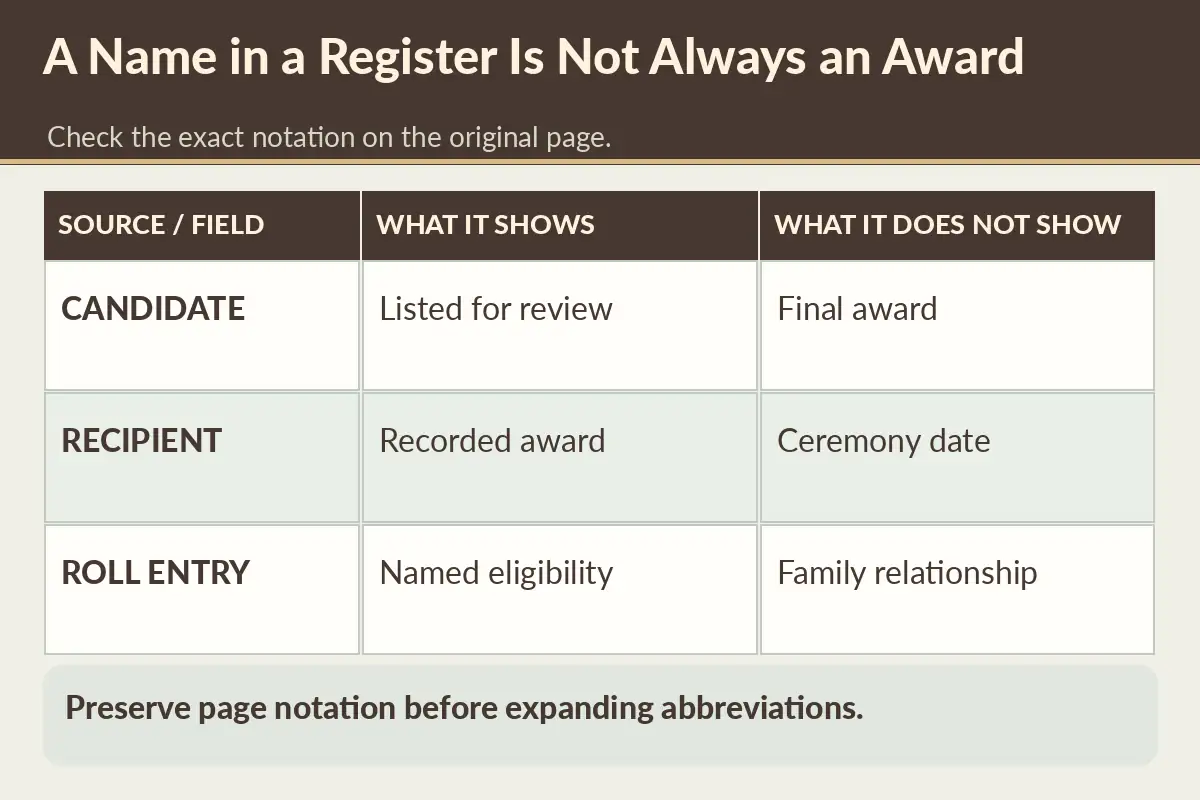
The official digital-microfilm guide describes WO 102 as registers of candidates noted for and recipients of long-service and good-conduct awards. “Candidate” and “recipient” are different administrative statuses. An entry may document consideration or eligibility, while other markings may document the eventual outcome; consult the actual page and any key to its columns before treating a name as a confirmed award. Neither a search result nor the mere presence of a candidate is sufficient proof of issue.
Transcribe every useful label and note the original line order, service number, regiment, rank, dates and decisions where they are visible. Never assume all volumes follow an identical form across 1831–1953. Capture abbreviations as written before expanding them. If a page is ambiguous, place it in the “status unresolved” column of your log. A robust article about a soldier should say “listed for consideration” until the register or another original record actually supports “awarded.”
Keep WO 101, WO 102, and WO 100 Apart
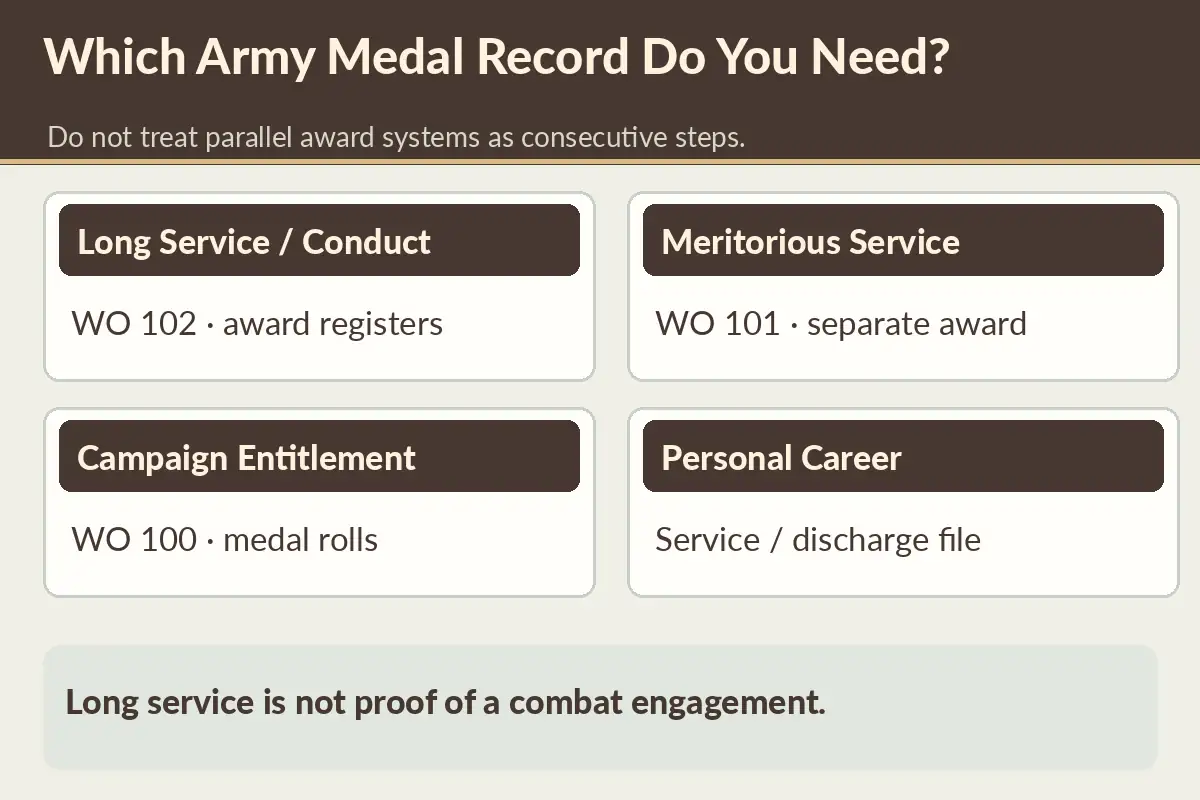
The National Archives directs researchers to WO 101 and WO 102 for long-service and meritorious-service matters, with separate research paths for awards made in combat. WO 101 is associated with meritorious-service awards; WO 100 houses campaign medal and award rolls. A soldier may appear in more than one series for different reasons, but these are parallel categories rather than mandatory successive stages of one application. Identify the precise medal named by each record.
In your comparison table, keep one row per award: an ordinary long-service or good-conduct medal, a meritorious-service distinction and a campaign entitlement. Attach the relevant WO series and the explicit disposition. A campaign roll entry may establish eligibility for a campaign medal but it cannot prove a later decoration for conduct. Conversely a good-conduct award does not establish presence at a named engagement. Service tenure, conduct and battlefield participation require distinct evidence.
Match a Soldier Despite Regiment Changes
A surname, initial and rank may recur in different regiments over a long period. Seek service number, unit, rank at the award date and relevant birth or discharge data in original enlistment or service sources. The same soldier could serve under a different unit designation; document the changes instead of guessing. A medal register may use the rank or corps in effect at consideration rather than during early service.
Consider two soldiers named Thomas Gray listed in similar decades. If only one can be matched through a service number to the family’s attestation or discharge, prefer that evidence over a county association. If neither is distinguishable, record both candidates and the missing fields. An indexed name is not a uniquely identified ancestor. A second independently kept source such as a dated service record or official roll must do the differentiating work.
Check Awards Without Inventing a Medal Ceremony
If the WO 102 page shows an affirmative outcome, describe exactly what the record certifies. Do not add the date a physical medal was presented unless a separate document reports the presentation. Dates of recommendation, approval, engraving and issue may differ. A soldier could be noted in one administrative register and later have a recorded correction; check annotations and associated pages before citing a final disposition.
The London Gazette can support some honors but is not a universal index of every good-conduct entry. The official medals guide specifically distinguishes different award classes and advises searching different sources for them. If you do not find an announcement, do not infer that the WO 102 award was cancelled. Instead identify whether an announcement would normally exist for that award and document the limits of the particular search.
Record What Long Service Cannot Prove
A long-service award speaks to service or conduct under its own rules; it cannot by itself identify the soldier’s spouse, children or exact military stations. Use civil and parish records for relatives, and original service records for postings. An impressive duration of service does not automatically prove residence in a town where the regiment was based. Avoid repeating a biography that presents the award as a proxy for an entire career.
An awarded or proposed medal cannot establish whether someone was wounded, engaged in battle or eligible for a pension. For those questions route to distinct medical, casualty or pension sources and check years and access restrictions. Be cautious about treating missing evidence as evidence that the soldier served dishonorably; survival and indexing gaps are common. A responsible biography states exactly what the award register documents and stops there.

Write the Award Finding With an Evidence Status
An effective final citation names WO 102, the register volume and page, the soldier’s identifying fields and the wording or mark for candidate or recipient. Add the record date separately from any later award date. Then state the next check: service number match, a second medal roll, or the original discharge entry. This allows a later reader to reproduce the conclusion without relying on a modern database label.
Keep a three-status ledger: identified candidate, confirmed recorded recipient and unresolved disposition. If a record is only indexed, the status may remain provisional until you inspect the page. A negative name search is limited to the specific volumes, variants and time range reviewed. These distinctions keep small military honors useful for genealogical identity work without creating unsupported legends.
How We Research This Specific Record Series
We check the primary repository guidance and its related official source for record custody, series function, date coverage and access caveats. We build a source-to-claim ledger: who authored an entry, when and for what administrative purpose, whether it survives as an original or copy, and what fact it can legitimately establish. We never convert a finding-aid name hit into an original document or a request into an approval. Where people have similar names, each remains a candidate until multiple identifying details agree in independent sources. Conflicts are transcribed and explained instead of silently erased. We also note when a source is missing, closed, only partly digitized or known through a later index, and specify the next document that could test the current conclusion. Historical illustrations accompanying this article are schematic, not facsimiles of archival records.
More Records and Archives Guides
Verified Archival Sources and Access Limits
The first official source establishes WO 102 downloadable registers of candidates and recipients for long service and good conduct awards, 1831–1953. A second archive publication supports WO 101/102 long-service research versus campaign and gallantry distinctions. Check the current catalogue for availability or copying arrangements of the individual piece before making plans to visit or pay. References to an online collection do not guarantee that every surviving page is indexed or downloadable.
No. A candidate or consideration entry must be distinguished from an award disposition.
No. The National Archives notes that these awards were not dependent on seeing action.
No. WO 100 concerns campaign medal and award rolls, a separate evidentiary purpose.
Sometimes, if unit, rank and other details can be matched independently to a service record.
The National Archives lists WO 102 digital-microfilm registers; check the catalogue for the relevant item.