
A WO 86 court martial register identifies a recorded military case, but its charge and sentence need context. Choose the right court, date and companion records before drawing conclusions. Begin with the custodian’s research guidance. See the GenHis affiliate disclosure before choosing an outside access provider.
Match the Hearing to the Actual Court
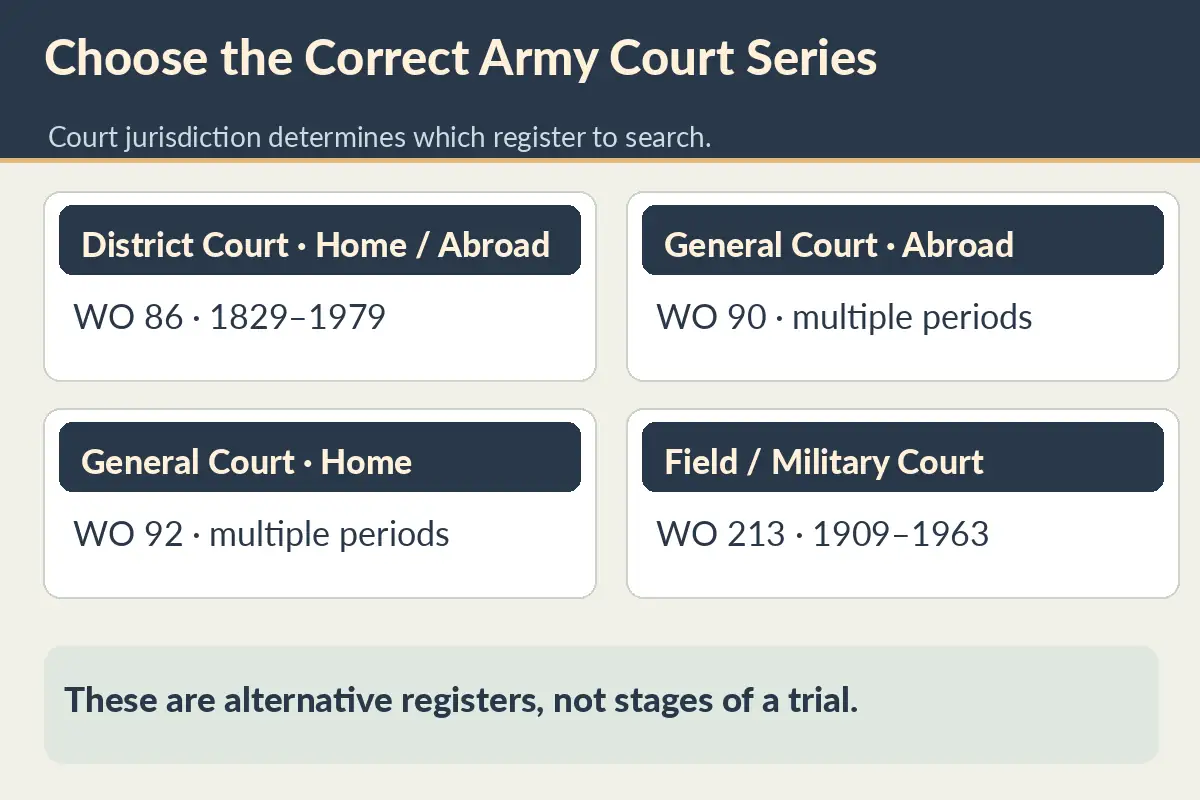
Start with the court, not the accusation. The National Archives identifies WO 86 as District Courts Martial registers, principally for courts held at home and abroad from 1829 to 1979. General Courts Martial abroad lead toward WO 90; home general courts often involve WO 92; field and military courts are also recorded in WO 213. These series are alternatives defined by court type, theatre and date. A failed surname search of WO 86 does not show that the soldier was never tried.
Extract the regiment, rank, service number if known, approximate month, and the place of trial from independent evidence. Service numbers are often stronger identifiers than names alone. A regiment could move through different theatres and a location supplied by later family testimony might refer to a station rather than the place of a hearing. Enter each proposed court series as a separate search line, with the dates examined.
Use the Register as a Finding Aid to a Proceeding
A military court register can show a name, rank, regiment, place of trial, nature of charge and a sentence. Its original handwriting matters: abbreviations, adjacent names, amended dates and marginal annotations may alter interpretation. The register is a condensed administrative record, not necessarily the testimony of each witness. Cite a precise WO 86 piece, original page or entry, and its date; an online name transcription is not an adequate substitute for reading the page.
For early cases seek proceedings or papers in WO 71 where applicable, but do not assume every trial file survives. The National Archives says considerable courts martial material for 1851–1914 was destroyed by bombing in 1940. A missing trial file therefore cannot be called proof that the indexed proceeding was fictitious. Some minor regimental court records may instead survive with individual regiment collections, rather than in a complete central archive.
Keep the Charge, Finding, and Punishment Distinct
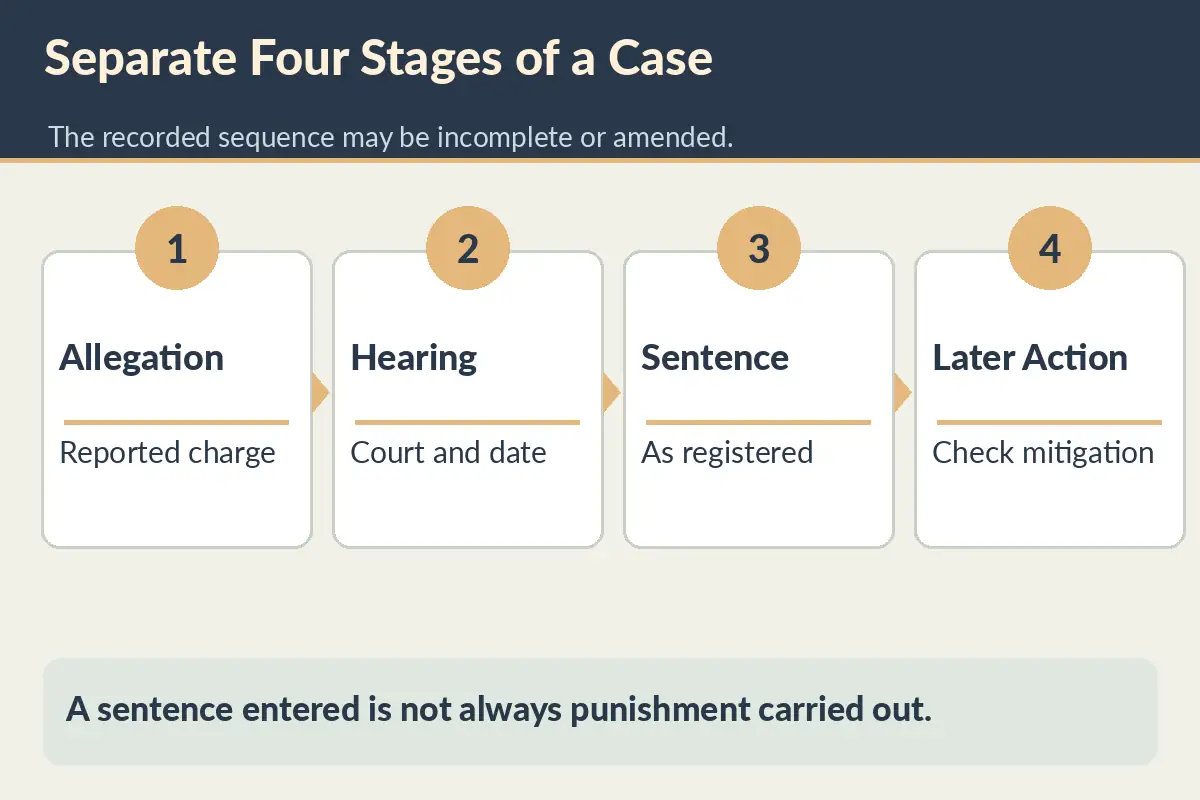
Create separate columns for alleged offence, what the register records as the finding, sentence entered, possible mitigation and actual later action. The printed word desertion or absence describes a military legal category, not an independent analysis of motives. A sentence entered in a register may have been reconsidered or commuted. First World War death sentences offer a stark example: the archive notes that most were changed to other penalties. Do not turn a row headed sentence into an unquestioned account of what happened afterward.
When a record identifies a witness, reporting officer or victim, note that person’s procedural role before making any family claim. Namesakes may occur in the same regiment. Compare the soldier’s number and unit with pay lists, service papers or the unit’s own chronology. If the source gives only initials and a surname, keep the identification provisional; later narratives cannot compensate for the missing independent match.
Build a Reproducible Search for Missing Files
Search systematically by the known period and military jurisdiction. Use the Discovery series descriptions to determine which pieces cover a range of dates and which require consultation or paid image access. Online platforms can provide name indexes for parts of WO 86 and WO 213, but indexes differ from manuscript coverage. Record whether a search tested indexed names, browsed a volume or inspected an image. A no-result online search is especially weak where the target book is not name-indexed.
In the research log, record combinations of initials, spelling variants, military number and regiment. Pay particular attention to officers who may have changed rank between the reported event and a later service summary. If an expected event still cannot be located, move to the correct adjoining court series and contemporaneous military correspondence. Do not assign the nearest same-name entry without reconciling unit and dates.

Test the Person and the Consequences Elsewhere
A pension, discharge entry or family letter can establish that the soldier survived an alleged episode or returned to service; it cannot necessarily resolve the trial finding. Conversely, a court record may identify a soldier who is absent from surviving service papers. Compare independent documents by their original date, reporter and purpose. Annotate conflicting spellings rather than silently normalizing them. A rank reported in a later pension paper should be dated independently from the rank at the hearing.
Describe the most defensible result narrowly: “A WO 86 district register records a case involving a soldier with this name and regiment” is more accurate than “our ancestor was guilty.” Only if the original entry and corroboration match should the statement be attributed to the family member. If a case concerns sexual violence, political unrest or living descendants, avoid public speculation and keep sensitive personal material appropriately restricted.
Document a Useful Final Research Decision
A successful worksheet records candidate person, military unit, jurisdiction, possible record series, period examined, original reference and evidence status. Put each found charge and its recorded disposal in its own column. Reserve another field for documents you could not inspect, because lack of access differs from an archival loss. Save images or detailed page notes with the collection and access date.
The next action depends on what remains unknown. If court type is unknown, resolve unit location first; if a register has been found but the result is unclear, locate surviving proceeding papers or related military correspondence; if the personal identity is uncertain, find a service number and independent unit record. This makes the military justice entry an accountable research lead rather than an unsupported biographical verdict.
How We Research Wo 86 Courts Martial Registers
We start with the original legal or administrative question that created this source. First we verify the time and geographical reach of the collection, then inspect the exact item rather than substituting a name index. We transcribe dates and labels in their original setting, note who supplied the information, and test an identifying detail against a separate source. If the relevant item is unindexed, incomplete, destroyed or restricted, we report that condition distinctly from a genuinely negative search. The remaining unknown becomes a specific next-record request, never an invented fact.
More Records and Archives Guides
Official Sources and Research Limits
For the record group and primary arrangement see The National Archives research guide: Distinguishes WO 86 district, WO 90/92 general and WO 213 field military courts; documents incomplete survival and appeal context.. For an independent description of scope or access, see the related archive guide: Confirms WO 86 1829–1979 alongside WO 90, WO 92, WO 213 and fields in military court registers.. An archival call number is a pathway to the evidence, not proof of the facts inside a document that has not yet been examined.
No. WO 86 chiefly concerns district courts martial; general and field court registers belong to other series.
No. Keep the alleged offence, recorded disposition, possible amendments and corroborating evidence separate.
Some papers, particularly for 1851–1914, were destroyed; others may never have reached the central archives.
WO 213 contains registers of field general courts martial and military courts, separate from WO 86.
A surname match is only a candidate; use regimental number, unit, rank, dates and other original sources.