
Locate a general court-martial in M1105 by name and unit, then use its exact alphanumeric number to request RG 153 proceedings. A register entry documents a case, not a conviction. Read our affiliate disclosure.
Search M1105 as a Locator, Not a Verdict
The National Archives identifies M1105 as registers of U.S. Army general courts-martial for 1809–1890. These registers serve as keys to larger proceedings in RG 153, not as summaries that establish guilt. Define the person, approximate date, Army unit, possible alias and known service chronology before opening an index.
An ancestor’s family story about a trial may be correct, partly remembered or confused with a court of inquiry. Keep those possibilities separate from what the register actually says. The official NARA service overview places the files in the Army Judge Advocate General record group and cautions researchers to work from register numbers into the case file.
Handle Overlapping Civil War Registers
The most common indexing trap occurs during the Civil War. NARA explains that six M1105 indexes cover 1861–1865 and that their date spans overlap. Some volumes have abbreviated alphabetical arrangements or repeated name entries. Search all registers relevant to the specific period rather than stop at the first no-result; one indexed reference can be duplicated without proving two separate trials.
The official article on courts-martial and campaigns gives an alphanumeric example such as MM 1256. Preserve any letters, spaces and numerals exactly because RG 153 files are organized by this scheme. Recheck the name, regiment, rank, trial site and convening date.

Obtain the Proceedings From RG 153
After the register supplies a case number, consult NARA’s RG 153 court-martial case files, traditionally cited under entry 15 or 15A in archival guidance. Search the catalogue or contact the appropriate reference service for the exact period and entry; do not assume a one-page online index is a complete scanned trial. Many proceedings remain accessible as archival originals rather than fully digitized files.
When placing a request, give the alphanumeric case number, defendant’s name, court date, and unit. If the register points to an inquiry rather than a disciplinary case, say so: a court of inquiry may investigate circumstances without conducting the same kind of criminal trial against a person.
Separate Allegation, Plea, Finding and Review
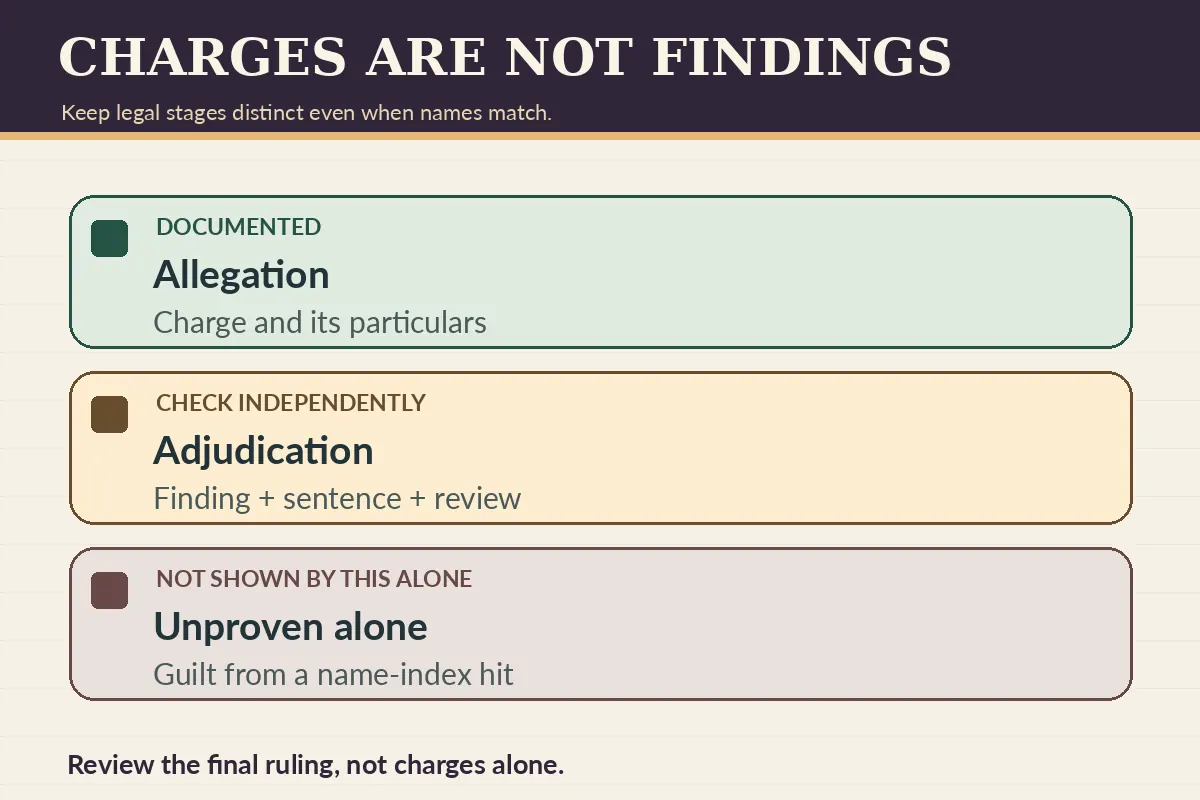
NARA’s study of Union Army proceedings lists documents that can appear in a file: charges and specifications, pleas, testimony and exhibits, findings, sentences, and higher-level review. Make those separate columns in a claim ledger. A charge identifies what was alleged, not a historical fact adjudicated by the court. A plea is not automatically a final disposition.
A sentence initially imposed could be modified, disapproved or remitted. Read the reviewers’ action and subsequent correspondence before reporting an outcome. When only the register survives or is accessed, restrict publication to the existence and date of proceedings, with the disposition unresolved.

Worked Example: The Same Surname in Two Regiments
Suppose a search reveals an 1863 case under Samuel Brown and a second Brown in a different infantry regiment. Compare the regiment and company from the register against a documented enlistment or muster. Record rank as of the proceeding, which can differ from later ranks or family recollections. In the full case, identify witnesses without labeling them relatives because they shared a unit or surname.
Suppose a witness reports that Brown was absent on a particular date; that testimony should be attributed to its speaker, not treated as incontrovertible proof of desertion. If the case concluded with an acquittal or disapproved sentence, the summary must retain that outcome. Separate the two Browns until at least one independent identifier resolves the namesake risk.
Use Chronology and Court Location Carefully
A court may have convened far from the soldier’s permanent home or even away from his normal unit. The trial location is not automatically residence; proceedings dates may follow the underlying event by weeks or months. If a file contains maps, medical statements or witness accounts, those items remain evidence of what their creators said.
Compare military service dates, company location and a related muster or pension document when reconstructing events. A case that mentions a battle does not by itself prove that the accused participated in that engagement. Keep the legal chronology and the service chronology in separate rows until independent records connect them.
Cite the Register and Case File Separately
A reproducible research note states NARA M1105, relevant register or roll, entry spelling, rank, unit, court date and the exact alphanumeric pointer. After reading the case itself, make a second citation identifying RG 153, the case-file series, case number, date and pages or documents consulted. Preserve any discrepancy between the index description and the full proceeding; do not silently “correct” the register by rewriting the original.
If your source is a modern extract rather than the original file, label it explicitly. When a case could involve sensitive descendants, avoid sensationalized descriptions and focus on public historical documentation rather than speculative judgments about later family members.
More Records and Archives Guides
How We Research Military Court Evidence
We test the claim in stages. First, locate an M1105 entry by person and time window, checking overlapping books. Second, verify unit and service identity independently. Third, request the alphanumeric case in RG 153 and classify each statement as a charge, witness testimony, court finding or reviewing action.
Finally, summarize the defensible result with quotations and citations, leaving ambiguous dispositions unresolved. This method matters because the existence of a military court record is not equivalent to conviction or guilt. It also prevents a name-only match from pulling an unrelated person into a family narrative. Negative findings list the searched register volumes and date limitations.
An especially important distinction arises when a document cites an order approving only part of a sentence. For family research, reproduce the operative wording rather than saying a conviction was simply upheld or reversed. Note whether a witness spoke from personal knowledge, repeated another person’s account, or supplied an inference. The military record may include historically biased language, which should be attributed rather than echoed as unqualified fact. A court officer and an accused soldier might share a surname or a posting; this does not establish kinship. To compare case-file evidence with an enlistment record, use a separate chronology for unit location, rank changes and the date of the alleged act. Court proceedings often illuminate events without answering every genealogical question.
No. The index identifies proceedings; a full file must be read to distinguish accusation, plea, finding, sentence and later approval or disapproval.
Capture the exact alphanumeric file number and consult the relevant RG 153 court-martial case-file series at NARA.
M1105 Civil War coverage uses several overlapping indexes; duplicate name references may point to the same case or separate cases.
No. M1105 indexes general courts-martial in its specified period, not every possible administrative or lower-level disciplinary action.
Not directly in the main name registers. NARA recommends units, dates and names as leads; the index is organized by person rather than battle.