
Use WO 116 for Chelsea disability-related out-pension admissions and WO 117 for pensions based on length of service. These are different administrative records with overlapping coverage. Inspect the dated admission and verify the soldier with separate service or discharge material. Follow The National Archives’ soldiers guide and our affiliate disclosure.
Choose the Pension Basis Before Searching
Royal Hospital Chelsea recorded different kinds of pension admissions. The National Archives identifies WO 116 as admission books for soldiers awarded out-pensions on disability grounds, with the specifically digitized range WO 116/1–165 covering 1715–1873. WO 117 records admissions to pensions awarded for length of service, covering 1823–1913. Those overlapping years do not mean the same books have interchangeable names. Begin with the reason the soldier left service and any stated pension basis, then select the series that fits the question.
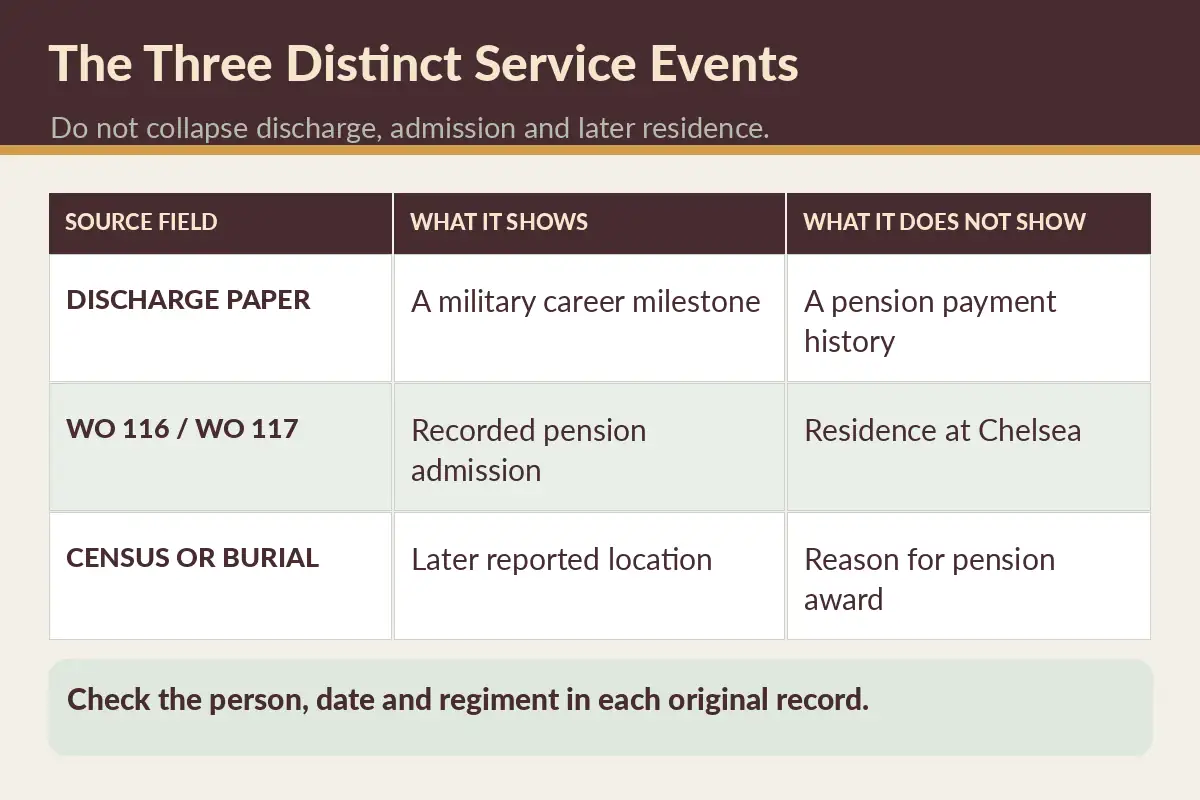
A pension admission means a claim or entitlement was recorded under an administrative rule; it does not automatically prove every payment was collected afterward or that the pensioner remained in Chelsea. “Out-pensioner” generally refers to someone who received a pension outside the hospital, not necessarily someone living in its building. Distinguish the award event from disability, discharge, later residence and death. If the family story says only “Chelsea pensioner,” search both bases cautiously rather than assuming injury in battle.
Find the Right Date Range and Digital Book
Open the official soldiers’ records guide and select the correct Chelsea admission series. The site describes digital microfilm as books that can be browsed, not necessarily a unified modern name index. Capture the date range and reference for each volume consulted. A record of admission in 1840 is not automatically a discharge record made that year; dates and administrative stages must be read from the exact page.
When possible gather regiment, service dates, age or birthplace from independent records to narrow candidates. Regiments changed names or numbers, and several soldiers of one surname may have served contemporaneously. Browse surrounding headings for context and record the full piece and page even if a database transcribes only a few fields. If the expected volume appears missing online, confirm whether it has been digitized and whether the original can be consulted at Kew before declaring a name absent.

Read an Admission as an Administrative Event
Transcribe the soldier’s name, regiment, service details, date of admission and any recorded reason or amount if present in that particular book. Do not presume all volumes use the same form. Where a physical condition is mentioned, quote the historical administrative wording and avoid making an unsupported modern diagnosis. A disability pension was assessed under contemporary military rules; it is not proof that a wound happened in one specific battle.
An entry may be summarized in an index or name list without providing the whole admission narrative. Mark the difference between an original page, a transcript and a later compiled entry. If a pension sum appears, capture its units and the date relevant to that amount; do not translate it into lifelong total payments. Use an explicit claim ledger with “stated by WO 116/117,” “suggested,” and “requires another record” columns.
Link the Pension to a Service or Discharge File
For a soldier’s career, pension books should be compared with discharge documents, regimental musters and other surviving service evidence. The National Archives describes WO 97 discharge records separately from WO 116/117 admission books. A discharge paper may help establish identity by birthplace, regiment, trade and years served, but survival rules change over time. Do not conclude that the absence of WO 97 means a Chelsea pension record is mistaken.
Build a date sequence: enlistment, regimental movements when available, discharge, pension admission and later independent residence or burial. If an admission appears several years after the recorded departure from service, investigate why rather than collapsing the two events. A soldier who served in multiple units may appear under a changed regimental designation. Match age, service length, service number when available and named events rather than treating a surname on two separate series as certain identity.
Check Related Hospitals and Other Pension Registers
The official guide also points to Royal Hospital Kilmainham pension admission books in WO 118 and regiment-arranged Chelsea records in WO 120. These are alternatives with different arrangements, not always subsequent stages. If Chelsea does not yield the expected person, review the geography, year and basis of pension before moving to another set. A person who died on active duty may have generated a different type of family entitlement rather than a personal Chelsea out-pension.
Keep service-related WO 116/117 admissions separate from widow’s pension claims, medal applications and medical treatment files. A later pension transfer or allowance can exist without proving an earlier disability award. If looking for a wife or child, seek marriage, census or military family records; one pensioner name typically does not itself establish family structure. A negative lookup can reflect missing coverage, a different spelling or a soldier never admitted to the kind of pension being searched.
Cite the Exact Book and Resolve Conflicts
A clear citation names Royal Hospital Chelsea, WO 116 or WO 117, piece and page or image, soldier, date, repository and access source. Add a brief note about why that series was chosen and whether the other pension basis was considered. When an abbreviated regiment or disability phrase is unclear, retain the verbatim line and bracket any interpretation. Do not alter the transcription later simply because another record tells a more convenient story.
If an 1846 pension admission appears to conflict with a later regiment roll showing a similar name, test rival identities first. Same-name veterans can differ in birthplace, rank or length of service. Review the actual entry rather than an unsourced online tree. The defensible conclusion distinguishes “listed as admitted to a pension” from “personally received money for life” or “served in a named battle.” Save unresolved contradictions as explicit research questions for the next original record.

How We Research Chelsea Admissions
We use the official pension-basis distinction to choose WO 116 or WO 117 before a name search. We inspect whole digital microfilm pages with the stated piece reference, compare admission dates with any surviving discharge and regimental records, and avoid projecting a single book’s fields onto every volume. We report an award or admission as recorded, without claiming continued payments, residence in the hospital or a specific cause of disability unless other sources establish them.
More Records and Archives Guides
Official References and Record Access
Our source checks use the custodian’s published descriptions, not guessed coverage. Primary repository guide supports the scope and identification method stated here. Additional official context supports the scope and identification method stated here.
WO 116 covers disability-related Chelsea out-pension admissions, while WO 117 covers length-of-service pension admissions.
The National Archives describes WO 116/1–165 as covering 1715–1873.
The official guide gives 1823–1913 for Chelsea length-of-service pension admissions.
No such residence follows from the term; check census or local household evidence.
No. Use dated military service and other operational sources for a specific battle claim.