
Army Nursing Pension Registers WO 23 is best used as a specific archival lead, not as a complete family biography. Start with an exact reference, distinguish what a surviving record actually states from what you infer, and use at least one independently created source before naming a person or asserting an event. This guide follows the available archive descriptions and highlights common traps in historical dates, coverage and institutional terminology. The goal is a reproducible decision about which document to examine next, not a plausible story produced from a matching name alone.
Create a working note with the research question, likely place and period, identity clues and the kind of document that could actually answer it. Record gaps in survival and access without treating them as evidence that the event never occurred.
Start with a pension question, not a complete biography
A reference to a nurse in WO 23 can be a valuable identity anchor, but it does not provide a ready-made career history. The National Archives identifies WO 23/93–95 as Royal Hospital Chelsea pension registers listing nurses among officers, approximately from 1820 to 1890. These entries may identify a workplace, length of service, retirement age and, in some cases, a death date. The key is to record exactly which of those particulars is present, rather than assume every entry has every field.
The first research decision is whether you are testing an existing family claim about a pension, locating an appointment, or looking for a hospital posting. Write one narrow question such as “Was this nurse receiving a Chelsea pension by 1875?” That question changes the next document to examine. A pension reference can help establish that administrative status; it does not prove that every service location mentioned in family tradition was actually a posting.

Distinguish WO 23/93–95 from WO 23/181
The nursing research guide distinguishes two useful clusters. WO 23/93–95 primarily concerns pensions for nurses listed alongside officers. WO 23/181, covering roughly 1857–1907, consists of Chelsea registers organized in approximate date order rather than a convenient alphabetical index. It can include appointment and resignation or retirement dates, and sometimes age at appointment or later a date of birth. Selecting by the event you seek prevents a searcher from mistaking an unindexed appointment register for a name database.
Build two search columns in your notes. Under “Pension” put the known retirement or payment clue, likely date and the WO 23/93–95 reference. Under “Appointment” put the first known hospital or nursing service association, the approximate date and WO 23/181. Search both when the evidence overlaps, but do not assume the same person appears in both. A woman could have an appointment record without the particular pension you expect, or one record could survive while another does not.
Copy identity fields before calculating a career
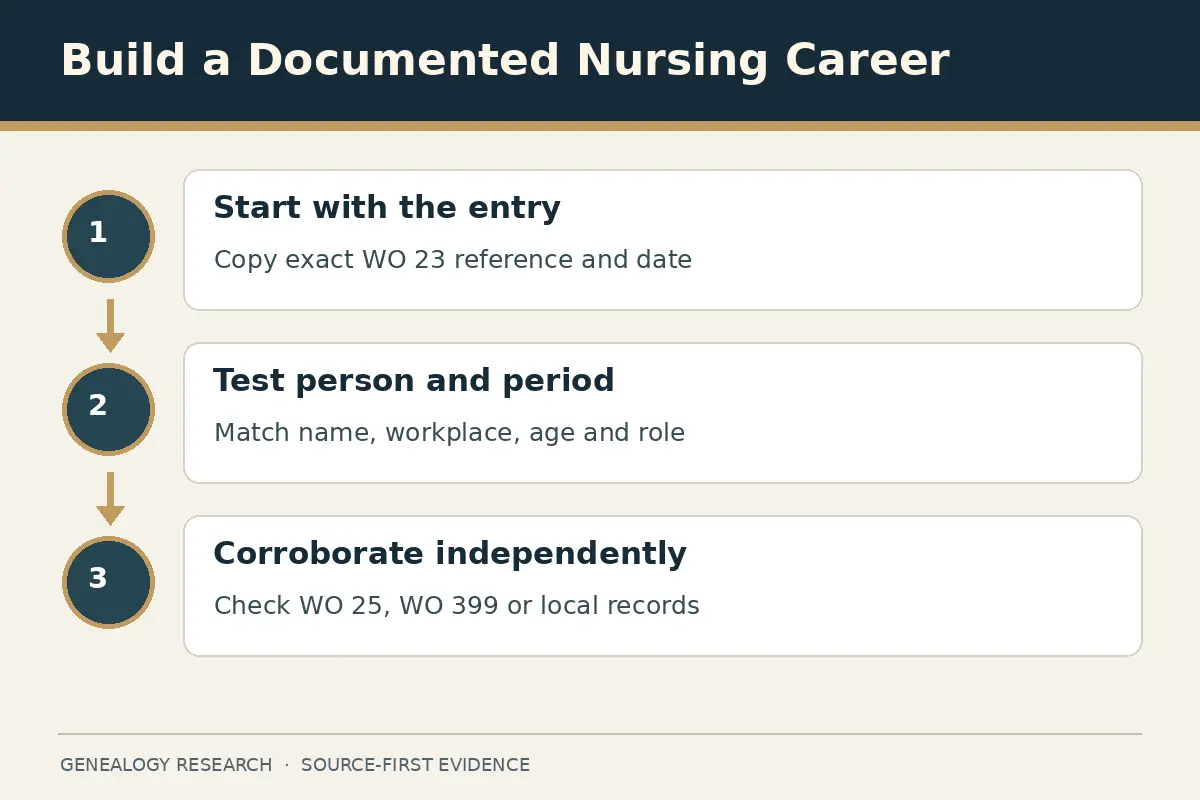
When you examine an original page, capture the repository, piece reference, page or folio if available, entry order, column headings and neighboring entries. Transcribe the name exactly; separately note modern spelling variations. Copy any stated age, place of work, appointment or retirement date, pay or pension amount and later marginal note. If a heading is unclear, photograph or describe it instead of silently translating it into a different administrative term.
A stated age at retirement and a dated retirement entry may suggest an approximate birth year, but ages can be rounded or recorded inaccurately. Record the arithmetic in your research log as an inference, not as the birth event. Likewise, a listed place of work is an institutional affiliation for the relevant entry, not proof of permanent residence. A name and a city alone are especially weak identifiers in a period when family names recur among hospital staff.

Verify a hospital posting through independent evidence
For a pre-1900 nursing history, look beyond the pension register to period-appropriate records. The National Archives points to WO 25/3955 for certain National Aid Society and Army Nursing Service records dated 1869–1891, and to separate medical or correspondence sources for Crimean War nursing. These sets may document seniority, service locations and selected personal details. They are alternatives to be checked for a specific time and organization, not steps that everyone must pass through.
When a likely match appears, compare at least two independently created attributes: for example, an age range plus a hospital, or a sequence of appointments plus a distinctive name. A newspaper notice, nursing school archive or local institution ledger can test the same claim from another administrative perspective. Keep conflicting dates visible rather than forcing them into one neat chronology. If the only overlap is surname and occupation, label the identity unresolved.
Respect organizational changes and survival limits
The Army Nursing Service began in 1881 and the Queen Alexandra’s Imperial Military Nursing Service followed in 1902; earlier nursing arrangements differed considerably. A twentieth-century military nursing service file is therefore not interchangeable with a nineteenth-century Chelsea pension register. The archive guide identifies other series, such as WO 399 for later nursing service, which should be selected only when the date and branch suit the research question.
Not all records can be read online, and an unsuccessful Discovery name search is not proof that the woman never worked as a nurse. The guide warns that some relevant volumes have no name index and need direct examination. Record whether you searched descriptions, a printed aid, an individual volume or all available entries for a relevant period. Your negative finding should describe the search actually made, not an imagined complete absence of service.
Turn the evidence into a cautious family-history note
Write one sentence for each supportable finding: “The Chelsea register records a pension entry for a nurse of this name,” followed by the precise reference and transcription. Follow with a separate sentence about the identity match, clearly noting which characteristics support it. If a second record confirms a workplace or service date, cite that independently. Do not use “served in the Crimea,” “held a commission,” or “died in this hospital” unless another document establishes those specific events.
For ambiguous matches, maintain a comparison table of all candidates rather than discarding the inconvenient one. A useful final note includes the proposition, exact source, date recorded, how it was retrieved, conflicting evidence, and the next testable record. That record-first habit makes an eventual biography more accurate and prevents pension arithmetic, administrative headings or family recollections from turning into unverified life events.
More Records and Archives Guides
How We Research and Verify These Archive Claims
We checked the relevant descriptions and searching instructions against The National Archives and The National Archives. These sources describe record categories, access and limitations; they do not identify any unnamed ancestor or certify a speculative biographical match.
For every claim we distinguish the wording of the inspected record, the archive or provider description, and our own proposed interpretation. Researchers should verify piece-level holdings and availability at the time of consultation. This is noncommercial guidance; see the affiliate disclosure for site policy.
No. A pension or appointment entry may establish an administrative event, while continuous wartime postings require dated service or hospital evidence.
No. The first group contains nursing pension information; WO 23/181 covers appointment and departure entries in approximate date order.
No. It may support an approximate birth year but must be checked against civil or other independent birth evidence.
Some volumes are not name-indexed online. Check the series description and the original register arrangement before treating the search as complete.
Cite the archive, full WO 23 piece reference, entry location, transcription, and independently checked identity characteristics.