
For the government of 1689–1702, SP 33 is an especially easy series to misunderstand. The National Archives says it is not calendared and contains duplicate Exchequer assessments from 16 counties for a grant in aid to the Crown in 1692. That is a targeted fiscal source, not a nationwide nominal census. SP 32, which covers the same broad administrative period, is more fully represented in the printed Calendars of State Papers Domestic. The official State Papers guide is the starting point for choosing between them.
For a repeatable search, separate three questions at the outset: which office created the source, what that source actually states, and what independent record could test your interpretation. A catalogue hit is a lead, not a complete transcription. Keep source, date, place and role alongside each tentative claim. The diagrams below show alternatives and conditions rather than a promise that every record survives.
Start with the right evidence question
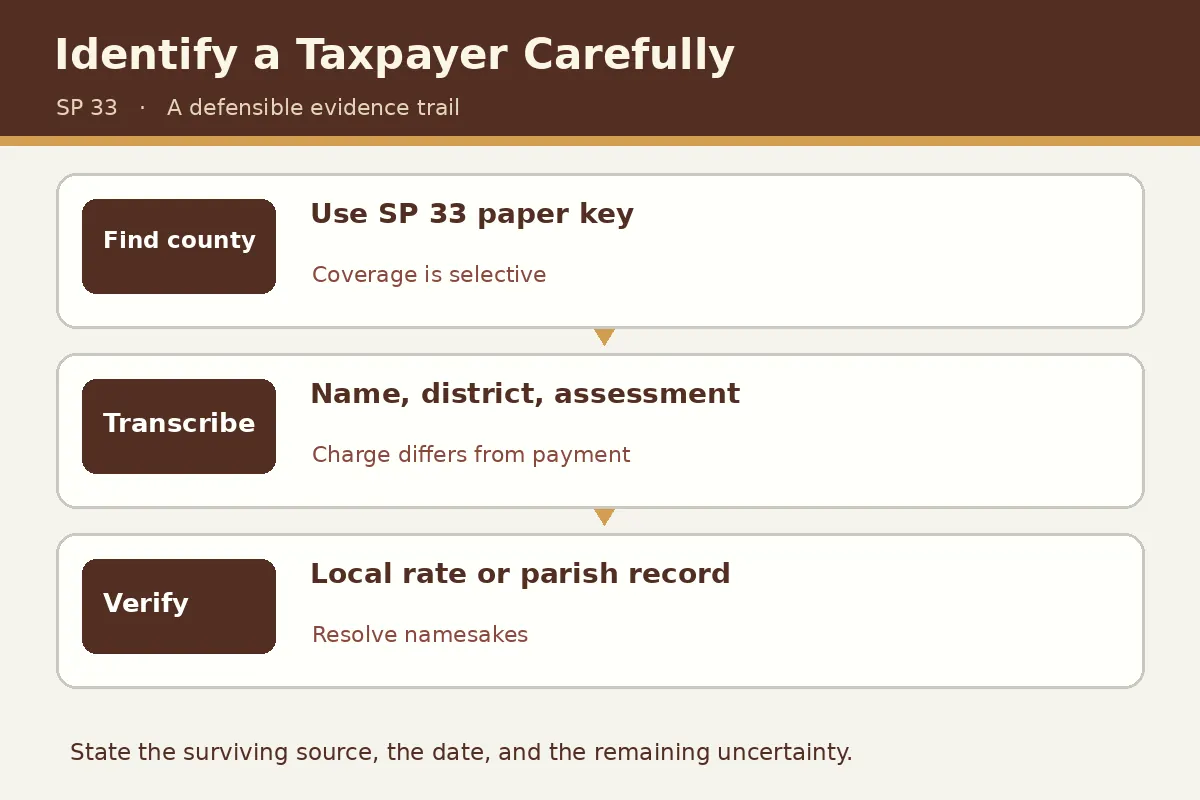
If you want to discover why a county was assessed or how government discussed revenue, begin with a policy or administrative question. If you want to identify a particular historical taxpayer, first establish a parish, a plausible year and a distinguishing occupation, holding or nearby associate. The guide explicitly describes SP 33 as including duplicate assessments from 16 counties in 1692. It does not claim that every surviving volume is a complete household list or that every adult was named. Ask what the original assessment actually records before treating names as people in a family tree.

Do not silently shift from ‘county represented’ to ‘every parish covered.’ Some records may use the property or contributor as the unit of assessment rather than an individual resident. A levy could be assessed, collected, copied and audited at different dates. Maintain separate columns for year described, document date and any period of collection. If a copied assessment lacks a date on a page, explain whether the context comes from a wrapper or catalogue description.
Distinguish SP 33 from the SP 32 calendar
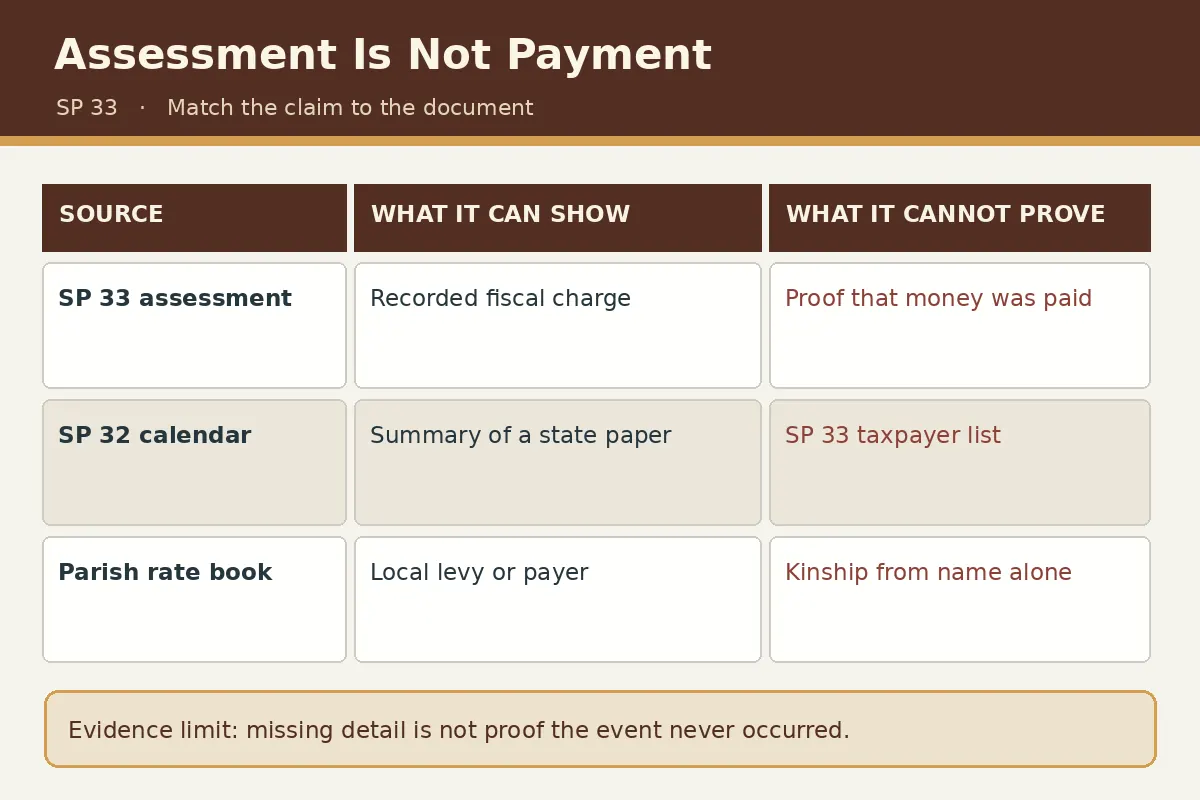
SP 32 and SP 33 cover the same 1689–1702 span but are not interchangeable finding aids. The National Archives’ guide describes SP 32 through a multi-volume printed calendar, with changing referencing conventions around 1698. It then states that SP 33 is not calendared and that a key to the 1692 county assessments is available in the paper description at Kew. A name found in an SP 32 calendar is not an entry in SP 33. Keep each series’ reference intact when following cross-references.
When remote searching fails, note that the limitation may lie in the finding aid rather than the archive. Plan for consulting the paper version or asking the repository about identifying a county volume. Search terms should include county and levy terms, but these may not index the names inside. Do not claim that an online keyword search has ruled out a taxpayer. An unindexed assessment requires a different access strategy from a calendared correspondence file.
Read a county assessment as a fiscal document
A tax assessment must be read in its administrative setting. Identify whether the item is a duplicate, local schedule, summary or certification and whether the named party is assessed directly or mentioned as an official. Record the unit used for any sums and the way names are grouped. A heading that identifies a parish or hundred can help locate a family, but it does not convert the amount assessed into a valuation of a house. Later historians’ transcriptions may modernize monetary notation or omit blank and damaged entries.
Tax sources regularly reveal differential visibility: those exempted or outside the assessment basis may disappear, and households may be represented through a single name. Even where an amount is present, it is not automatically a record of payment. An assessment represents a charge or valuation in a fiscal process; receipts or account rolls would be different evidence. Avoid drawing a false arrow from ‘assessed’ to ‘paid.’ Use any marginal annotations only after verifying when and by whom they were made.
Test names and places outside the taxation series
After extracting a named assessment, use a contemporaneous parish register, rate book, deed, estate account or independently dated court record to test the identity. Select evidence that has a matching parish and a second distinctive feature, such as an occupation, spouse or property description. A common surname in the correct county is too weak to resolve two people of the same name. If a record gives only a surname, mark the forename unknown rather than borrowing it from a descendant’s family tree.
The 1692 context is narrow. Avoid stretching it into claims about where someone was born or remained resident for decades. The counties represented are a subset, and record survival and administrative selection also matter. If a family’s expected locality is outside the surviving set described by the guide, move to local taxation or land documents instead of making a national negative-evidence claim. A carefully limited outcome is often the more accurate result.
Explain the difference between a copy and a payment
The National Archives identifies the assessments in SP 33 as *duplicates*. That single word matters: a document reproduced for the Exchequer may be a reliable administrative copy without being the local original signed at the time. Record the physical kind of document and any corrections or certification. If a local archive preserves a corresponding assessment, compare the names, sums and district headings, noting every difference and possible later update. Neither version should automatically be called the more complete one without evidence.
Finish with an evidence statement: ‘A person named X was listed for an assessment in the described district’ is stronger than ‘X paid the king in 1692 and owned this farm.’ Specify any missing columns, illegible entries or gaps in the surviving units. A reproducible citation includes SP 33, the full piece reference, the manuscript page where possible, and the place. Distinguish the official guide from any information read in the manuscript itself; the guide supports the series’ history, not an individual genealogical identity.
More Records and Archives Guides
How We Research and Verify These Records
Our starting points are research guide from The National Archives additional archival guidance. We checked the series descriptions, dates and stated survival or access limits on November 2, 2026. The diagrams are explanatory reconstructions, not reproductions of historical manuscripts. We distinguish a catalogue summary, an original document, a later transcription and an independently checked claim; none should be silently substituted for another. Use the full piece-level archive reference and folio where available.
Every suggested research route is conditional on the surviving records for the place and date in question. We do not infer a negative historical event merely because a public search yields no result. Dates that appear in later indexes can be editorial and must be differentiated from the date written in an original document. This guide contains no paid partnership claim; see our affiliate disclosure.
No. The National Archives expressly says SP 33 was not calendared.
The guide describes duplicate assessments from 16 counties, not nationwide coverage.
Not on its own. A charge recorded in an assessment differs from a receipt or payment account.
SP 32 offers calendared government correspondence that can explain the context; it is a separate series.
Record the exact place, name and assessment status, then verify identity with independent local evidence.