
Celebrated Merchant Ships BT 100 is best used as a specific archival lead, not as a complete family biography. Start with an exact reference, distinguish what a surviving record actually states from what you infer, and use at least one independently created source before naming a person or asserting an event. This guide follows the available archive descriptions and highlights common traps in historical dates, coverage and institutional terminology. The goal is a reproducible decision about which document to examine next, not a plausible story produced from a matching name alone.
Create a working note with the research question, likely place and period, identity clues and the kind of document that could actually answer it. Record gaps in survival and access without treating them as evidence that the event never occurred.
Begin with the vessel, not the surname
BT 100 is a special collection of agreements and crew lists relating to a selection of celebrated British merchant ships, rather than a complete register of all mariners. The National Archives says that researchers can search the series by the ship’s name and identifies its coverage broadly as 1835–1999. That makes it a promising place for a documented association with a famous vessel, but a poor substitute for a universal surname search. A family legend about a renowned ship is a lead, not yet an entry for a particular sailor.
Write down the vessel name as originally given, a plausible date range, and every alternative spelling or renaming mentioned in sources. Separate the ship’s historical fame from the specific crew agreement you need. If a family story names only a ship type or a line rather than a distinct vessel, start with port records, shipping lists and the ship’s official number before assuming BT 100 is the appropriate series.
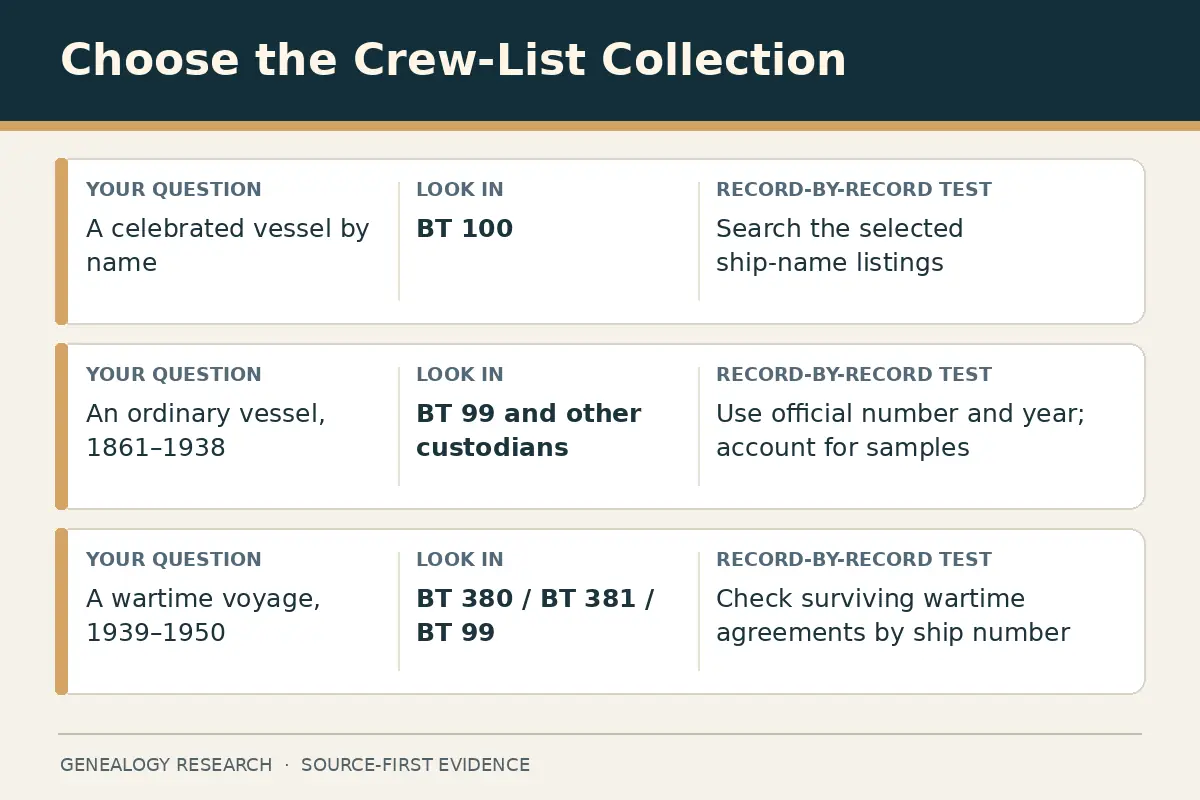
Know when BT 100 is not the right archive
Coverage changes with era and custody. For many crew lists dated 1861–1938, The National Archives retains a ten-percent sample in BT 99, with large portions of other surviving material held elsewhere. The guide distinguishes wartime BT 380 and BT 381 as well as BT 99 for 1939–1950. BT 100 has a different selection principle: celebrated vessels. The word “selected” is crucial. It does not guarantee that every ship with historical importance appears, or that every year of one ship’s career survives.
Create a small decision table with ship, date, source series, archive, search key, and result. A query that finds no BT 100 item may call for a BT 99 official-number search, a visit to a maritime museum catalogue, or an inquiry to the Maritime History Archive in Newfoundland. Each represents a separate evidence search; do not report a collective negative finding after searching only one website.
Extract the actual contract and crew fields
Crew agreements record an engagement between master and crew. Depending on date and form, a list may state the sailor’s name, age, birthplace, rating or job, vessel previously served in, and dates or places of joining and leaving. Some agreements contain additional remarks or conduct entries. Copy the headings for the particular schedule rather than importing columns from an example printed decades earlier. The absence of a birth date is not a statement that it was unknown to the sailor.
For a candidate match, transcribe the full surname and given names, job title, age, and the vessel’s identifier together with the dated document. The agreement’s date and an individual’s joining date can differ. Even where the ship’s itinerary is known independently, do not assign every port call to every crewman: a person might have joined later, departed early, been transferred, or appeared in only one of a sequence of agreements.

Separate one engagement from a career at sea
The National Archives guide explains that ships may have crew agreements and log books, but these are not always stored together and surviving series differ. A crew list is evidence of the engagement it records, not a complete occupational biography. To extend the chronology, look for later agreements for the same official ship number, a merchant seaman register if appropriate to the period, a discharge record or a separate newspaper report tied to the same person.
The same name may belong to two seamen serving similar routes. Build a comparison based on birthplace, approximate age, rating and previous ship where provided. A change in a recorded birthplace may have a plausible historical explanation, yet it still needs examination rather than automatic acceptance. Keep the evidence chain visible: first agreement, second agreement, independent identifying record. If one link is missing, do not report an uninterrupted twenty-year career.
Account for renaming and official ship numbers
A ship’s name can be reused, and a vessel can change names. An official number is usually more useful for tracing a particular registered ship across lists and registration changes. The maritime guide recommends the Mercantile Navy List and Lloyd’s Register for finding official numbers in the relevant years. In BT 100, the name search may be the starting point; after locating a candidate agreement, record every identifier and date available before expanding into other series.
Distinguish a famous ship from another vessel bearing the same name by comparing registry port, tonnage, owner, route, master and official number when the document supplies them. Never invent a number from a similar modern database entry. A vessel built after the family’s claimed voyage plainly cannot be its source, but a matching number and overlapping years still require an actual crew entry to establish the sailor’s involvement.

Publish a sourced voyage note, not a legend
A well-supported research note states that an identified person appears in a crew agreement for a named vessel during a specified documented engagement. Quote only a short, accurately transcribed field and cite the BT 100 piece, page and entry. Then identify the separate evidence, if any, for each further port, promotion or discharge. This makes the article useful even when the most attractive version of the family legend remains unproved.
If the original entry is not yet seen, say “a catalogue entry suggests a relevant agreement,” not “the sailor served on this voyage.” Add a task to check the actual list and its surrounding pages. An index may omit a middle initial; a ship log may describe an accident involving unnamed crew. Treat those as clues that require joining to the person through matching records. A cautious chronology is more valuable than a dramatic story with missing sources.
More Records and Archives Guides
How We Research and Verify These Archive Claims
We checked the relevant descriptions and searching instructions against The National Archives and The National Archives. These sources describe record categories, access and limitations; they do not identify any unnamed ancestor or certify a speculative biographical match.
For every claim we distinguish the wording of the inspected record, the archive or provider description, and our own proposed interpretation. Researchers should verify piece-level holdings and availability at the time of consultation. This is noncommercial guidance; see the affiliate disclosure for site policy.
No. It is a selected collection, not a comprehensive list of all ships called famous or celebrated.
A ship-name search is the designated route; a named crew entry in an original agreement is needed to identify the individual.
No. It documents the engagement and events recorded on that agreement, not every voyage in the vessel’s career.
Use the date and ship official number to test BT 99 or wartime BT 380/381, and consult other maritime archive custodians.
Correlate the person’s age, birthplace, rating, previous ship and dated engagements in independent records.