
General Register Office Circulars RG 41 is best used as a specific archival lead, not as a complete family biography. Start with an exact reference, distinguish what a surviving record actually states from what you infer, and use at least one independently created source before naming a person or asserting an event. This guide follows the available archive descriptions and highlights common traps in historical dates, coverage and institutional terminology. The goal is a reproducible decision about which document to examine next, not a plausible story produced from a matching name alone.
Create a working note with the research question, likely place and period, identity clues and the kind of document that could actually answer it. Record gaps in survival and access without treating them as evidence that the event never occurred.
Ask what the circular was meant to regulate
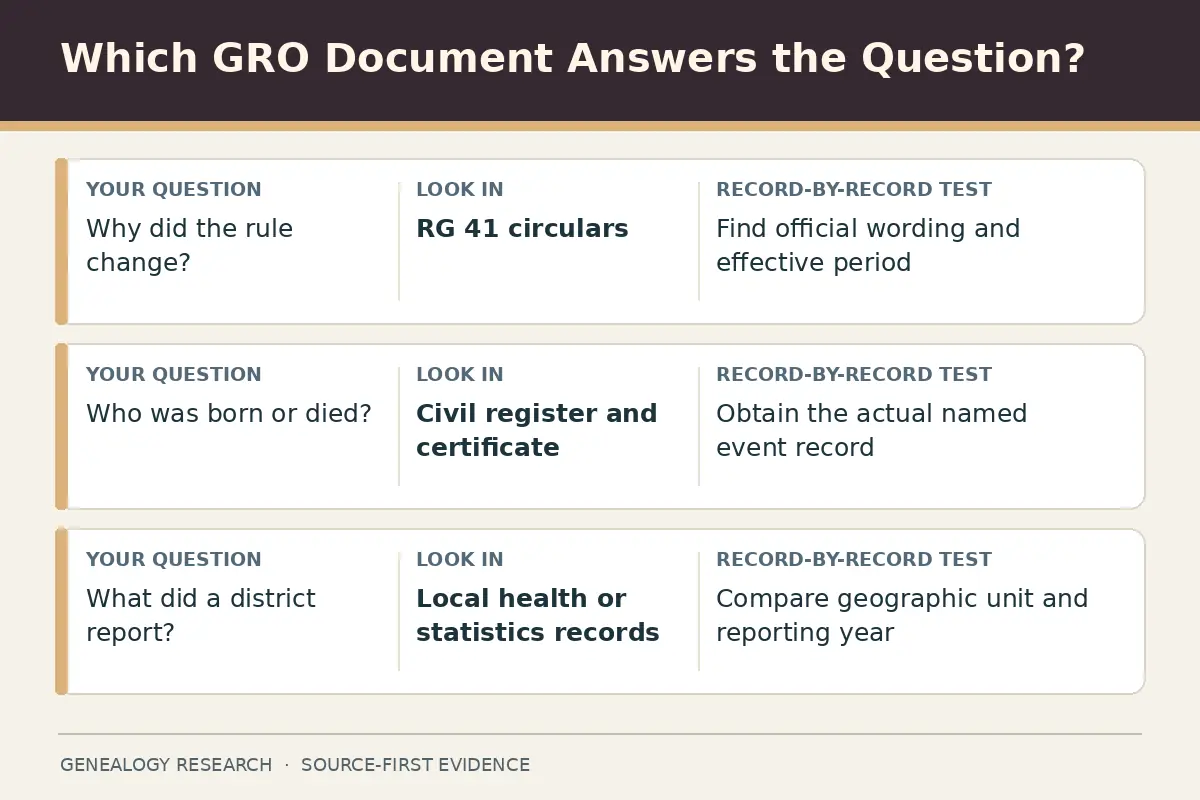
RG 41 is not a substitute for a civil birth, marriage or death certificate. It contains General Register Office circulars and associated official material relating to registration and vital statistics. The National Archives public-health guide identifies selected General Register Office circulars for 1910–1940 and notes their connection with public-health reports and limited statistical material. A separate government description of this family of holdings dates registration circulars from 1909 and vital-statistics circulars from 1910. These are different kinds of evidence from an entry naming a parent, child or deceased person.
The strongest research question is administrative: “Which rule or reporting practice was in force when this entry was compiled?” A circular may help explain a column heading, category, change in reporting practice or instruction received by officials. It normally cannot establish that a particular registrar followed that instruction correctly, or that an individual family event took place. State the question in the research log before searching the series.
Separate registration guidance from health statistics
An RG 41 item may relate to the machinery of civil registration, statistical compilation, or public-health reporting. The precise piece and its headings must decide which. A statistical table covering several districts is not a collection of family certificates, and a circular giving a standard method is not a district’s completed return. If a user seeks a cause of death for an ancestor, a contemporary death certificate or another individual-level medical record is the appropriate evidentiary target.
Create an evidence-type field before you transcribe: “instruction,” “statistical return,” “annual summary,” or “local event.” Record the date to which the contents refer separately from the publication or issue date. A document circulated in one year may summarize an earlier reporting period. Historical health categories also change their definitions. Never compare percentages across decades unless you have confirmed the age groups, boundaries and terms are comparable.
Search series and time before keywords
Use The National Archives Discovery advanced search to restrict your search to RG 41 and a suitable date range. Try the subject term from the original certificate or public-health report as well as contemporary administrative vocabulary. If no result appears, browse the series structure and its piece descriptions; not every substantive word inside a circular is present in the catalogue title. Preserve the piece-level reference rather than recording a broad series label as though it were an examined original.
For each plausible item, write the question it can answer and what would falsify the proposed interpretation. For instance, if a changed reporting category appears to explain a sudden rise in a district’s recorded deaths, check the actual circular wording and dates, then inspect the district’s records. A one-line Discovery result alone cannot demonstrate a policy change. Nor does a national instruction guarantee immediate uniform implementation by every local registrar.

Connect a national instruction to a named record cautiously
To apply an official rule to a family-history puzzle, first determine the place and date of the individual entry. Find the relevant registration district and any historical boundary changes. Then identify the RG 41 instruction that was actually current, if any, for that administrative setting. Finally inspect the named record itself. This three-layer model distinguishes a general rule, a local administrative practice and the particular statement that an informant supplied.
An ancestor’s age, place or relationship may have been entered by someone with imperfect knowledge. Even if the form was required under a known official rule, the content can still be wrong. Compare original records created independently, such as parish registers, census schedules or probate documents, depending on the question. A rigorous conclusion should not equate an official form with perfect factual accuracy or treat regulatory uniformity as proven local compliance.
Avoid misleading comparisons across districts
RG 41 can also help interpret why officials counted certain events in particular ways. The public-health guide treats these circulars as part of the wider historical public-health record, not as stand-alone household histories. When comparing place A to place B, identify whether each figure uses the same calendar year, district boundary, population denominator and reporting category. Separate births recorded in a district from residents born elsewhere, and respect the actual wording of the historical source.
If a printed report provides rates for a population rather than named entries, do not attempt to infer the health experience of one family from an aggregate. A rate may describe a context or risk environment; it cannot identify who became ill. It is also important to retain original historical terms in quotations while explaining outdated terminology accurately and respectfully. Source quality depends on how a number was produced, not only on whether a government office printed it.

Document the limits of the policy explanation
Your final research note should identify the RG 41 piece, document title, issue date, clause or page, and the specific practice it addresses. In a separate sentence, state the personal record and the observation you are trying to explain. If the link between policy and local execution remains uncertain, preserve that uncertainty. A clean citation lets another researcher repeat the check instead of accepting a generalized description of how all historical registrars worked.
When an RG 41 search is negative, keep the exact dates, search terms and catalogue filters used. Search related local registration or public-health archives if the national record does not answer the question. A successful inquiry may produce a narrow explanation of a form or figure without supplying any new ancestor names; that is still a valuable result, because it prevents a historical administrative detail from being mistaken for direct genealogical proof.
More Research Method Guides
How We Research and Verify These Archive Claims
We checked the relevant descriptions and searching instructions against The National Archives and The National Archives and The National Archives. These sources describe record categories, access and limitations; they do not identify any unnamed ancestor or certify a speculative biographical match.
For every claim we distinguish the wording of the inspected record, the archive or provider description, and our own proposed interpretation. Researchers should verify piece-level holdings and availability at the time of consultation. This is noncommercial guidance; see the affiliate disclosure for site policy.
No. RG 41 concerns official circulars and some public-health or statistical material, not the standard personal certificate search.
Start with the date of the record you are interpreting; registration circulars are described from 1909 and statistical circulars from 1910.
No. It shows an instruction or policy; a local record or inspection is needed to test execution.
Aggregate figures describe groups or areas and are not individual records of illness or death.
Record the RG 41 piece, issue date, clause or page, the relevant district, and the separate personal record being explained.