
Start With an Issued Band, Not a Recovered Bird
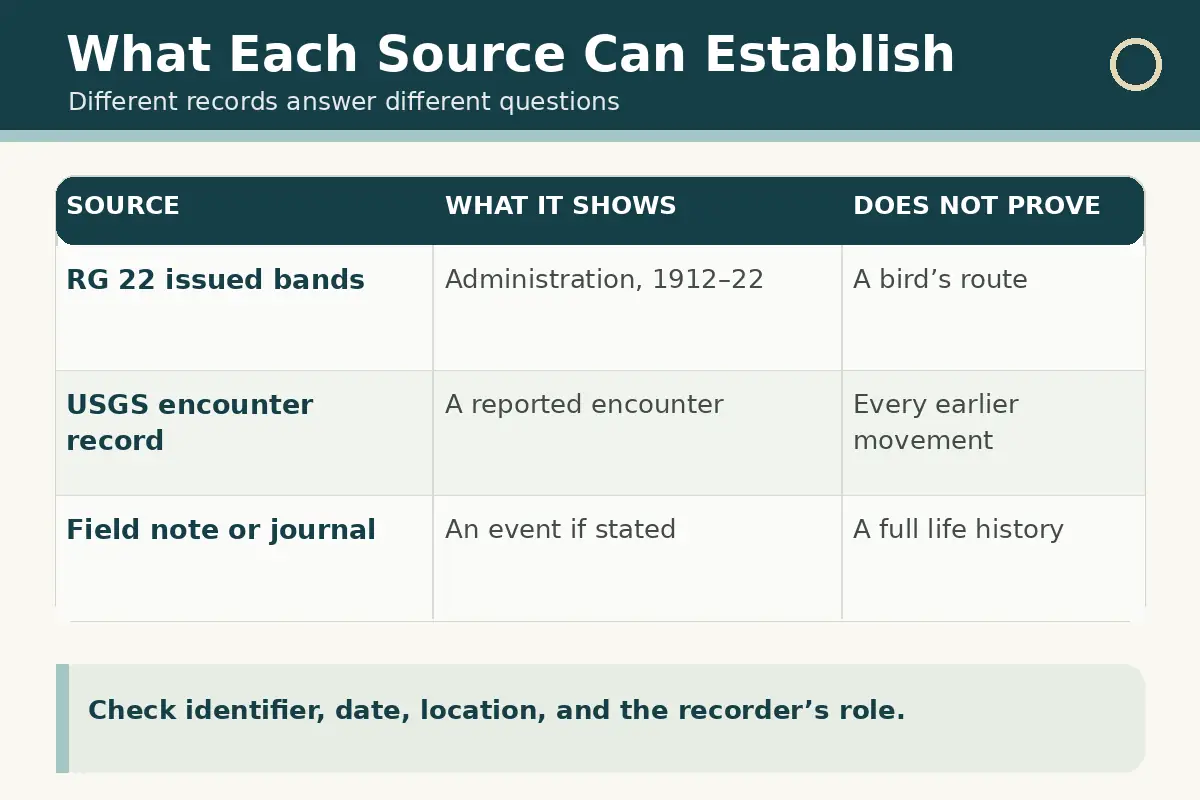
The National Archives describes “registers of bands issued by the American Bird Banding Association, 1912–22” among the Bureau of Biological Survey material in Record Group 22. That precise wording matters. An issue register documents administration of numbered bands; it is not, merely by virtue of its title, a list of birds recaptured at a second place. Begin by asking whether the evidence in hand concerns the distribution of a metal band, an original bird banding event, or a later report that a marked bird was encountered.
A family notebook may contain a band number, a species, a date, or the initials of a naturalist. Keep those clues separate. Even a band with a readable number may have passed through several hands before use. Write down the number exactly as seen, note uncertain characters, and distinguish an inscription copied from the physical object from a later typed recollection. Your first goal is to identify which historical transaction a surviving clue actually represents.
Choose the Correct Historical Record Window
The RG 22 guide dates the American Bird Banding Association issue registers to 1912–1922. It separately identifies bird migration schedules and waterfowl reports from 1884–1924 in records of the Patuxent Wildlife Research Center. These are not interchangeable series. A schedule may describe observations, while a band register addresses numbered markers. When a story mentions a bird “seen again,” investigate an encounter or field report rather than assuming the register records the second observation.
Use the date of the claim as a gate. For a reported number issued in 1918, the RG 22 register is a sensible archival lead. A reported banding from 1935 falls outside that register’s published dates, even though other wildlife records continue later. A modern online database search is a different route again. State which period you have tested instead of treating every failed search as evidence that an early observer was mistaken.

Test the Claim Against USGS Data Coverage
The USGS Bird Banding Laboratory explains that individual banding records are held electronically beginning in 1960. For pre-1960 banding, the available data described by USGS are tied to birds that were encountered; individual encounter data begin in 1913. Therefore, a missing early band from a modern electronic search does not erase the historical issue register. Conversely, finding an encounter does not automatically identify the person who first attached the band without a reliable link to the original banding record.
Search and request data using the actual evidence type. If the family possesses a leg band, preserve its lettering, measurements, and the circumstances of discovery before entering a number online. If a contemporary journal reports a bird recovered in another state, transcribe the original source and look for the specific matching band or encounter. The distinct records serve distinct purposes; neither should be promoted into the other.
Read an Issue-Register Entry Conservatively
Ask the archive for the relevant issue-register series and physical volume or file rather than a speculative “bird migration certificate.” If the volume is available, record its cover title, inclusive dates, folio or page, and the exact names or numbers actually present. The national guide confirms that the series exists; it does not publish a universal list of fields, a complete name index, or a promise that every register has been digitized.
Suppose a surviving page links a sequence of bands to an organization. That would support the narrow conclusion that the sequence was issued in a specific administrative context. To say that one numbered band was attached to a particular bird on a particular day requires another record stating that act. To say it traveled between two places requires observations tied to the same individual marker with credible dates and locations.
Separate Collector, Bander, and Reporter Roles
Historical natural-history notes may name a person who requested bands, the person who tagged a bird, a person who found a band, and someone who transcribed the report. These roles may coincide, but do not merge them by inference. Write a role column beside every name: requestor, bander, observer, finder, data compiler, or unknown. The register title alone cannot decide which role a name describes.
For genealogy, the presence of a surname in an institutional ledger is evidence of a documented activity, not a complete occupation or residence history. Match the person against a dated directory, scientific publication, local society minutes, or contemporary correspondence. Preserve spelling variants and institutional affiliations. If the same initials appear across two documents, explain the evidence connecting them instead of declaring an identity from initials alone.
Build a Bounded Migration-Evidence Chain
A persuasive movement claim begins with a particular band or marker and a documented banding event. It then adds an independently dated encounter of the same marker, with a place stated in the original record. Only after the identifiers and chronology match can you discuss movement between observations. The observations do not themselves describe every stop, breeding location, or route the bird used between them.
Use a small evidence ledger: source title; exact band characters; observation date; place stated; responsible recorder; record type; and unresolved uncertainty. If a publication offers a route map based on aggregated birds, do not assign the route of that species to a single band in family papers. A cautious sentence such as “the same band was reported in two locations” is more defensible than a guessed itinerary.

Find the Archival Description and Request the Item
Look for the Biological Survey record series in the NARA RG 22 guide, then use the National Archives Catalog instructions to locate the appropriate series-level description and holding unit. Search title variations such as “bands issued” and the organization’s formal name. A catalog description may cover a box or volume without transcribing each individual band number.
Include the precise period and your type of evidence in a records inquiry. Ask whether a finding aid, box list, microfilm copy, or reference service can identify a specific volume. Do not infer public online access from a general series listing. If an on-site visit is necessary, request the handling and reproduction rules in advance, and cite the reference information supplied by the repository.
Write What the Evidence Actually Establishes
There are three different acceptable outcomes: an archival record confirms distribution of a band; an independent source confirms that a bird was marked or encountered; or sources establish a linked sequence of observations. Label the result precisely. A band number alone is an identifier, not a migration record. An issued band that was never used will still belong to the administrative history of the program.
The most useful research note leaves an explicit next question: “issued in 1917—need dated field note,” or “encounter reported in 1921—initial banding not yet corroborated.” These limitations make the result reusable by future researchers rather than hiding its weakest link.
More Research Method Guides
How We Research Early Bird Banding Evidence
We anchor the period and type of document in the NARA description of RG 22, compare it with the USGS Bird Banding Laboratory coverage statement, and distinguish issue, marking, and encounter records at every stage. We do not assume a record was digitized, indexed by person, or exhaustive simply because a series is named.
This guide is independent historical research, not an endorsement of a commercial service. Our affiliate disclosure explains our editorial and link policies. When citing any individual band, preserve the repository identifier, page, exact transcription, and the distinct interpretation drawn from the record.
No. NARA calls them registers of bands issued, which is an administrative transaction. Migration requires a separately documented banding event and reliable subsequent observations.
No completeness claim is justified. USGS states individual electronic banding records begin in 1960; pre-1960 data are available for encountered birds.
Not without confirming what role the person’s name represented and finding evidence of that particular tagging event.
Record the search range and try a series-level inquiry at NARA. An online miss is not proof that the historical register or the activity never existed.
Prefer an identified marker, a documented banding event, and at least one trustworthy dated encounter linked to that marker. Report observations, not an imagined full route.