
To find a German ancestor in a church register, start with a historical town and its parish, not just a surname. Church books (Kirchenbücher) were created by local religious institutions, and their repositories depend on denomination, changing boundaries and archive transfers. Archion hosts many Protestant church books; Matricula Online offers records from participating Catholic and other church archives. Neither portal claims to contain every German parish. This is a location-and-volume research problem before it becomes a name-search problem.
Identify the correct historical parish before browsing
Find the ancestral village from a document created close to the migration: a U.S. marriage record, passenger departure entry, obituary, naturalization paper or family letter. Record the place as literally spelled, the probable date and the surrounding county or historic territory. Place names can repeat in Germany and can change across language and national borders. A large town may have multiple parishes; a hamlet may have belonged to a mother parish some distance away. Check a contemporary gazetteer or a regional church directory before choosing a book.
Build a three-part location note: historical civil locality, likely denomination and ecclesiastical parish during the year of the event. Do not assume a modern municipality matches a 1750 parish. If you know only the region, use witnesses, sponsors, church affiliation and surrounding records to narrow the place. An undocumented village guess can send weeks of work into an archive holding perfect books for the wrong family.

Choose Archion, Matricula or an offline custodian
Archion describes its site as a place and archive search for historical church books and sells access passes. Inspect the list of available archives and register ranges before paying; a matching town in the catalog is not proof that the needed baptism year has been digitized. Matricula describes its offerings as parish books contributed by multiple European archives. Open the relevant diocesan or participating archive tree to see which parishes and volumes are actually available, and note restrictions on recent entries.
The third outcome is just as important: the volume may be held in a parish office, a diocesan archive, a regional Protestant archive or another institutional repository and not online. Record who created the volume and where the original or microfilm is kept. Catalog coverage changes; check the holder’s current access rules, image availability and search restrictions. Absence from Archion or Matricula is not proof that a baptism, marriage or burial never occurred.

| If the locality is… | Start by checking… | Then verify… |
|---|---|---|
| Historic Protestant parish | Archion archive and parish catalog | Correct volume and year range |
| Participating Catholic parish | Matricula archive and parish tree | Diocesan coverage and access |
| Unlisted or closed volume | Regional church or diocesan archive | Holding, permission and copies |
| Only a migration clue | Civil locality and parish boundaries | Independent homeland link |
Read baptisms as dated acts, not ready-made pedigrees
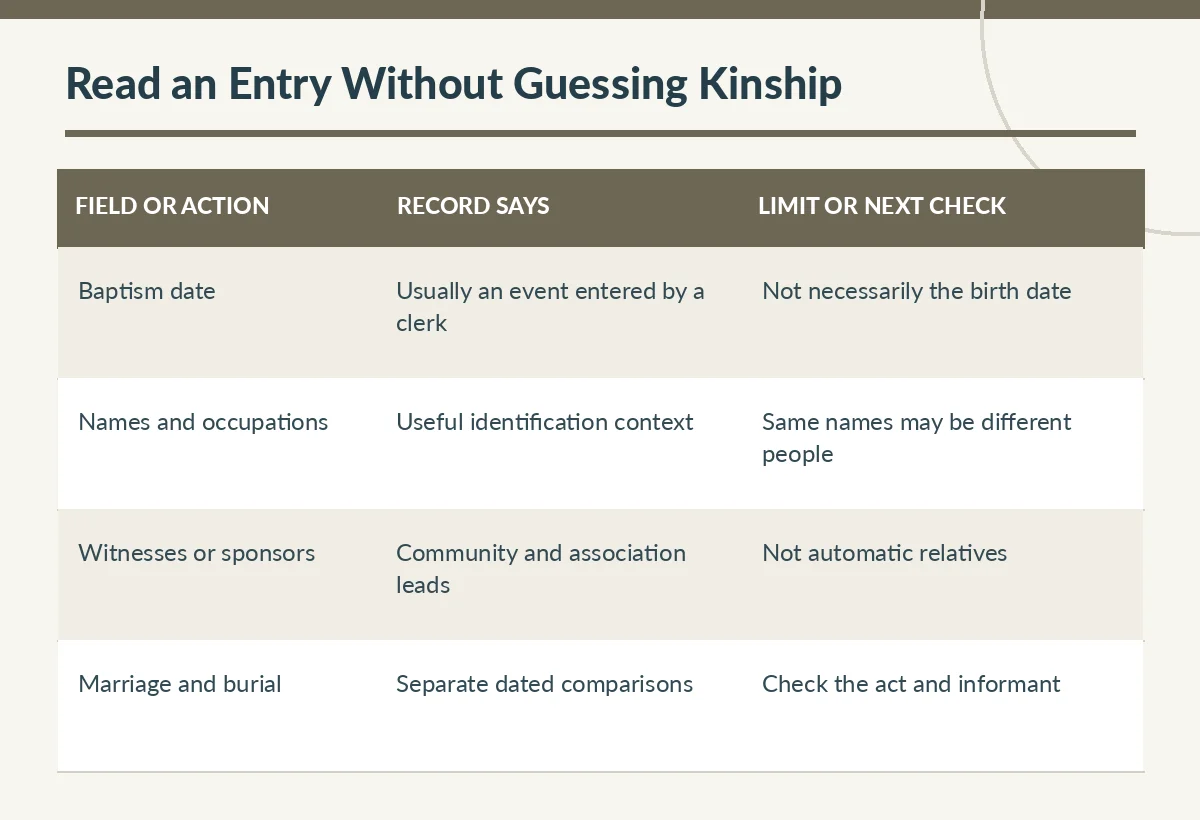
A baptism record may distinguish the date of birth from the date of baptism, although not every book or period supplies both. Look for child, parents, locality, occupation, sponsors and the officiating cleric where actually recorded. Latin names and German script may render one person in very different forms; for example, Johann may appear with an additional given name used in daily life. Write a diplomatic transcription of the original form beside a normalized reading and translation rather than silently modernizing the page.
Baptism witnesses or godparents can be kin, neighbors or social associates. Treat them as leads, not an automatic list of uncles or grandparents. If two men named Johann Müller had children in the same parish, compare occupations, house numbers where present, mothers’ names, witnesses and the order of family events. A name-and-date match without a verified parent link is insufficient to attach a child to one couple.
Use marriage and burial books to test identity
A marriage entry may identify the couple, residences, parents, prior marital status, ages or witnesses, but the detail varies sharply by period and locality. Keep a distinction between an engagement or banns entry and the marriage act itself. In burial registers, age at death may be estimated and may describe date of burial rather than date of death. Capture the record label, date, original volume page and a separate translation for every assertion you use.
A strong parish reconstruction follows one household across baptisms of several children, marriage entries for possible parents and burials before claiming a link. Consider two same-name couples when a childbirth interval is implausible or a burial precedes a supposed later event. Use independent civil or occupational records where they survive. Do not overwrite unresolved conflicting data with whichever online tree repeats a convenient version.
Work across script, language and calendar obstacles
German records may appear in Latin, German or another local language, and hands may use Kurrent or older script forms. First identify the column headers or repeated formula in an undamaged entry. Copy the uncertain letter group with a question mark; compare nearby surnames written by the same clerk. Abbreviations, local month forms and patronymic or occupational names require particular caution. A modern OCR transcript or automated handwriting recognition is a discovery aid, not a substitute for checking the image.
Keep exact archival citations: repository, church parish, register kind, covering dates, page or folio, entry number if supplied, and digital image locator. Save the access date and stable catalog identifier when one exists. Reopen the cited page without relying on search history: if another researcher cannot find the entry from your citation, improve it before advancing the pedigree.
Handle gaps and denomination changes without a false negative
Register beginnings, war damage, missing years and transfers of congregations mean that a carefully searched volume may still be silent. A family might worship in a neighboring parish, change confession, or have a child’s baptism recorded where the mother was temporarily staying. Compare the date range of the cataloged volume with the event window, then look for duplicate registers, neighboring parishes or local civil documents instead of repeating the same full-name search.
A negative conclusion requires a defined search scope: the books searched, their date ranges, the relevant parish boundary, and the specific event claimed absent. The safest note is often ‘not found in these surviving volumes,’ not ‘never baptized.’ Keep the evidence distinction visible when discussing people from historically minority religious communities.
More Research Method Guides
How We Research German Parish Registers
We separate the two digital access tools from the original record custodians. Archion’s current archive search and paid access description, Matricula’s archive coverage notice, and the FamilySearch reference guide provide the cross-check. We do not claim that a modern denomination map can identify a historic parish without local research, nor that transcription software has read an entry correctly. Hypothetical examples illustrate possible identity conflicts only.
Before a link is accepted, our worksheet requires an identified parish, volume range, exact original entry and a second source supporting the proposed family relationship. No commercial portal is endorsed or linked through an affiliate program. See our affiliate disclosure for general policy; access fees and holdings can change.
No. Archion holds books from participating archives, mainly Protestant; check the individual archive and parish catalog for the necessary years.
No. It publishes records contributed by participating archives. A missing parish may be held elsewhere or unavailable online.
No. Some give both birth and baptism dates; others supply only baptism. Transcribe the actual labeled field.
No. Sponsors are possible associates or kin, but kinship must be corroborated in other records.
Resolve the historical jurisdiction and denomination from independent documents before selecting a parish or accepting a name match.