
To find German marriage records, identify the town and date before you pick a database. A civil act from a Standesamt and a church entry for a Trauung are different documents, sometimes created for the same couple. Civil registration began in different years across German states; it was not introduced everywhere on one date. First choose the right local office or parish, then check names, parents, prior marital status and witnesses in the original entry. An indexed marriage hint is not a substitute for the signed or registered record.
Anchor the town and date before using national search tools
Start with a place documented in a letter, birth record, passenger manifest or later residence entry. Record the original German spelling and the historical state or province where the town belonged at the time of marriage. Many towns have the same name; a modern postal code alone does not tell you which 19th-century registrar or church kept the book. Germany has no single searchable, complete marriage register for every region and denomination. Look for a municipal or district archive catalog tied to that locality, then for the actual Standesamt district and the couple’s religious parish. Our guide “German Parish Registers” shows how to choose the right church book and archive.
When only a broad region is known, use parents’ places of birth, an earlier child’s baptism or a migration record to narrow the search. Establish whether the wedding was before or after a known child’s birth, allowing for different registration conventions. Log each hypothesis rather than treating the first online marriage index entry as fact. The German Federal Archives explains that it does not hold the country’s civil or church vital registers and advises beginning with the relevant local and regional archives.
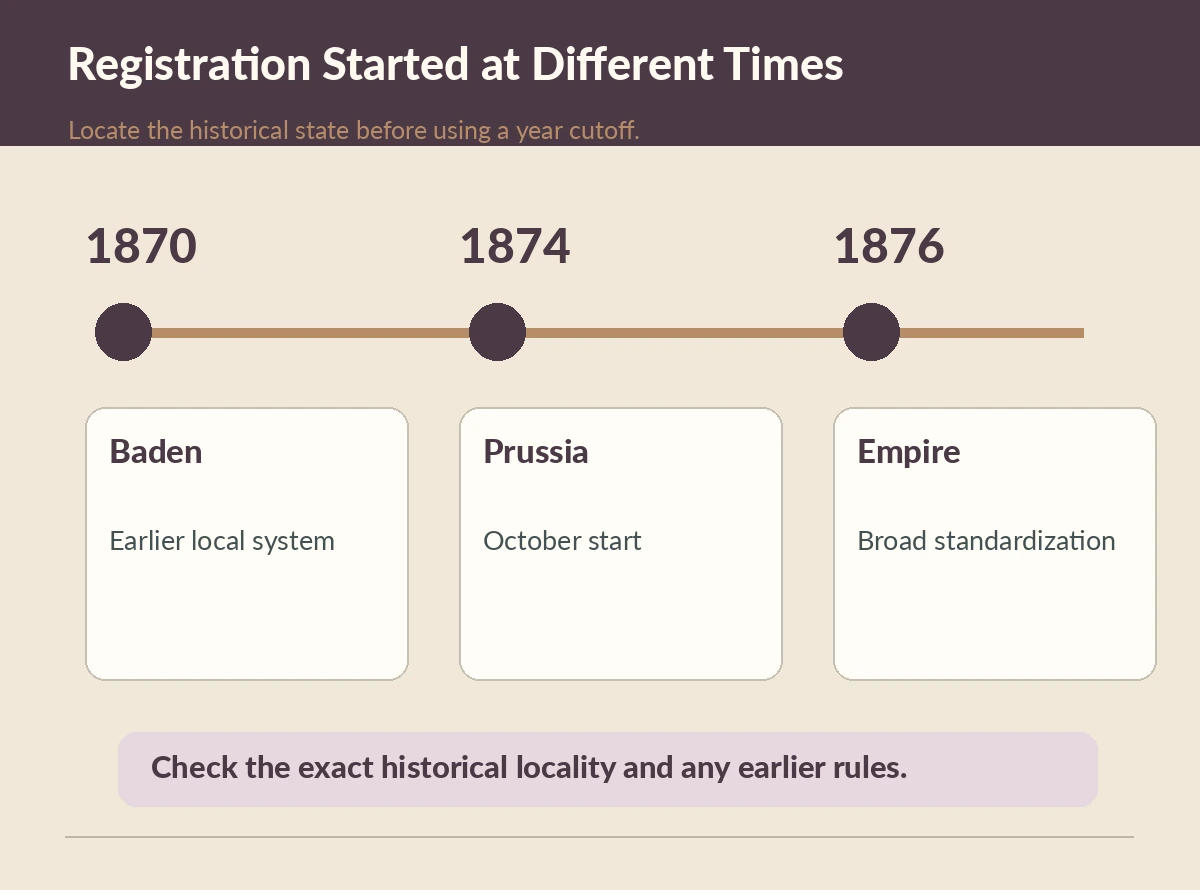
Use the correct civil-registration start year for the region
The Baden-Württemberg State Archives dates civil registration in Baden to 1870, Hohenzollern to 1874 and Württemberg to 1876. Prussia adopted civil registration in October 1874, followed by empire-wide requirements in January 1876; some cities had earlier systems. Consequently, “before 1876 means no civil marriage” is an unsafe blanket rule. Verify the law and archival custody of the precise historical jurisdiction. An 1875 Württemberg wedding may need the church trail, while a contemporary Prussian one may have a civil register.
Older civil books often pass to municipal archives, while younger volumes remain in the local registry office. The Baden-Württemberg guidance notes that most old official civil registers are not in its state archive, despite the archive being an excellent research guide. Request the appropriate volume and event type using town, date range, bride and groom names, and any known record number. Fees, availability, and privacy restrictions may apply and differ by authority, so verify those conditions with the actual custodian rather than assuming an index page grants unrestricted image access.
Route earlier or parallel weddings to the correct parish
A Protestant or Catholic wedding can be recorded in the relevant Kirchenbuch even when a civil act also exists. Search the parish serving the couple’s residence, but consider a bride’s home parish or a neighboring church. Lutheran, Reformed and Catholic jurisdictions are not interchangeable. The earlier FamilySearch Germany Marriages index includes only selected localities, varies by date, and explicitly warns that its data should be checked against original records. A missing hit means little until you know the collection’s place coverage.
Read the original page’s heading: Trauungen are wedding entries; Aufgebote or banns are announcements of intended marriage. A set of published banns does not by itself prove a ceremony followed. Likewise, an index can provide the couple’s names and date but omit a margin note or another spouse with an identical name. Capture both the parish name and its archival custody, because church boundaries and denominations can change even when the secular town name stays constant.

Read bride, groom, parents and witnesses as separate claims
German civil marriage records often identify the bride and groom, their occupations or residences, and details about parents and witnesses, but forms and completeness vary by state and year. Transcribe the actual statements on each page, noting whether a parent is described as living or deceased. Compare a marriage act’s birth information to a birth register rather than treating a later informant’s memory as primary evidence for birth. In some locales the civil record contains later margin notes about death or divorce; they should be cited by their own annotation dates. For a related choice, see our guide “Prussian Birth Records”.
A witness could be a relative, employer, friend or official. Shared surnames are clues, not proof of kinship. Label the role exactly: witness, registrar, informant, parent of groom or parent of bride. If a handwritten abbreviation is unclear, keep a diplomatic reading and mark uncertainty. FamilySearch’s Hesse civil registration collection, for example, illustrates how indexed coverage of marriage acts and images can differ even within one regional collection.
Compare banns, church marriage and civil marriage in a dated ledger
Build a chronology with separate rows for an announced intention to marry, a civil act, a religious ceremony and a child’s later birth. If the banns and the church marriage differ by several days, that is not automatically a contradiction. If a later civil entry reports the wedding on a date apparently different from the church book, check whether each document uses its own event date, registration date or annotation. Record the actual form heading before treating either record as an error.
A practical candidates worksheet lists the couple’s names as written, parents, village, occupations, witnesses, date type and archival identifier. The strongest identity match accounts for independently documented family connections and geography, not only matching first and last names. Two same-name couples marrying in nearby towns can be separated by the bride’s maiden name, ages, parents or children in subsequent baptisms. Where those details conflict, do not collapse them into one family tree entry.

Handle missing volumes and accessible copies without inventing coverage
Archives and databases vary. Some church registers have only indexed extracts, others have digital images, and other books must be requested from a parish or diocesan archive. The FamilySearch Germany Marriages collection calls itself a partial, legacy index covering only selected localities. A commercial search result or database date range therefore cannot support the claim that every wedding in that period has been digitized. Save the collection-specific geographic scope and title when recording a negative search.
For an unresolved wedding, document the searched Standesamt, church parish, dates and name variants, then widen outward one jurisdiction at a time. Check the original civil or church book and any index volume separately. Ask the custodian whether gaps are due to destroyed volumes, restricted access, a change of office or simply unindexed images. Explain which is unknown. A useful citation includes the exact historical town, office or parish, register type, year or volume, page or entry number, repository and image or copy consulted.
More Research Method Guides
How We Research German Marriage Registers
We checked German Federal Archives guidance on repository custody, Baden-Württemberg State Archives dates for local civil-registration rollout, and the FamilySearch marriage-index and Hesse source descriptions. We keep general national timelines subordinate to a named historical jurisdiction. Also, We also distinguish the legal civil act, the religious ceremony and banns, and do not treat any witness as a relative without other evidence.
This article uses government and institutional source guides rather than paid product placements. We make no affiliate product recommendation here; read the affiliate disclosure for our editorial policies. Examples are interpretive research scenarios, not verified genealogies of named people.
No. Baden and several other places had earlier systems; Prussia began in October 1874 and the wider empire standardized registration in 1876.
Usually the municipal archive or the responsible Standesamt, depending on the locality, register age and custody.
It refers to a marriage or wedding entry, while Aufgebot commonly refers to banns or an announcement.
No. The role must be verified using independent evidence such as another vital or property record.
The FamilySearch index includes selected localities and incomplete periods; also check parish holdings and original local registers.