
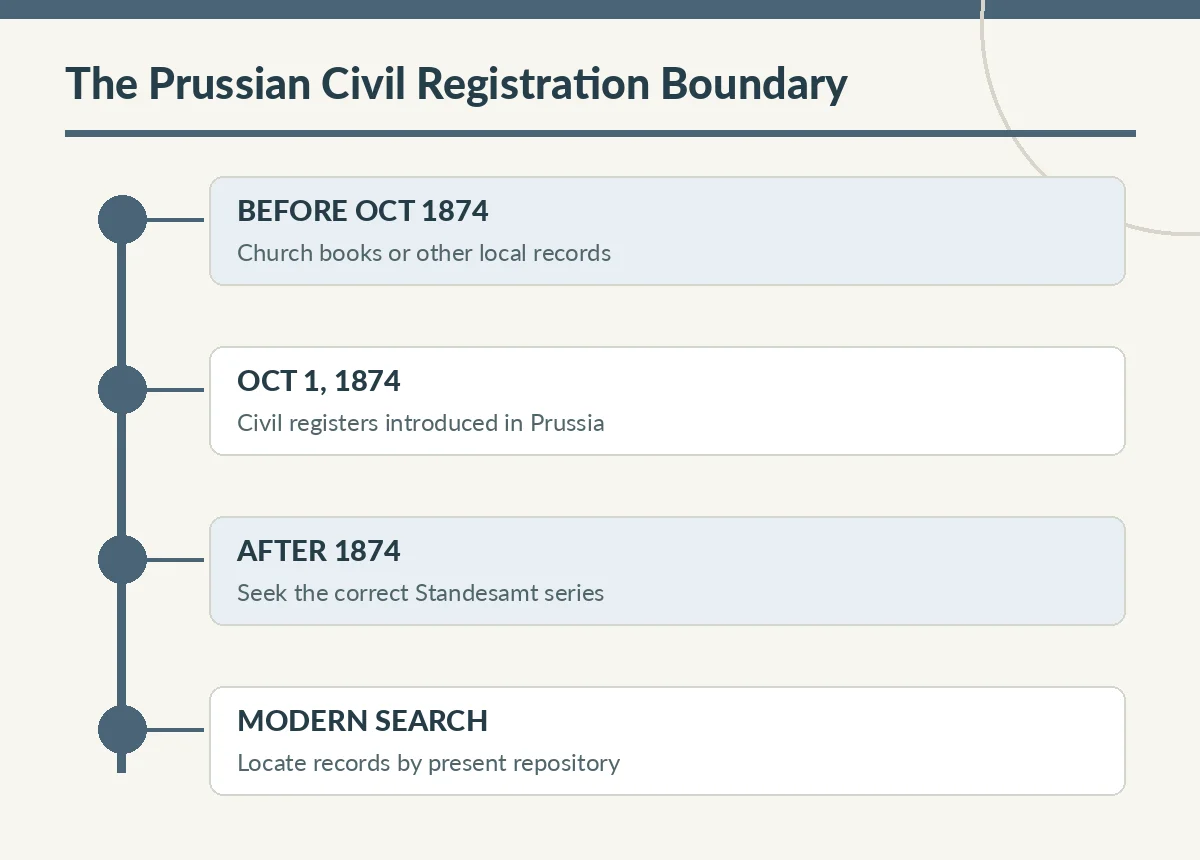
Prussian birth records require two decisions before a name search: where the birth occurred under its historical jurisdiction and whether it was before or after October 1, 1874. The Geheimes Staatsarchiv Preußischer Kulturbesitz states that civil vital registration began across Prussia on that date. An earlier birth generally needs a church register or another surviving local record, not a nonexistent Prussian civil certificate. A later event belongs to a Standesamt civil register, whose custodian usually depends on the town and its modern archival jurisdiction. “Prussian” is a historical location clue, not an archive by itself.
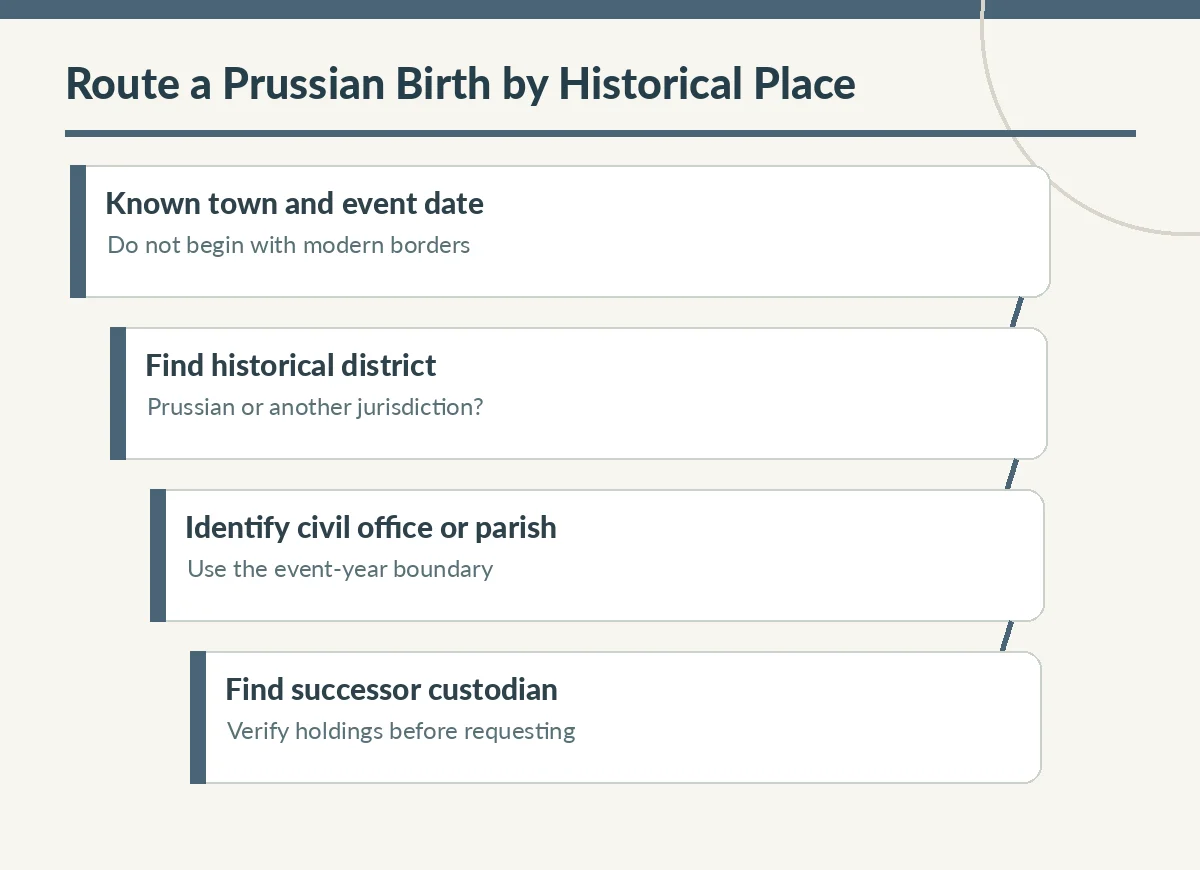
Establish the historical Prussian town before searching a surname
Start with the earliest independently documented place name in an immigration record, marriage record, family letter or church entry. Write the name as it appears, plus its approximate date and language. Prussia contained territories now administered by more than one modern country; a town spelling copied into a U.S. document may be a district rather than a village. Use historical maps, gazetteers and parish indexes to distinguish same-name localities before choosing a repository.
For example, “Neustadt, Prussia” is not precise enough for a successful archival request. Add a district, nearby town, denomination or documented residence clue. Do not convert a historical German name to a single modern location without checking geographic evidence. In a search log, keep alternate names and changing civil and church boundaries visible. This place-first screen often saves more time than another round of phonetic surname searching across unrelated German records.
Apply the October 1, 1874 Prussian birth-record boundary
The Prussian state archive’s family-history guide explains that civil registers were introduced through legislation effective October 1, 1874. For an event in a locality then subject to Prussian law, a civil birth entry from that date should be sought through its Standesamt registration district and successor holding institution. For an earlier event, do not request a Prussian Standesamt certificate that was never created.
This is a regional historical rule, not a blanket claim about every German-speaking community. Other German states began civil registration at different times, and civil registration became broadly standardized in the German Empire in 1876. If the family’s locality was not actually in Prussia, the 1874 gate may be wrong. Always confirm the town’s jurisdiction on the event date. Also distinguish the date of birth from a later registration, baptism or document issuance date. For a step-by-step method, see how to find German ancestry records by town and date.
Find the right Standesamt or successor state archive
A Standesamt is the civil office that recorded births, marriages and deaths. The Prussian archive’s guidance makes clear that it does not hold the ordinary civil registers from all Prussian towns. Records are generally held by the responsible Landesarchiv, local civil registry or another successor repository. Berlin and Brandenburg provide examples, not universal destinations. Start with the place and district, identify the original office and ask what series and years were transferred. For a related choice, see our guide “German Marriage Records”.
An archive catalogue record for a series is not proof that an individual certificate has survived or is indexed by personal name. Record coverage and access restrictions vary with age, locality, destruction and transfer practices. Some eastern Prussian holdings were displaced or destroyed during twentieth-century border changes and wars. Before writing an institution, gather the ancestral spelling, approximate event date, denomination, parents if known and the most precise locality possible.

Search an earlier baptism in the correct church archive
Before 1874, a historical church book can be the strongest surviving birth-related source. Identify whether the family participated in Lutheran, Reformed, Catholic or another religious community and find its actual parish at that date. An older baptismal register may give the date of baptism, parents, residence and sponsors; it may or may not state a distinct birthday. Consult the responsible church archive or a catalogued image collection instead of assuming the Prussian state archive has every parish book. Our walkthrough on how to find historical U.S. birth records and verify the source sets out each step.
A sponsor, witness or neighbor named in a baptism is a research lead, not a proven relative. Two children with the same given names need not belong to the same family. Compare parental occupations, farm or street, successive baptisms, confirmation, marriage and probate evidence. If the church register reports only the ceremony date, leave the exact birth date unknown rather than importing that date as an established birthday. Be especially careful where families crossed parish or state boundaries.
Distinguish historic Prussian, imperial German and modern borders
Use an event-specific jurisdiction table with columns for event year, original town, historical district, contemporary state and present custodian. Prussia was not synonymous with Germany, and a modern archive address can lie in a different country from the ancestor’s historical residence. A search query built around today’s name alone may miss catalogues organized under a former district or parish. When variants disagree, cite the map or original record supporting each identity, not just a modern web result.
Do not infer nationality or ethnic identity from a country label in a modern index. Historic boundaries often changed while families stayed in one village. A later U.S. census reporting “Germany” and a baptism referring to a Prussian district can be consistent without proving a move. Geography is the routing tool; the actual person’s identity must still be tested against parents, spouse, occupation and dates in independent records.
Keep a civil-versus-church birth evidence comparison
A civil birth registration may provide parent names, precise event time and registration details depending on jurisdiction and date. A church baptismal entry documents a religious rite and whatever birth information its minister chose to include. Neither record should be described merely as “the original birth record” without naming the record class. Extract the registrar, informant, minister, date recorded and exact spellings where visible, and cite the specific volume and entry.
When sources conflict on year or given names, weigh who supplied the information and when. A late-issued certificate may reproduce an older entry; an emigrant’s later testimony is a separate and potentially less direct witness. Write out the conflict instead of choosing whichever year makes the family tree line up. If no record can be found, define precisely which offices, parish books, ranges and alternate town names were actually checked.
More Records and Archives Guides
How We Research the Prussian 1874 Transition
We grounded the October 1, 1874 cutoff and custody distinctions in the Geheimes Staatsarchiv Preußischer Kulturbesitz’s family research guidance. The resulting method deliberately contrasts civil and church records and requires verification of historical boundaries before applying a Prussian rule. General archive catalogues and online transcriptions are finding aids; they cannot stand in for a specific original entry or a confirmed person match.
We do not assert that any particular record survives in a town we did not inspect or claim access to restricted personal documents. The hypothetical place example is for routing practice, not a fabricated ancestral case. No paid archive is endorsed; see our affiliate disclosure. Repository opening hours, access charges and reproduction requirements should always be checked at the current institution.
The Prussian archive gives October 1, 1874 as the date civil registration was introduced there; verify that the event locality was in Prussia.
No. Ordinary civil registers generally belong to relevant state or local archives and successor civil-registry authorities.
Parish baptism registers are a major route, supplemented when available by other local historical records.
No. Copy separate dates as stated and leave a birth date unknown if the record does not supply it.
Yes. Historical Prussian territories crossed modern borders, so identify the specific place and current record custodian first.