
The most reliable way to find German ancestry records is to identify a historical town, a year and the relevant religious or civil jurisdiction. Searching for a German surname across an entire modern country will return many unrelated people. Civil registration, church books and local citizenship records belong to different systems, and borders changed repeatedly. The practical question is: which office created the record at the time of the event, and where is that book today? Start with an American document giving the original locality, then choose the correct register rather than guessing from nationality.
Extract the hometown from immigrant records first
Look for the oldest document that actually specifies a town: passenger list, naturalization paper, church marriage, family Bible, obituary, military form or German-language newspaper. Copy the exact wording and date, including a province or district if supplied. Different family members may report different levels of specificity. A record saying “Prussia” identifies a large historical polity rather than a modern search county; “Bavaria” and “Saxony” can similarly require a more precise district and village before an archive can be selected.
Compare names in at least two independent documents. German-speaking migrants could come from places now outside Germany, so do not automatically assign the modern state of Germany to every German-language record. Preserve umlauts and alternatives such as ae, oe or ue when searching, but do not assume those variants establish identity. A record from a child’s marriage may clarify the birthplace listed only vaguely on a parent’s death certificate.
Match the place to its historical jurisdiction
FamilySearch’s Germany research guide recommends finding a town in a gazetteer and then identifying historical jurisdictions. Record the settlement, civil district, parish and former state or province for the target year. A nineteenth-century Protestant parish and Catholic parish serving the same town may hold distinct event books. More than one place can have an identical name, and a village’s registration office could be in a neighboring settlement. A modern map is useful for orientation but cannot replace an old gazetteer or original record heading. For a related choice, see our guide “Polish American Genealogy”.
Build a locality card with the spelling from an immigrant record on one side and the historical German forms on the other. Include neighboring locations, the parish church and the Standesamt office if relevant. Before requesting a copy, consult the archive finding aid for the exact series, beginning and ending dates. This avoids ordering an event from an institution that only holds a different jurisdiction or a different period. To go further, our guide “German Parish Registers” shows how to choose the right church book and archive.

Choose civil or church records using the event year
Standesamt civil registration is often a leading source for later nineteenth-century births, marriages and deaths. The timeline is not uniform: Prussia introduced broad civil registration in October 1874, while the wider German empire followed in January 1876; local civil systems existed earlier in some territories. The FamilySearch Hesse-Nassau collection documents these regional differences. Therefore “before 1876 equals church only” is too simple. Inspect regional histories and catalogs for the actual local start date and surviving civil books. For a related choice, see our guide “Prussian Birth Records”.
For earlier periods or gaps, identify the appropriate Protestant or Catholic church register. Baptisms, marriages and burials may mention parents, occupations, residences or witnesses, but column headings and completeness vary. Some books have duplicates and indexes; an index alone may omit a village or parent’s name. A civil certificate is not a guarantee of biological parentage, and a baptism register records a religious rite, not necessarily the exact date of birth unless explicitly stated. Our walkthrough on how to research Hispanic ancestry across countries and records sets out each step.
Read handwriting without inventing a translation
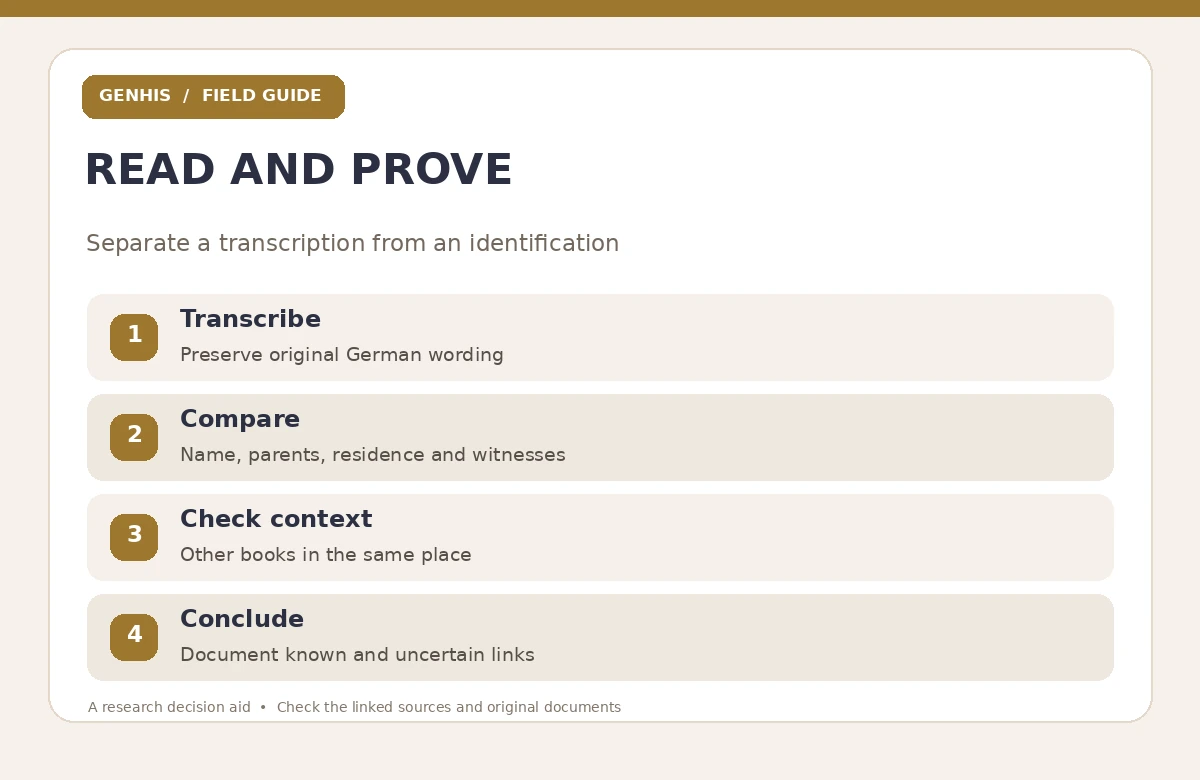
Old German records may be in Kurrent or other historic handwriting styles, with Latin script used for some words or names. First transcribe the date, entry number, names and locality literally. Expand standard abbreviations only when context supports them, and mark illegible letters with brackets rather than guessing. Compare repeated letters in the same writer’s hand. If the register provides a column structure, copy the headings too; otherwise a surname could be assigned to the wrong person on a multi-family page.
A useful example is a hypothetical birth record from Hesse in 1880 whose parents appear as Johann and Anna. Those common names do not identify the immigrant couple you seek. Compare parents’ occupations, mother’s birth surname, residence and witnesses with a known marriage record and later household. Keep the apparent match provisional until these independent features agree. If originals are unavailable, state precisely that the information comes from a catalog or derivative index.

| Record or tool | What it can contribute | What it cannot decide |
|---|---|---|
| Civil birth or marriage | Legally recorded event and parties | Start dates vary across territories |
| Church baptism | Religious event and possible parents | Event date may not be birth date |
| Historical gazetteer | Parish, district and place disambiguation | Not evidence of family residence |
| Emigrant file | Potential hometown or relatives | Reported names require corroboration |
Locate a custodian and document a negative search
Check a local Standesamt, municipal archive, state archive, diocesan archive or church archive according to collection descriptions. Some digitized church books are accessible via named providers, but an archive catalog is the better starting point for checking whether a particular volume exists. Access restrictions and fees may vary by jurisdiction, record age and holding institution, so verify them for the requested record instead of promising universal free viewing or modern online delivery.
When no entry is found, document the books and years actually inspected, the spellings tried and whether the parish boundary changed. A missing baptism may reflect residence in a neighboring parish, damaged pages, a differing confession or a birth outside the stated year. It does not establish that the ancestor lied or left the country. Identify a substitute such as confirmation, residence, marriage or military documents, and state explicitly which parent-child link remains unproved. For a step-by-step method, see how to find Italian parish records beyond civil indexes.
Cite the record and compare cross-border alternatives
For each original page record the event type, name of the register, village, creator, book or volume, entry number, year, image or page, repository and access URL. Preserve a screenshot or transcript for personal research where allowed. Cite both the image and the original collection holder if a website hosts a scan. This makes it possible to recheck a disputed handwriting interpretation without repeating a worldwide surname search.
If evidence places the family in a former German-speaking region now administered elsewhere, repeat the jurisdiction step using that place’s historical state and current archive. The deciding issue is the location and record creator in the target year, not the modern ethnicity suggested by a surname. A well-documented conclusion may only narrow the origin to several parishes; record that uncertainty and test the next documentary clue. For the fuller picture, see our guide “Genealogy Place Names”.
How We Research These Sources
We compared FamilySearch’s German hometown research guidance with its Hesse-Nassau collection description, which distinguishes October 1874 Prussian civil registration from the broader January 1876 rule and recognizes earlier local systems. That historical nuance determines our civil-versus-church decision graphic. The Hesse sample is hypothetical and not a quoted archival entry. Individual holdings, parish limits and access requirements must be confirmed in the custodian’s catalog; no German identity is attributed from a surname alone.
More Research Method Guides
Verified Sources and Privacy Notes
Source descriptions reviewed: FamilySearch German town, historical gazetteer and record-repository workflow.; Hesse-Nassau church and civil records and 1874 versus 1876 registration history.; Hesse civil-registration collection with specific coverage and archival custody.; Illustrative collection limitations; not complete coverage for all German locations.. Historic legal and religious classifications are not modern identity determinations. Do not redistribute living people’s certificates or institutional correspondence without appropriate permission. No affiliate or fee-based resource is promoted in this article; see the site affiliate disclosure for transparency.
No. Prussia used widespread civil registration from October 1874, and some regions had earlier systems. Identify the applicable jurisdiction and year.
Not reliably. Use a historical gazetteer and the ancestor’s confession, locality and date to find the correct parish.
Transcribe clear elements first, compare the same handwriting in adjacent entries and mark uncertain letters instead of inventing a name.
No. German-speaking populations lived across many historical territories, and surnames spread widely by migration.
Original registers, duplicate volumes and transferred books can have distinct custodians. Check the finding aid for each dated series.