
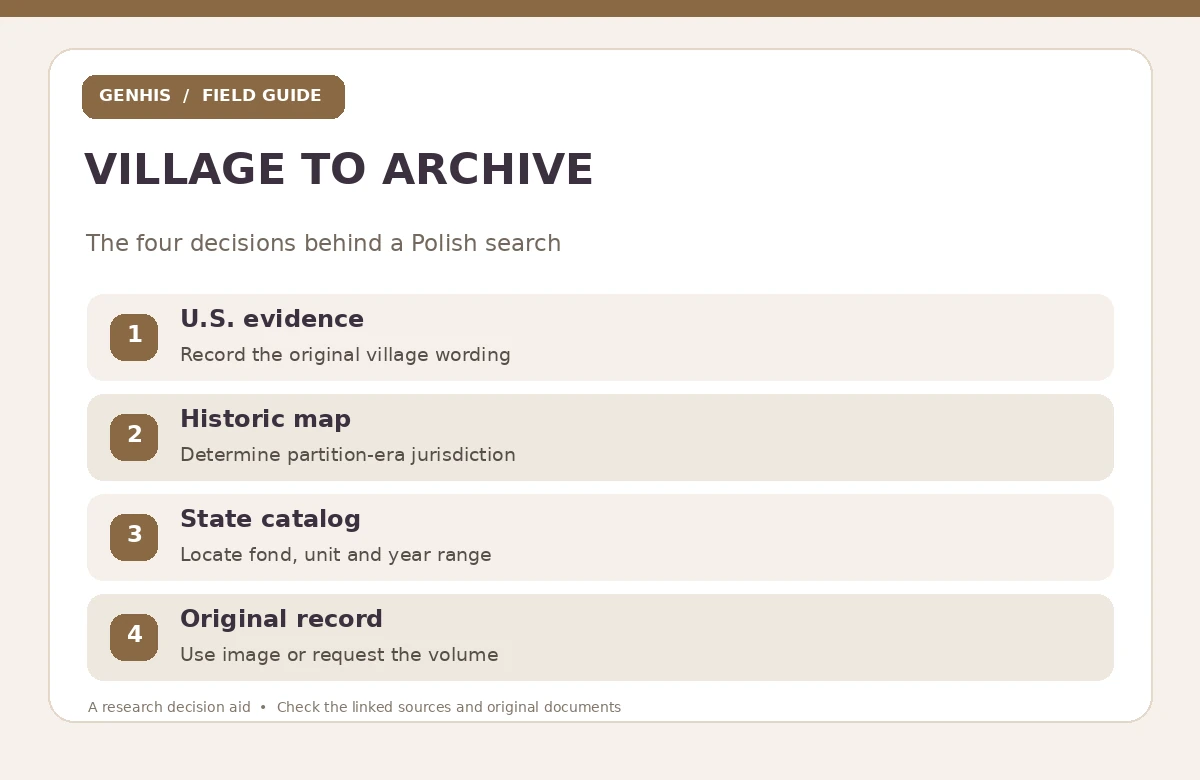
Polish American genealogy becomes much more productive once a family’s actual town or village is identified. An immigrant may have reported “Russia,” “Prussia,” “Austria,” “Galicia” or “Poland” at different times without changing birthplace. These labels can reflect the political authority over the same locality rather than a contradiction about identity. Start with the earliest documented immigrant and connect the place on a U.S. record to the correct historical district. Then use Polish State Archives catalogs, parish and civil registers, and regional indexes to find a particular event—not merely a familiar surname.
Recover the village from U.S. family records
Examine naturalization petitions, ship records, U.S. marriage papers, church registers, draft forms, obituaries and cemetery documents. Copy the exact birthplace or last-residence spelling, including unfamiliar accents or case endings. Cross-check siblings and cousins: one immigrant might name a village while another supplies a province or parish. Keep a table of dates when each place was reported, because it helps distinguish a birthplace from an embarkation point or later home. Our walkthrough on how to find Italian parish records beyond civil indexes sets out each step.
Avoid assuming that the modern Polish spelling will resemble an old English transcript. Village names recur frequently, and immigrant paperwork can label places under the partitioning power that ruled them at the time. “Galicia,” for example, was a historic Austrian crownland with territory now in more than one modern country. Locate the named person in a record contemporary to the family rather than choosing the first similarly spelled village shown on a modern search map.
Rebuild the historical administrative map
Identify the village’s powiat, gmina or other relevant unit and the parish serving it during the target decade, using period maps and archivists’ locality guides. Poland’s borders and systems changed across the partitions and later political changes. A register might be written in Polish, Latin, Russian or German depending on creator and place. Record modern coordinates separately from the archival jurisdiction to prevent the present-day province from being mistaken for a nineteenth-century record series. If you want the full process, read how to find German ancestry records by town and date.
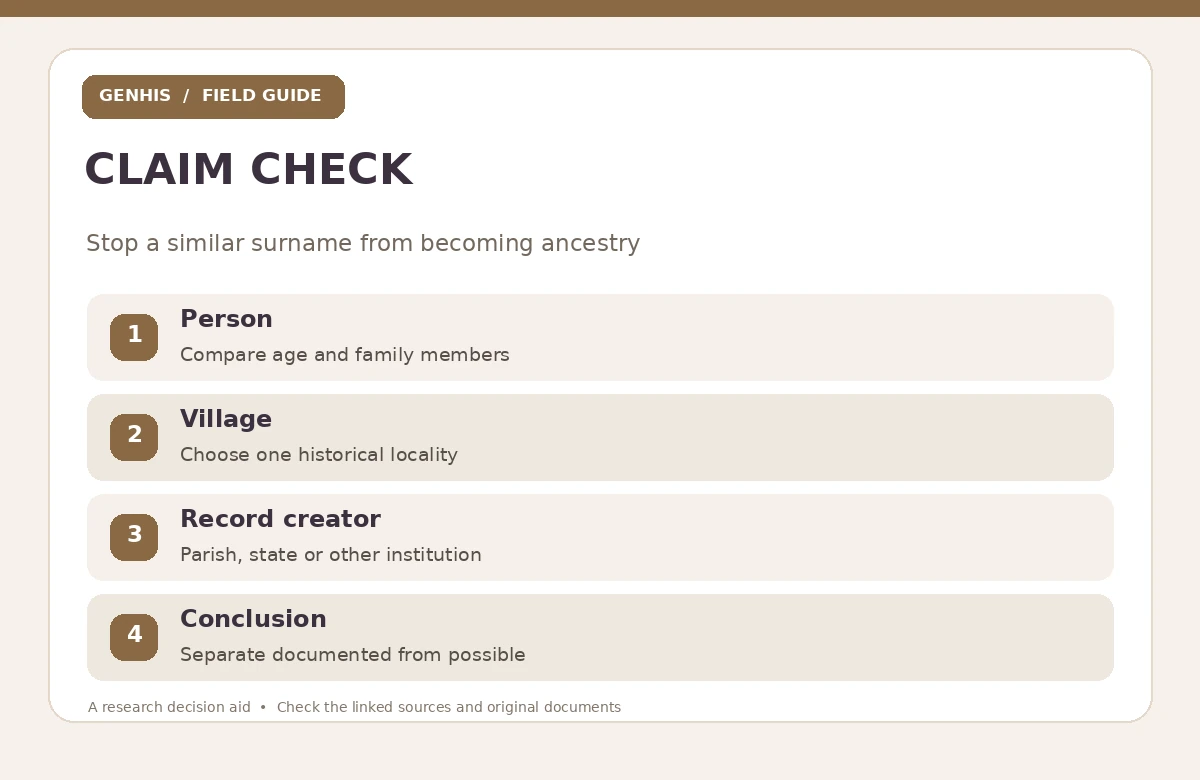
If two candidate villages have the same name, compare nearby towns, the immigrant’s religion, neighboring migrants, occupational clues and the dates when the place existed under that name. A photograph of a gravestone or a church marriage record can give a parish better than a passenger list. When no exact village is known, produce a candidate table and leave the origin unresolved rather than connecting every immigrant with the same surname in one indexed town.
Search the official Polish archive catalog by collection
The National Digital Archives describes Szukaj w Archiwach as a portal for descriptions and scans from Polish archives. Its metadata draws on the ZoSIA archival information system and references PRADZIAD records on parish and civil registration holdings. Search a locality, collection title and dates, then inspect the finding aid to see whether images, inventory only or partial date ranges are available. A portal is not itself proof that every birth in a named parish has been scanned. If that is your next decision, our guide “Polish Birth Records” explains how to find parish and civil acts in state Archives.
When you identify a collection, record the holding archive, fond or unit identifier, title, register type, page or scan and any access restrictions indicated there. If an image is absent, use the description to contact the named archive about the particular unit. Do not assume that a blank name-search result means the register is lost; it may be unindexed or cataloged by parish, district or archive series instead of by individual surname.
Use Geneteka and local indexes as finding aids
Polish genealogical volunteers have indexed large numbers of parish and civil events. The Polish Genealogical Society of America lists Geneteka among useful national and regional surname-search resources. Start by selecting the likely region and time span. Try recorded spellings rather than invented Polish equivalents and compare parents or spouses supplied by the index. An index can point to a register, but transcription and coverage vary between volunteers and collections.
If a promising entry appears, determine whether a scan or archival citation exists and seek the original. Check the entire book heading and adjacent entries, particularly if the locality had multiple religious communities or similarly named people. Do not claim a lineage because an index gives a rare surname; the mother’s family name, groom’s parents or witnesses may disprove that apparent match. Save the index result with its retrieval date as a search lead separate from the original record citation. For a related choice, see our guide “JRI-Poland Search”.

| Record or tool | What it can contribute | What it cannot decide |
|---|---|---|
| U.S. immigration sources | Possible village, relatives, former nationality | Last residence can differ from birthplace |
| Szukaj w Archiwach | Collection descriptions and available scans | Catalog entry does not mean complete index |
| Geneteka | Candidate birth, marriage and death entries | Volunteer indexes need image verification |
| Historic parish or civil book | Specific event and named relatives | Language, creator and survival vary |
Recognize languages and religious jurisdictions
Catholic, Protestant, Jewish and other communities maintained different records, and government offices created civil registrations according to the legal system then in force. Ask what kind of event you need: baptism, marriage, burial, civil birth or residency. The archive that holds one set may not hold the other. Historical Latin terms, Cyrillic script and Germanic handwritten forms require careful transcription and context-sensitive translation rather than phonetic guesses. Our guide “Ashkenazi Ancestry Research” covers a related question.
In a hypothetical case, an American marriage certificate names parents Jan and Katarzyna, but a Polish index lists a bride with the same name in another district. A correct link needs more than first names: compare place, age, spouse, mother’s surname and other independent records. If two candidates remain, keep separate profiles. Distinguish the identity of a named person from any religious or ethnic label recorded by officials; such classifications reflect their administrative setting. Our walkthrough on how to research Hispanic ancestry across countries and records sets out each step.
Create a reproducible Polish repository request
Organize one folder per confirmed locality with period maps, alternate spellings, Polish administrative terms and a register inventory. For each relevant item include creator, archive, fond, unit, year, entry number or image and an exact URL. When writing to an archive, include a concise family question, verified names, a narrow date range and the catalog reference. Ask whether a scan or authorized reproduction can be provided instead of making an open-ended request for an entire family tree.
A successful research session may identify the exact church book even when it does not yield a name match. Log which indexes and date ranges were actually searched, what was found and which years remain unexamined. Historical borders mean that a documented ancestral locality might now lie outside Poland; in that case follow the custodian and legal context for that place instead of assuming modern country labels determine the old record’s location. For a step-by-step method, see how to research Jewish genealogy across names, towns, and archives.
How We Research These Sources
Our checklist follows the National Digital Archives explanation of Szukaj w Archiwach, its archival descriptions and ZoSIA/PRADZIAD metadata, supplemented by the Polish Genealogical Society of America’s archival and Geneteka directory. It differentiates historical partition labels from a modern passport nationality and a digital catalog from a surname index. Jan and Katarzyna are hypothetical names, not a real connected family. Exact village, book, scan availability and archive jurisdiction remain specific questions for each search.
More Research Method Guides
Verified Sources and Privacy Notes
Source descriptions reviewed: Polish National Digital Archives description of state archival search, scans, ZoSIA and PRADZIAD.; Polish Genealogical Society of America guide to archival and church repositories.; PGSA listing of Geneteka and other region-specific Polish genealogy indexes.. A historical classification of religion or nationality may reflect the registrar’s political setting rather than how a family identifies today. This guide does not ask readers to expose documents about living relatives. The external archival resources are informational, not sponsored; consult the site disclosure for the broader transparency policy.
Political control of ancestral regions changed. Such labels may refer to state authority at a particular date, not a new birthplace.
No. It describes and hosts selected holdings and scans. The specific collection and date coverage must be checked.
An index is a strong lead, but the original record and supporting identity evidence should be examined before concluding kinship.
Compare historical district, parish, migration associates, dates and family records to distinguish candidates.
An identified locality, event type, documented names, narrow year range and the cataloged fond or unit when known.