
An autosomal DNA test can compare inherited genetic markers with other testers and produce two very different kinds of output: a relative-matching list and a statistical ancestry estimate. For genealogy, the match list can suggest branches to investigate, while the ethnicity panel is mainly a broad population-comparison clue. Neither feature names an ancestor on its own. Before buying a test or interpreting results already held, decide whether you need a documented cousin connection, a geographic research clue or a way to test a specific family-tree hypothesis. The answer changes what you should record and what further sources you need.
What the autosomal test actually examines
Autosomes are the chromosomes other than the sex chromosomes. Consumer ancestry testing typically samples large numbers of common genetic variants and compares them against other individuals’ data or reference populations. A company’s report may show total shared DNA with another tester, sometimes in centimorgans, as well as an estimated relationship category. The test observes genetic similarity; it does not read the birth certificate of a shared grandparent. Test platforms also differ in their matching thresholds, databases and reporting methods, so two services need not produce identical match lists.
Most people inherit autosomal DNA from both biological parents, and recombination changes which stretches pass to each generation. This makes autosomal testing useful across many family branches but limits visibility farther back. An actual fifth cousin might not appear as a detectable match, while a comparatively modest shared amount could fit several genealogical relationships. If a result seems inconsistent with the tree, check how the tree was documented, whether more than one ancestral line is possible and whether the reported figure uses the same measurement conventions as the chart you are consulting.
Interpret the match list before using the tree
Start with the features the test actually gives you: shared total, any segment-related information provided, the estimated range of relationships and the existence or absence of shared matches. Record them in a private worksheet without publishing another test-taker’s account information. Treat an attached family tree as a lead to records; its names and dates may be incomplete, copied or misattributed. A true DNA match can be paired with an inaccurate documentary tree. Compare the historical places and generations in the proposed line before deciding which branch deserves the next search. Our guide “Genetic Genealogy Explained” goes into more detail.
For a simple teaching illustration, suppose an anonymous test reports 215 cM shared with another tester. That number is not a certificate saying ‘second cousin’; the Shared cM Project shows ranges that overlap among several types of cousins and other relatives. First ask whether the documented generations make each possibility chronologically reasonable. Then compare independently sourced ancestral lines and consider the possibility of multiple connections. The safest output is a ranked list of questions and records, rather than a newly assigned parent for someone who lived a century ago. If you want the full process, read how to read a centimorgan chart and compare cousin relationships.
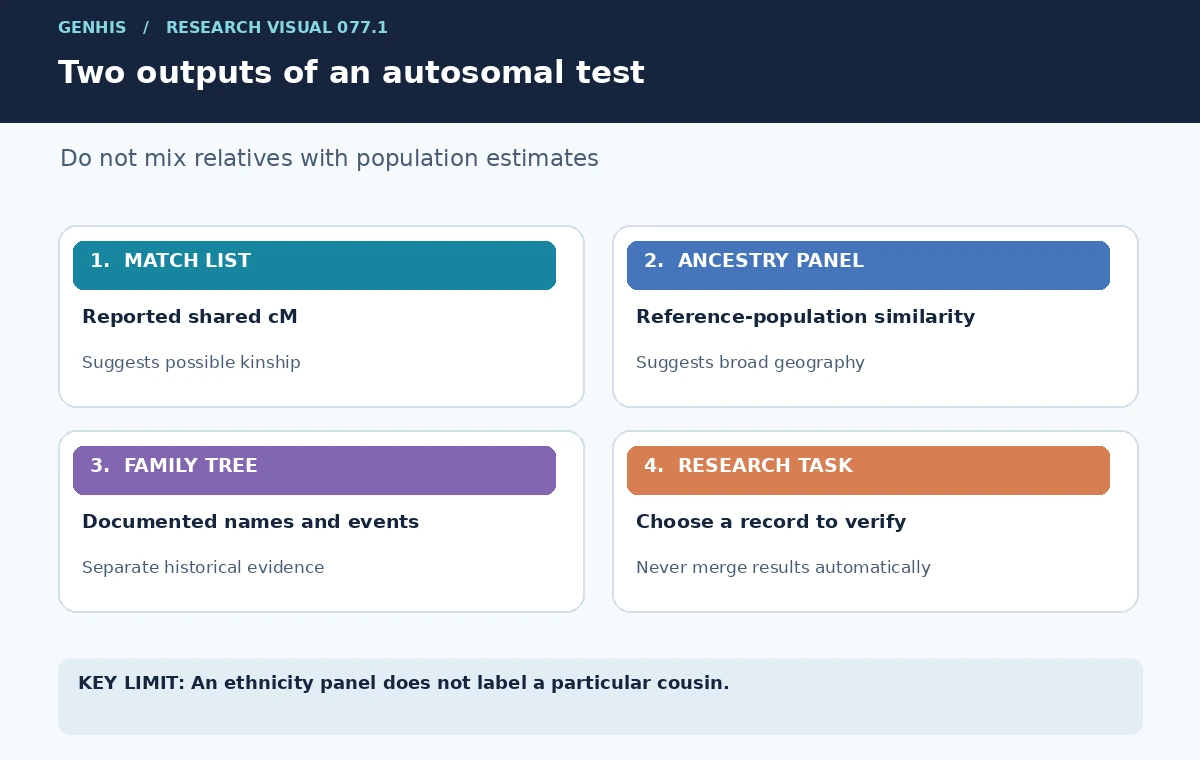
Choose an appropriate next record search
Build a two-column research plan: ‘DNA observation’ and ‘document needed.’ For a possible common great-grandparent, that document might be a marriage entry connecting one branch or probate papers placing a person in a household. For a migration hypothesis, it could be an original arrival list plus later census and naturalization records. If the candidate’s place of birth is unclear, avoid relying on a modern surname map or broad ethnicity panel. Each candidate relationship must survive independent scrutiny using the jurisdiction, event date and primary record wherever available.
A useful log keeps failed searches, too. Note exact collection titles, years covered, name spellings attempted, index limitations and the original image if examined. If multiple hypotheses survive the DNA evidence, document the unresolved alternatives instead of forcing a single relationship. FamilySearch explicitly treats DNA findings as complementary to documented family history; this approach keeps your next action directed at an actual gap in proof. It also protects against copying unverified living-person family details from another tester’s public profile.
Why different testers get different matches
Two siblings inherit different mixtures of their parents’ autosomal DNA. They therefore may see overlapping but not identical distant match lists even when the underlying family tree is the same. Database participation also differs: a known cousin who never tested with your service may not appear there. Provider algorithms and minimum reporting thresholds add another difference. No match is not a universal statement that two people are unrelated, especially for distant genealogical cousins. The correct conclusion may simply be that the available test and database did not detect sufficient sharing.
Comparison between sites requires care. One platform might report percentages while another uses cM totals or a proprietary relationship estimate. Before converting figures, read that platform’s explanation of what is counted. Do not use the reported relationship label as if it were a uniform legal degree of kinship, nor assume that upload support or privacy defaults have stayed constant. This article deliberately does not recommend a brand or instruct users to transfer raw genetic data between services: those decisions involve current consent and security terms beyond this introductory method.

Decide what ethnicity output can and cannot answer
An autosomal ancestry report compares a person’s variant patterns with a company’s sampled reference groups. Results are estimated similarities to represented populations, not a complete list of individual ancestors. MedlinePlus identifies differences in reference databases and historical population migration as reasons estimates can vary by company. A category label also cannot establish a family’s legal, cultural, religious or tribal identity. Keep population estimates separate from the documentary evidence table; a percentage is not a substitute for the named people and events required by historical genealogy. Our guide “DNA Ethnicity Percentages Explained” adds more detail on this.
Ethnicity panels may still help identify broad research questions when used modestly. A result that seems unfamiliar might prompt a review of records for migration, name variation or a previously overlooked region. But it is not an instruction to replace a documented ancestor, and small percentage changes after a company’s database update should not be interpreted as an ancestor appearing or disappearing. The more rigorous next step is to seek independently dated records and keep uncertainty visible, especially when a population is poorly represented by the reference samples.
More DNA Genealogy Guides
How We Research consumer autosomal results
We separate the existence of a reported match from an inferred family link and from a statistical reference-population estimate. MedlinePlus Genetics describes autosomal-marker testing and its population limits. FamilySearch explains why DNA complements traditional family research. DNA Painter’s Shared cM Project illustrates overlapping relationship ranges. All numerical examples here are fictional teaching scenarios, not real test results. The article provides no medical interpretation or consumer product endorsement. See the site’s affiliate disclosure; no affiliate DNA link is used.

Yes. It examines DNA inherited across many branches, although inheritance and recombination limit the ability to detect increasingly distant connections.
No. Shared-centimorgan relationship ranges overlap, and several possible genealogical relationships can fit a total in that neighborhood. Documents and generational structure are needed.
Siblings can inherit different segments from their parents, and matching platforms may use different thresholds. As a result their detected distant cousin lists may differ.
No. One compares genetic patterns with sampled reference populations; the other compares shared segments with participating testers. The genealogical claims they support are different.
That is a separate privacy and consent decision requiring review of current service terms. This educational article does not instruct or recommend uploading raw files.