
A long DNA match list becomes useful only when every entry has a traceable status and a next research action. Sorting hundreds of testers by total shared centimorgans is not the same as establishing which grandparents connect them to your family. A practical organization system separates observed platform data, documented genealogical relationships, and unresolved suggestions. This guide builds a minimal spreadsheet and a cautious shared-match cluster system that works without downloading raw genetic files or exposing information about living people.
Design a match log before naming family branches
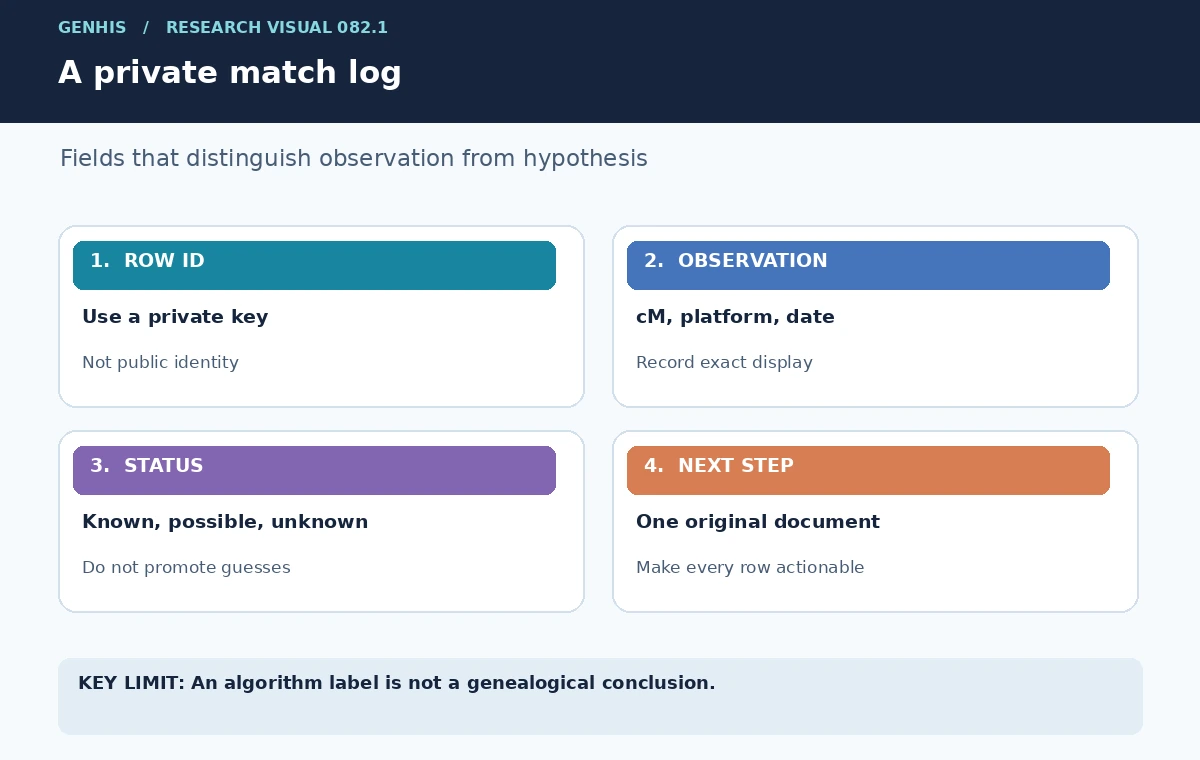
Start with a private table and a unique internal row ID. Include the test provider, observation date, total shared cM, source display name or private identifier, estimated relationship range, reported shared-match group, documentary link, confidence status, and next step. Add a field for which platform screens were examined and when; interfaces and algorithms can change. Keep private contact information in a secured separate location rather than replicating it across several spreadsheets or publishing it in a public family tree.
An especially useful column is ‘what the platform actually showed.’ If the service reports 126 cM, write ‘126 cM reported’ rather than ‘second cousin.’ If it reports a suggested maternal side, label that as a provider assignment until you can check against known relatives. Avoid treating a newly added public-tree hint as an original source. Write the title of a historical record, its repository, date, and the specific assertion it supports. This makes your sheet an evidence log rather than a list of exciting guesses.
Sort matches by useful and repeatable questions
Choose a first pass that answers a particular genealogical question. Someone investigating a missing great-grandparent may prioritize established relatives with fully documented lines; another user may begin with unfamiliar but sizeable matches whose tree contains a verifiable place and time. Prioritizing solely by match count creates work without direction. Filter by the problem, the documentary coverage, and whether a match contributes independent information. Save a snapshot of your criteria so you can repeat the review after new results arrive.
In a hypothetical teaching example, three anonymous matches report 168, 122 and 105 cM. Put the amounts in one column, but do not assume those three people form one cousin branch. Make a second field for which pairs appear in shared-match lists and a third for any historical ancestral couple supported by independent sources. You may find that two entries belong to one network and the third is related through a different line. None of the invented amounts is an instruction to identify a living person. Our guide “Third Cousin DNA Matches” goes into more detail.
Build color clusters without overclaiming their meaning
A shared-match cluster is a set of match-list relationships, not a named genetic segment. Genealogist Dana Leeds describes a color clustering procedure in which an initial match gets a color, that match’s shared matches receive the same column color, and the process repeats with unassigned matches. Her original Leeds Method explanation used a particular intermediate-cousin range for an AncestryDNA workflow; it is not a universal cutoff, and providers vary in how they display shared matches.
Label columns neutrally as Cluster A, Cluster B and so on until documents justify a family side or ancestor. A tester can appear in several clusters because people may be related along more than one historical line. ‘Shared matches’ can also be affected by minimum reporting thresholds and database membership. A color does not demonstrate that all participants share a particular chromosome segment; that requires segment-level comparison where available. Do not rename a cluster ‘Grandfather X’ solely because one member uses that surname in an unsourced tree. Our guide “Chromosome Browser for Genealogy” goes into more detail.

Turn every cluster into a document test
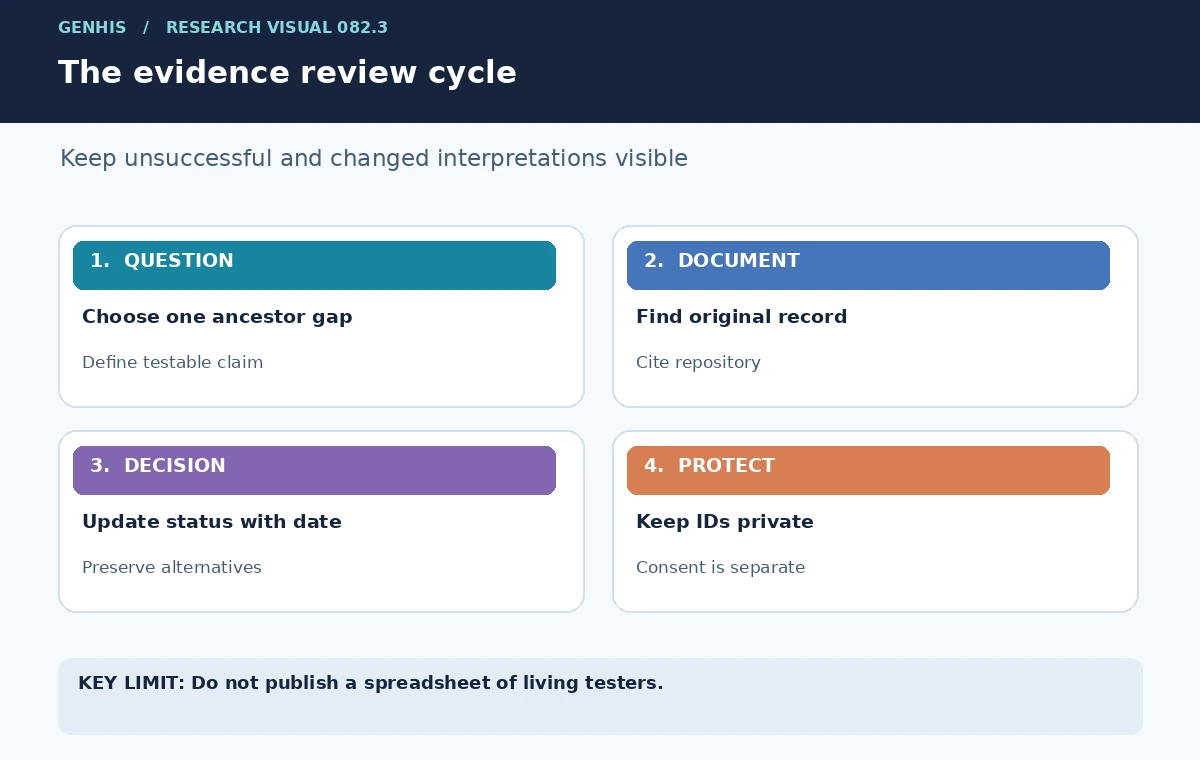
For each cluster, choose one working hypothesis and one original-document search that could challenge it. If several match trees independently name a settlement, check whether the spelling and boundary were correct in the historical period. Search a relevant register, household schedule, or land or probate record for the exact generation that needs connecting. Use a separate evidence field to distinguish ‘place reported by another tester’ from ‘place stated in a primary historical document.’ A failed search still belongs in the log because it may reveal an archive coverage gap.
Set an explicit status vocabulary: observed, untested, partly supported, supported by identified documents, and contradicted. A color-cluster assignment can remain ‘observed’ while the ancestor hypothesis remains ‘untested.’ When conflicting evidence appears, do not erase the prior version; date the update and explain why it changed. The result is a small audit trail that someone else could repeat with access to the same records. If the information is too personal for publication, describe the method publicly while keeping match-specific data private. Our guide “DNA Triangulation Explained” goes into more detail.
For a manageable weekly review, pick just five entries with a plausible historical location and an unresolved documentary step. Enter the collection to search and its known date coverage before opening more matches. After looking at the original images, record a positive find, a genuine conflict, or the precise search that returned nothing. Only then consider changing a cluster name. This prevents an expanding list of hints from replacing an answerable research question. A cluster that produces no identifiable records is not worthless; it may reveal where coverage is missing or where the hypothesis is too broad.
More DNA Genealogy Guides
How We Research responsible DNA organization
This workflow follows the original Leeds Method overview and the creator’s practical guidance on sequence numbers and known versus unknown labels. For the distinction between shared matches and actual segment triangulation we checked FamilyTreeDNA’s explanation of its Matrix. The recommended spreadsheet columns are an editorial research design, not a claim that a specific test company exposes those same fields in its current interface.
The value of organization is a repeatable choice: which uncertain ancestor question deserves a specific original record next? This page does not ask readers to collect raw genomic files, contact an unknown living person, or publish a relative’s identity. Keep all permission and privacy decisions outside the genealogical inference process. Citations to source documents should say what they actually contain. Our affiliate disclosure explains relationships; this guide requires no linked paid product or unverified partnership.
No. The essential fields can be maintained privately in many spreadsheet or note applications; make sure storage is secured and accessible to authorized researchers only.
No. The method groups shared-match patterns. A named ancestral branch must be supported with reliable documentary relationships.
Record it as the platform estimate in the observation column, not as an established genealogical link.
Multiple genealogical paths, shared-match reporting behavior and complex historical pedigrees may produce overlapping groups; inspect the records before interpreting them.
Review when new results or original records address a specific hypothesis, documenting the date and why any status changed.