
A DNA ethnicity percentage is an estimate of how similar parts of your genetic profile appear to the reference populations used by a particular analysis. It is not a count of ancestors, a direct measurement of nationality, or proof of a person’s cultural or tribal identity. Different services can report different percentages because their sample sets, geographic categories and methods differ. The most useful way to read an ethnicity report is to ask what comparison was made, how uncertain the category is and which documented family-history question—if any—the result suggests. Keep the report separate from your proven family tree.
What the percentage actually describes
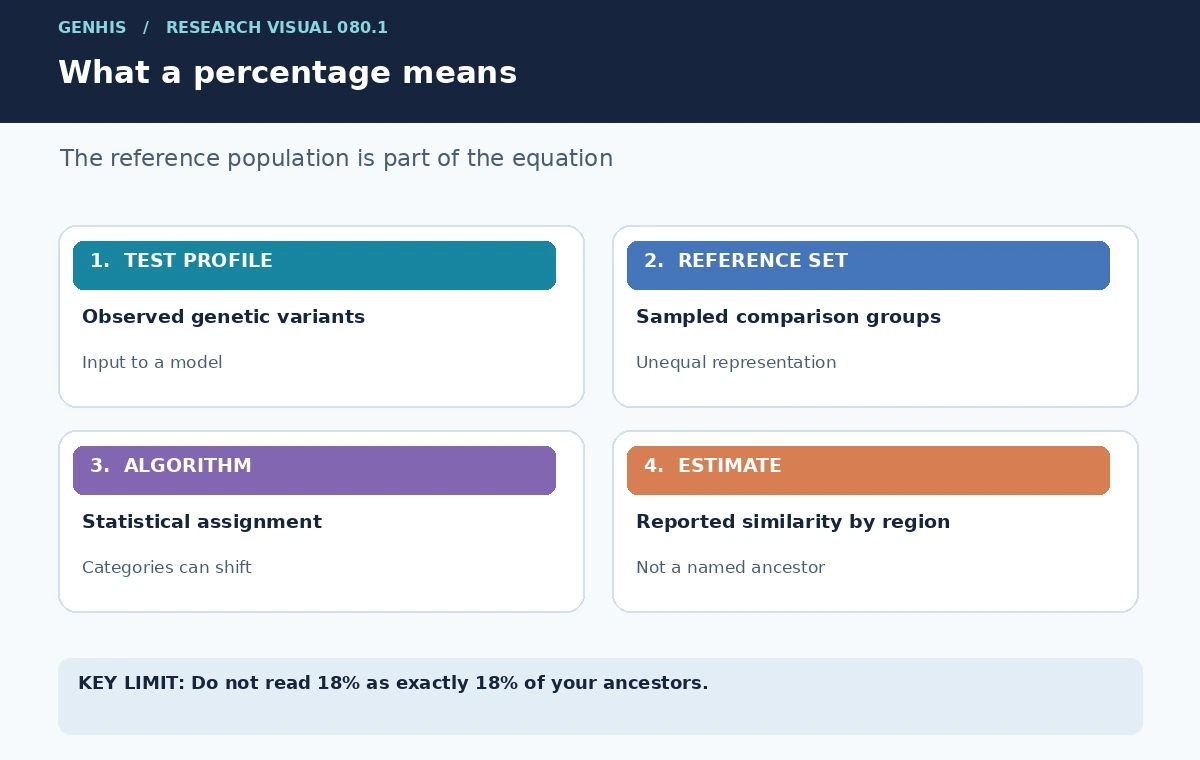
A testing company analyzes genetic variants and compares patterns with groups of individuals selected as reference populations. The output assigns statistical similarities across named regions or groups. A displayed ’18 percent’ should not be read as ’18 percent of my known ancestors were born in that nation,’ since ancestors do not contribute DNA in neat, equal surviving portions over many generations. Nor does a region label certify that a specific great-grandparent belongs to it. The figure describes the company’s current statistical model for the tested person’s genetic profile.
The reference groups themselves are not uniformly sampled from the whole world. Some regions have extensive data; others have less informative samples, and neighboring groups may share genetic patterns. MedlinePlus Genetics explains that companies may use different reference databases, with changing representation and methodology. Consequently, the same person can receive distinct estimates from separate companies. Differences are not by themselves evidence of fraud or of a changed family history; they often reflect different analytical classifications.
Understand why reports can change over time
A company can update its reference population dataset, change how it groups regions or revise the algorithm assigning genetic segments to categories. Your inherited DNA remains the same, but the statistical labels and percentages can shift. An apparent new geographic category is not the discovery of a new ancestor; a category disappearing after a software update is not evidence that the ancestor vanished. Keep a dated copy of the report’s descriptions and uncertainty information if you intend to compare versions later, and avoid presenting a screenshot without its analysis date.
A useful log has ‘reported category,’ ‘percentage or range,’ ‘report date,’ ‘provider method description,’ and ‘confidence/uncertainty notes.’ Add a separate column for historical documents that actually name a person and a place. Do not overwrite a dated birth record merely because the ancestry analysis maps a segment to a neighboring country. A historical family may have crossed borders, used different languages and recorded locations under multiple governments; modern genetic reference labels and historical administrative geography answer different questions.
Distinguish region, citizenship and identity
Genetic ancestry, citizenship, language, ethnicity, religion and community membership are not interchangeable. A person may identify with a culture because of family upbringing and history regardless of how a statistical test labels their genetic profile. A reference population is not a legal register of national affiliation, nor does a small percentage establish enrollment eligibility in an Indigenous nation or any other community. NHGRI emphasizes that population categories are proxies developed for particular research purposes and that people choose how they identify.
This distinction matters in family storytelling. A family may have well-documented ancestors from a historical borderland now administered by another state. A DNA report might use a broader region or a name that did not exist at the ancestor’s date. Treat the report as a modern comparison, not a correction of their own recorded place or identity. Avoid assigning a community, religion or legal status to an ancestor based on a probabilistic ethnic estimate, especially where that assertion could misrepresent a living group or a historically marginalized population.
Use a hypothetical estimate to choose better research
Imagine a fictional report showing 60 percent assigned to one broad region, 30 percent to another and 10 percent spread across neighboring regions. Those figures are not evidence that exactly six of ten ancestors came from the first region; there are not ten equal genetic ancestor slots. A careful reader might instead ask whether known migration records or marriages illuminate why the family lived near the boundaries of those labels. The appropriate sources are dated civil registers, parish books, passenger records and local histories, not a rewritten ancestry percentage.
Now imagine that a company revises the fictional 10 percent group into two new categories the next year. The documented names and family relationships should stay unchanged unless new historical evidence warrants an update. Record the model revision as information about the genetic report itself. If you find no evidence for a proposed region, the truthful outcome is ‘unresolved.’ A statistical percentage should not be stretched into a convenient origin story, especially when a dramatic narrative might travel farther than the limitations attached to the original analysis.

Compare services without creating false precision
The number of decimal places on a report is not an index of real historical certainty. A single decimal might appear scientific while representing a category whose boundaries are blurred or whose underlying population is unevenly sampled. Look for the service’s published explanation of how reference groups were assembled and whether alternative assignments or uncertainty intervals are supplied. Two companies may not even mean exactly the same territory by a similarly named label. Before contrasting ’12 percent’ with ’14 percent,’ check whether the groups and time frames are comparable.
Percentages across different reports should not be averaged to manufacture a ‘more accurate’ ancestral identity. Nor is it reliable to divide a result by four or eight and assign percentages to individual grandparents or great-grandparents. DNA is inherited through recombination, and far-back ancestors may contribute little or no identifiable autosomal material. Keep historical claims grounded in documents: names, event dates, jurisdictions and family links. Use the estimate only as a cautious prompt to look for more evidence when it points to a reasonable, independently testable question. Our guide “Autosomal DNA Tests for Genealogy” adds more detail on this.
Keep genetic data handling proportionate
An ancestry estimate is about a living person’s sensitive genetic information even when the research objective is historical. Do not share someone else’s full report, raw data or private match details without their informed permission. Avoid public screenshots with account names, kit identifiers or living relatives’ profiles. Review the chosen service’s current privacy and data-use terms before deciding to save or share genetic files, and recognize that family members may have different preferences. This guide does not advise ways to identify living individuals or infer health conditions from inherited markers.
In a family-history book or website, you usually need only the defensible historical conclusion, not a roster of private DNA results. If mentioning the role of genetic analysis is appropriate and consented to, describe its limitations and avoid presenting an ethnicity chart as a scientific ancestry certificate. When a record says one thing and a percentage suggests another, prefer a research question over an accusation. The goal is historical accuracy and respect for the people connected to the family, not maximizing dramatic claims from a proprietary estimate. Our walkthrough on how to research native American ancestry using tribal and federal records sets out each step.

More DNA Genealogy Guides
How We Research population ancestry estimates
MedlinePlus Genetics explains how autosomal ancestry tests compare variants with reference databases and why results vary across providers. NHGRI’s population-descriptors discussion documents the statistical and social limits of ancestry categories. FamilySearch emphasizes returning to documented family history. Examples here are imaginary and describe no actual living person’s DNA. Nothing constitutes medical interpretation, ethnic certification or partner marketing. Read the site’s affiliate disclosure.
No. The percentage is a model-based comparison, not an equal-count breakdown of named ancestors. Recombination and uneven reference population data prevent such simple conversion.
The company may have revised reference groups, categories or algorithms. That changes the reported estimate without changing your DNA or rewriting the documentary family history.
No. Genetic similarity does not determine citizenship, enrollment or community identity. Those questions depend on the applicable community’s own rules and evidence.
Not necessarily. MedlinePlus notes that providers differ in reference datasets and population coverage, so estimates for the same person may not agree.
Preserve the report date, read uncertainty information, pose a specific historical question and seek dated records. Do not replace verified ancestors solely because of a population estimate.