
DNA triangulation is a stronger question than simply asking whether two people appear in your shared-match list. In segment triangulation, at least three testers are compared to see whether each pair shares the same relevant stretch of DNA, with enough evidence that the overlaps reflect one inherited segment rather than unrelated coincidences. Even when the segment condition is met, genealogical records are still needed to identify a common ancestral line. This article is a testable comparison workflow, not a method for exposing an unidentified living relative.
Distinguish shared matches from triangulated segments
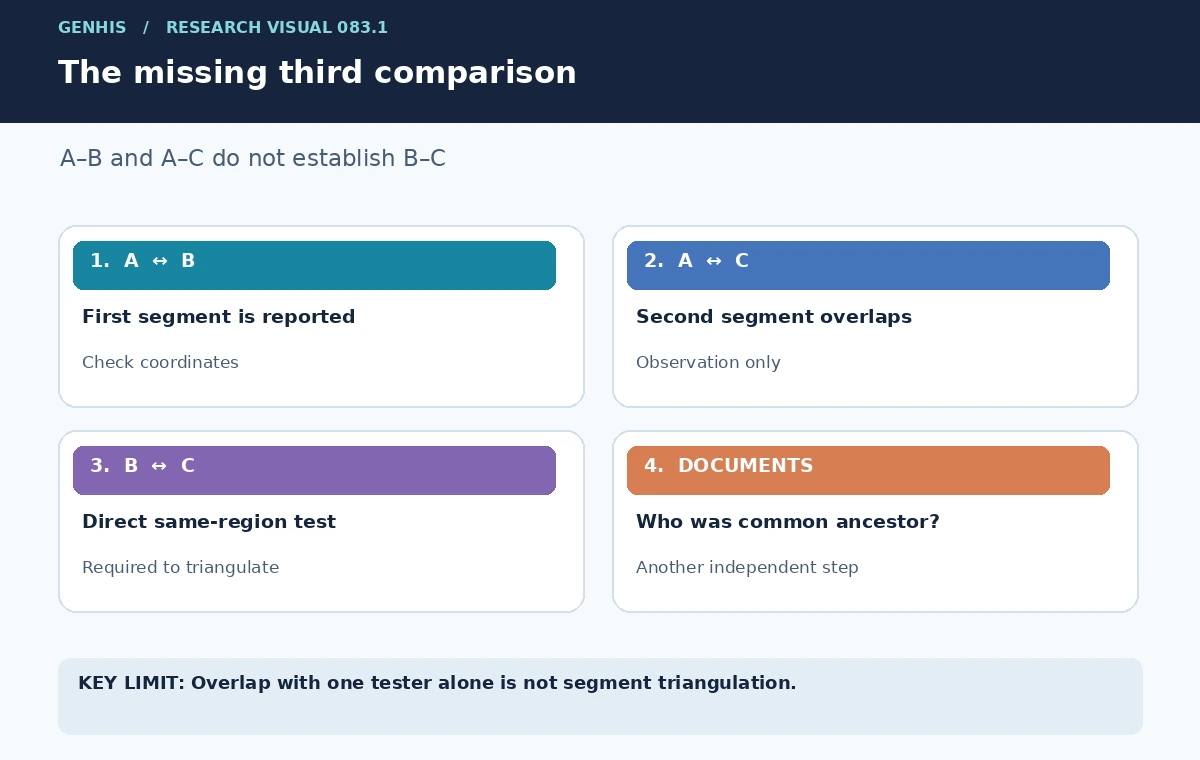
Suppose A is the person whose DNA was tested and B and C are two matches. A matching B and A matching C does not establish that B matches C. A shared-match list may indicate that the two individuals match somewhere in their genomes, but not necessarily on the exact stretch each shares with A. Even a chromosome browser view of two overlapping colored bars against A may reflect different parental chromosome copies. The FamilyTreeDNA Matrix explanation specifically warns that displayed overlap by itself is insufficient.
‘Triangulation’ can also refer to comparing documentary pedigrees or to methods involving Y-DNA, so state which kind you are discussing. The procedure here concerns autosomal segment triangulation only. A useful observation checklist has three pairwise comparisons: A–B, A–C and B–C, plus the relevant chromosome and coordinates. If you cannot obtain a verified B–C comparison for the target segment, the group remains an overlapping-match candidate rather than a confirmed segment-triangulation result. If that is your next decision, our guide “Chromosome Mapping for Genealogy” explains how to label only proven lines.
Compare all three pairings on one location
Choose a sufficiently well-supported reported match segment and record the chromosome, beginning coordinate, ending coordinate, cM length, and platform that reported it. Then look at A–B and A–C on the same coordinate interval. Finally, where the service and tester permissions allow, verify whether B–C share that same interval. The pairwise comparison must be on the same stretch, not merely ‘they match somewhere.’ Record whether each measurement comes from the same reference genome build because raw coordinates are not interchangeable across builds without translation.
For a fictional example, A–B spans chromosome 7 from 40 to 68 units on a teaching diagram and A–C spans 52 to 75 units. Those intervals overlap on 52–68, but no amount of overlap can tell you whether B matches C there. A B–C comparison is the missing test. The example uses invented coordinates, not actual genetic measurements or persons. It demonstrates the logic of the three-edge triangle while avoiding a misleading promise that sharing one visual region identifies a particular great-grandparent.
Watch for two parental copies and false positives
Most autosomal chromosomes occur in maternal and paternal copies. A chromosome browser can paint matches against a combined view without revealing which copy carries the shared region. B might match a stretch of A’s maternal chromosome while C matches a similarly positioned stretch of A’s paternal chromosome. Their bars could overlap on the screen without supporting one inherited segment through a single ancestor. Phasing with documented parental relatives can help when data are available, but it does not replace actual pairwise comparisons.
Very short reported segments also warrant care. ISOGG’s discussion of identical by descent distinguishes a genuine inherited segment from an identical-by-state or technical artifact. Thresholds and detection behavior differ among platforms; avoid announcing a universal ‘safe’ cM cutoff. Historical endogamy, a second family connection, or a chance match can complicate interpretation. Record the threshold and source of each displayed segment, then describe results proportionately rather than assuming they are all equivalent quality.

Link a triangulated group to historical documents
Even a convincing segment triangulation group establishes neither a named ancestor nor a single ancestral couple. Each tester could have incomplete pedigree branches or share more than one historical line. Build a small evidence matrix: tested pair, segment confirmed, proposed common line, independent original records supporting that line, and competing lines not yet ruled out. Look for people who descend through separate documented children of a candidate couple; such paths are more informative than copying the same public family tree into three columns.
When a segment group is supported but the historical common ancestor is still missing, state that result directly. Search for the first documentary connection absent from the branches, not for an attractive surname. A census, registration, parish entry, probate distribution, or migration record may narrow the connection, depending on place and period. If segment access or informed consent is missing, the honest conclusion is ‘triangulation not tested.’ That is scientifically clearer than claiming to have confirmed what the available comparisons cannot show.
A useful stop rule protects against false confidence: if only two of the three pairwise segment comparisons exist, call the result an overlapping-match candidate and do not use the word ‘confirmed.’ If a third pairing is available but reports several different segments, identify which coordinates correspond to the target region before considering the comparison resolved. Keep both the observed intervals and the unanswered question in the research log. This also helps later reviewers distinguish a truly confirmed segment group from a chart that merely looks persuasive. Our walkthrough on how to organize DNA matches with a private evidence log sets out each step.
More DNA Genealogy Guides
How We Research segment triangulation claims
We checked FamilyTreeDNA’s Matrix update for the distinction between matching A and actual pairwise match confirmation, and the ISOGG triangulation discussion for the distinction between segment and genealogical triangulation. The workflow treats a display overlap as an observation, an all-pair segment comparison as stronger evidence, and a named ancestral line as a separate documentary hypothesis. Those three evidence levels should not be compressed into one sentence.
The drawings use hypothetical test labels rather than real matches, and they are conceptual: they are not raw DNA, probabilities, or medical interpretations. Interface availability varies and should be verified in the reader’s own provider account before taking action. Protect the consent of every tested person; do not publicly publish coordinates or identities tied to an individual’s genetic profile without permission. Our affiliate disclosure is provided for transparency; no affiliate tool is needed for the research logic.

Frequently Asked Questions
No. A shared-match list can indicate a connection somewhere in the genome without confirming identical intervals shared across all three testers.
For three testers A, B and C, the relevant interval needs A–B, A–C and B–C assessment, with comparable segment information.
No. The segments could come from different parental copies or B and C might not share that segment with one another.
No. Documentary pedigrees and comparisons of alternative ancestral paths are needed to propose a named ancestor.
Yes. Matching thresholds and technical factors can produce false positives or coincidental matching, so short segments require extra caution.