
JRI-Poland search is a powerful way to discover candidates in indexed Jewish vital records, but it does not automatically show the original birth, marriage or death entry. On the current JRI-Poland search page, you can begin with a surname, given name or town; Beider–Morse phonetic matching helps find spelling variants. The search is free, while a free researcher account is required to view full results. Treat each hit as a direction to a town, register, year and archive, then examine available scans before making a family claim.
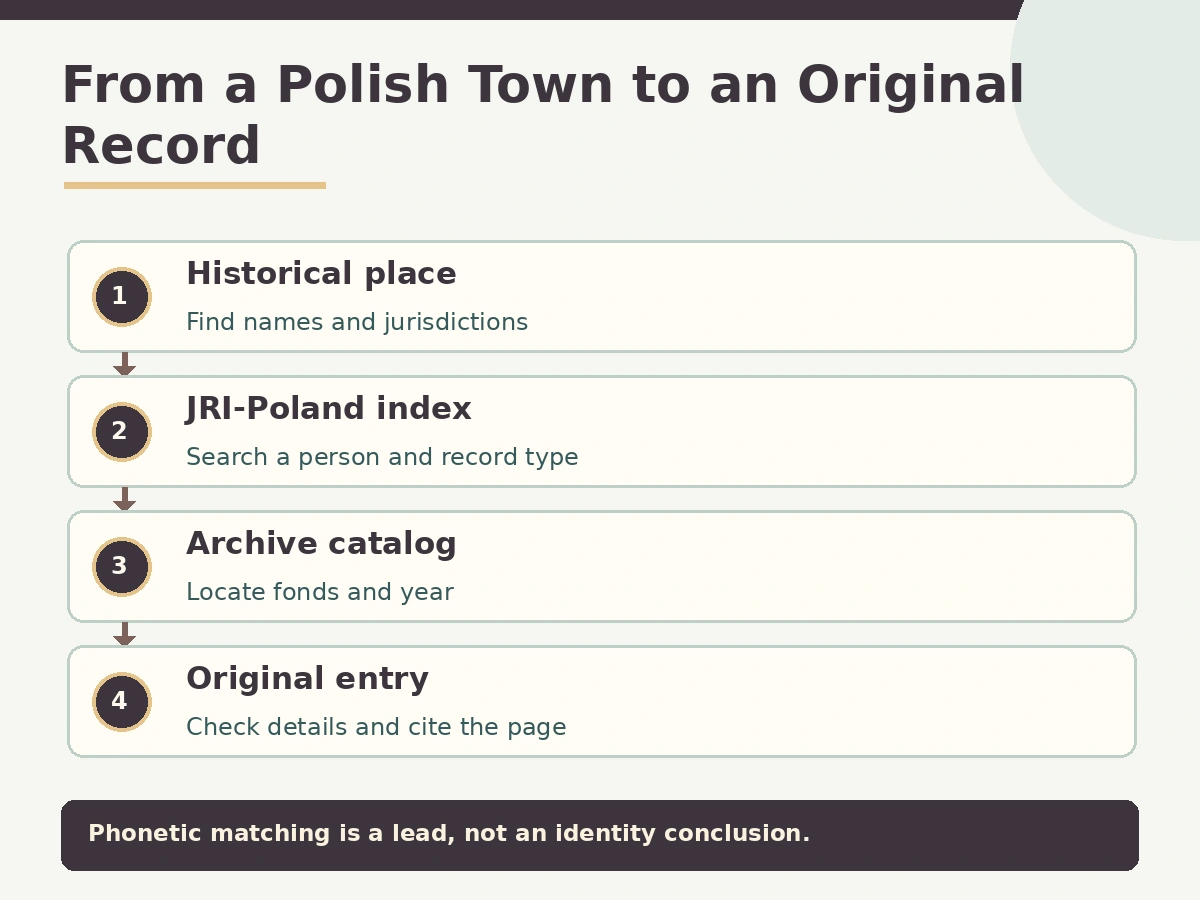
Identify the historical town before opening JRI search results
Build a locality file from documents made where the family later lived: marriage certificates, naturalization records, passenger lists, family letters and grave inscriptions. Record each version of the Polish place name, the historical province or partition if known, and a nearby larger town. A modern country label or surname distribution alone is not enough to select a town. The historical jurisdiction affects which civil registers and archives may hold the event.
Use JRI-Poland’s Town Explorer and Project Explorer as finding aids for locality coverage and project status. These tools answer “what collections and towns are represented?” more readily than “is this indexed person my ancestor?” Make a table of town, historical name, record type and dates. If an emigrant gave only a broad regional name, keep multiple localities in play rather than choosing a popular town from the first search result.
Search name variants with JRI-Poland phonetic matching
Enter a documented surname and the best-known town, then test given-name forms or nearby settlements. The site’s current search uses Beider–Morse phonetic matching, which can surface plausible spellings that do not look identical. Do not take a phonetic match as a statement that two surnames refer to one person. Record exact query terms, candidate towns, approximate dates and how the search was filtered.
If many matches appear, prioritize an event window supported by independent records rather than arbitrarily picking the oldest candidate. If none appear, widen one dimension at a time: alternate given name, town spelling, jurisdiction or year. A missing result may mean the right records have not been indexed, or that this collection never included the town for the relevant event. An indexed database is not a universal census of Jewish residents.
Distinguish Town Explorer, full results and original registers
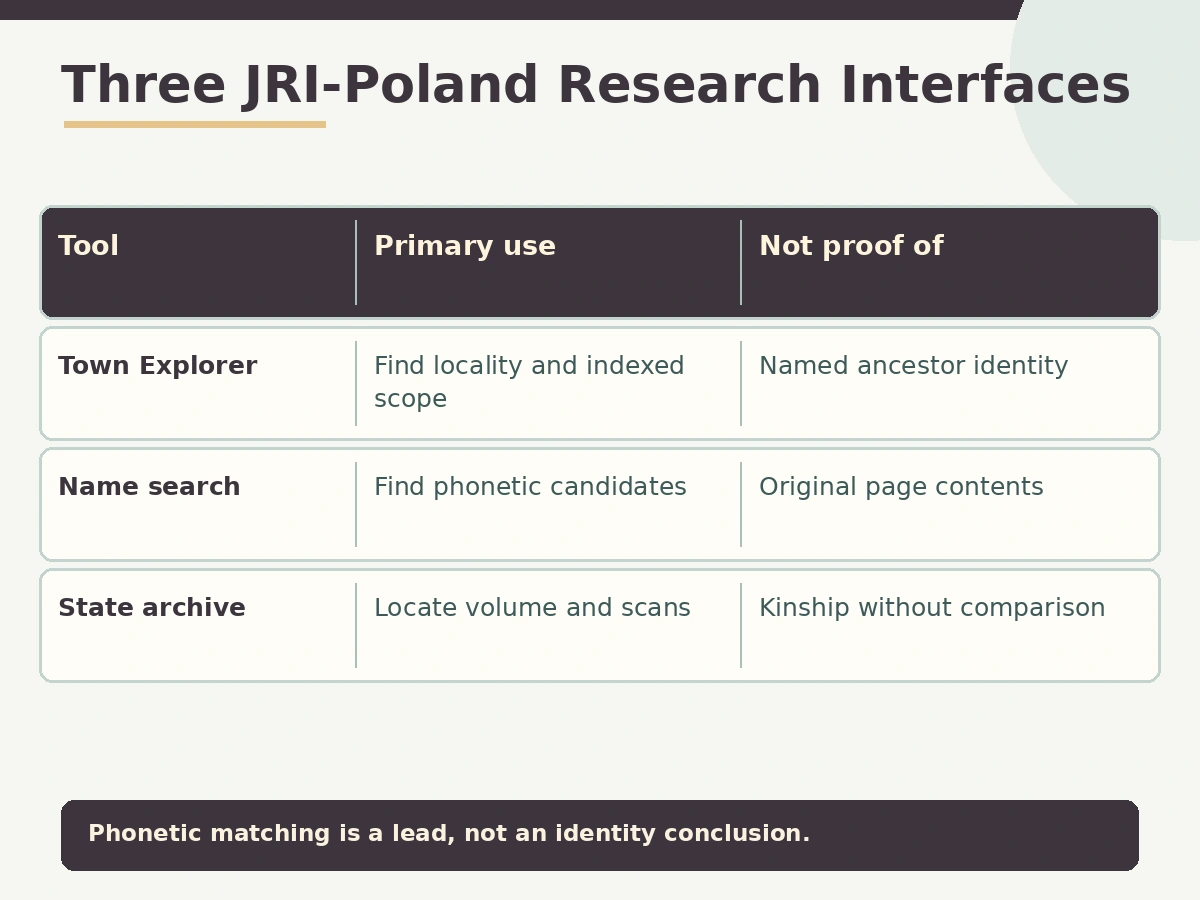
JRI-Poland’s project tools describe collections, contributing projects and possible record types. Full search results require a free user account; the availability of a record index does not mean its scan is directly attached. A database row may summarize a birth, marriage, death or another administrative source. Before transcribing fields, identify the type of entry, year and any reference to a book, archive, page or registration number.
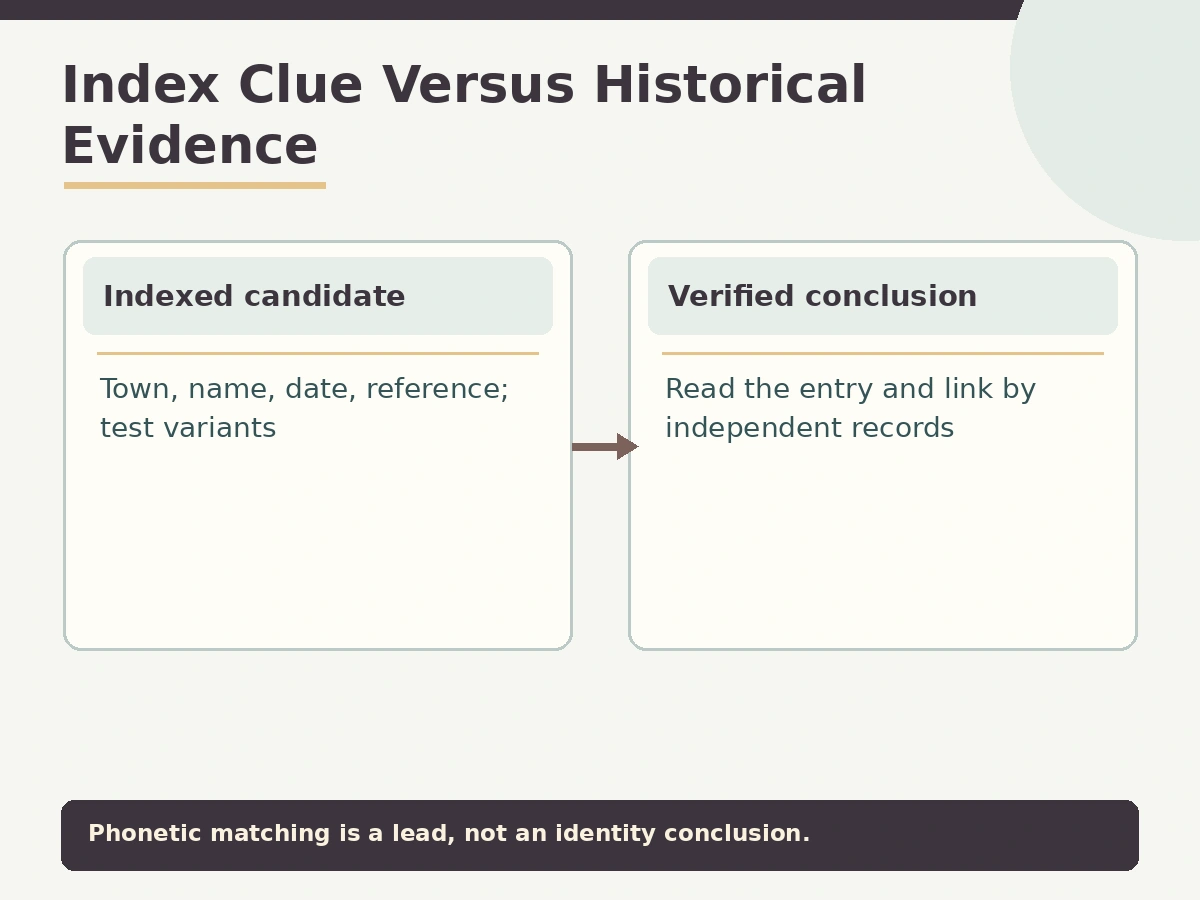
A town surname list shows that a form appears in indexed materials; it does not identify your person. Likewise a result for a father with a matching given name might describe a namesake from a different household. Maintain separate “found in index” and “verified on original image” statuses. This avoids silently upgrading a search algorithm’s candidate into a fully established parent-child relationship.
| Source | What it supports | What it does not prove alone |
|---|---|---|
| Town Explorer | Locality and project coverage | Identity of ancestor |
| JRI name index | Phonetic candidate and citation clues | Original page wording |
| Archival scan | Registered event, as written | Family connection without correlation |
Locate the Polish State Archives record behind the index
The Polish National Digital Archives describes Szukaj w Archiwach as a search service for archival descriptions and digitized material, including genealogical holdings documented through ZoSIA and PRADZIAD. Search for the town and the relevant records or archival unit, using year and repository to narrow the results. The English-language search also lets researchers distinguish collections with scans from description-only material.
Compare the JRI result with the archival description’s place, years, fonds and series before opening images. Books may contain multiple chronological sections or numbering systems. If the image is unavailable, write down the actual archive and unit references and check what lawful access or copy procedure the repository offers. Do not fabricate an image number merely to make a citation appear complete.
Read the source language and capture the entire family entry
Original civil or religious registration entries may be written in Polish, Russian, German or another language according to time and administration. Identify the language and document form before translating names, dates or occupations. Record the entry’s exact spellings and number; separate a literal transcription from your English translation. Calendar conventions and patronymic wording require care: do not impose a modern surname form or convert a date without stating the method.
For a possible baptism or birth, identify whether the entry is a birth registration, a religious event or a later extract. For marriage, distinguish a certificate entry from banns or supporting documents. Witnesses and informants may be valuable locality clues but not proven relatives. Compare the original fields with the indexed summary and log omissions or transcription errors rather than hiding them.
Build a reproducible town-to-record identity argument
Use a compact evidence register: candidate name, town, event date, parents or spouse as recorded, index reference, original citation and an independent comparison source. Give the strongest weight to relationships actually documented on the original page and to external records that connect the family to the same locality. A similar surname in a nearby village may be important but remains a distinct candidate until the person’s movements and family relationships are traced.
Preserve both original and modern place names and state what remains unknown. If only a JRI index can be viewed, the conclusion should be “candidate indexed event in this collection, original not yet inspected.” If you find the scan and independent connecting records, explain the chain. Remember that a town index reflects surviving and indexed documents, not every birth, marriage and death that historically took place there.
More Research Method Guides
How We Research JRI-Poland Indexes
We reviewed the current JRI-Poland search interface, its project explorer and the Polish National Digital Archives description of the state archival search service. We distinguish a free search from free-account access to results and an original record image. Examples are instructions, not claims to have identified real individuals. No genealogy subscription or donation is presented as mandatory. See affiliate disclosure for our site policy.
The search is free; the current site states that a free researcher account is needed to view full results.
No. Beider–Morse matching proposes candidates. Confirm the specific person using locality, relationships and original records.
No. It is a finding aid summarizing names or projects for a town, not an original registered event.
Check Szukaj w Archiwach and the archival unit referenced by the index; not all described units have online scans.
Cite the index and its stated source, label the person an unverified candidate and seek the original register or an independent record before claiming kinship.