
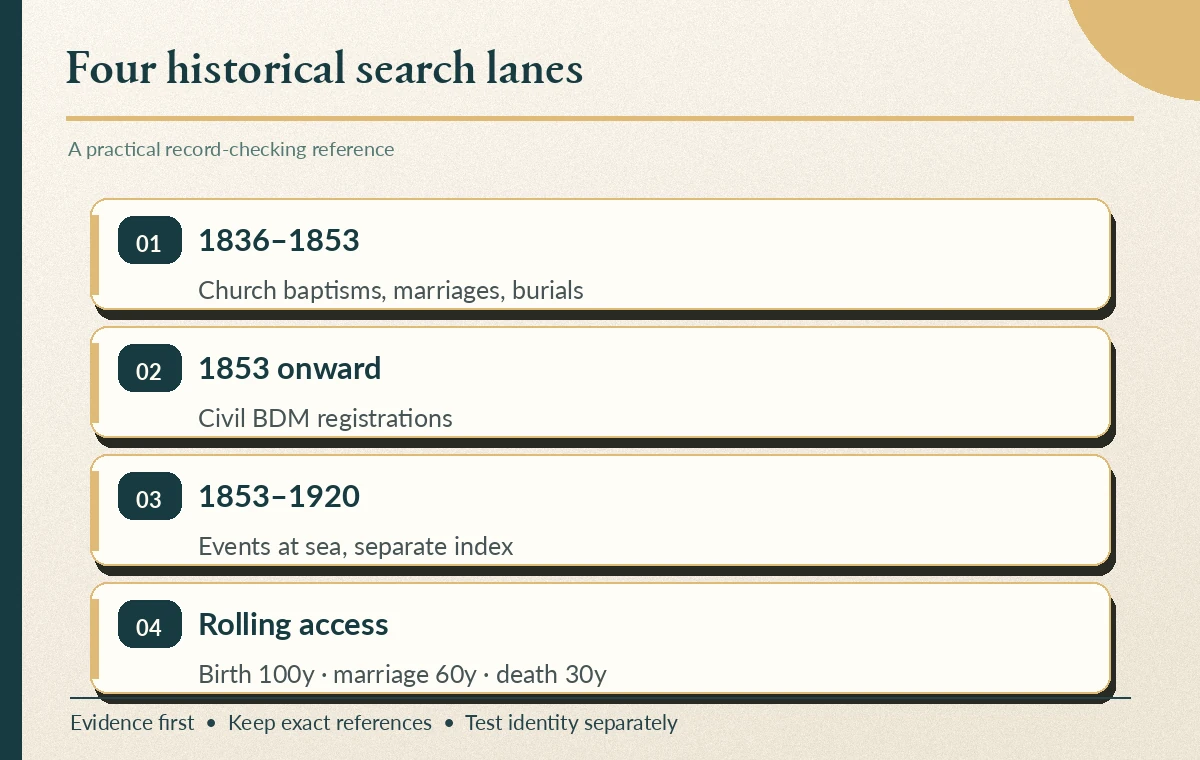
Victoria’s historical birth, death and marriage (BDM) index is a finding tool, not a family tree. Start with the location and approximate event date, choose the right collection, copy the registration reference, and inspect the historical image when available. The Victorian registry provides civil registrations from 1853 and some church baptisms, marriages and burials from 1836 to 1853. Its historical search also has a separate events-at-sea index. This guide turns those distinctions into a practical, low-waste research sequence, including the registration-date access limits and the evidence you should collect before adding a parent or spouse to your tree.
Choose the right Victorian collection first
Make a one-line event hypothesis: person, event, likely year span, and the exact place as it was known at the time. Victorian civil birth, marriage and death registration began in 1853; church entries indexed for 1836–1853 are a different kind of evidence. If the claimed event occurred aboard a ship bound for Victoria, check the registry’s separate events-at-sea index, which covers events from 1853 through 1920. A baptism is not a birth registration, and a burial is not the death event itself. The category you choose shapes both the search and what the surviving document can prove. Our guide “NSW Historical BDM Index” adds more detail on this.
Check historical access by registration date
The registry states that historical birth records become searchable after 100 years, marriage and relationship records after 60 years, and death records after 30 years. It calculates restrictions from the registration date, which can differ from the date the event happened. Do not convert these rolling limits into a permanent final calendar year. If a family event is too recent for historical search, lack of a result is a privacy boundary, not evidence that the person was never registered. Use the official eligibility and certificate processes rather than attempting to bypass restrictions.
Search narrowly, then change one field at a time
Begin with the surname, a given-name spelling supported by another source, an event type, and a modest year range. The registry warns that exceptionally broad searches can time out. If nothing appears, widen dates cautiously and try an alternate forename, a spelling variant, or a partner’s surname. Record each attempt, including failed ones, because an unlogged search is impossible to audit later. Avoid attaching parents or partners to an index result simply because its name resembles the person in an imported family tree. Search settings and the exact result reference belong in your research log.
Copy the registration number before buying anything
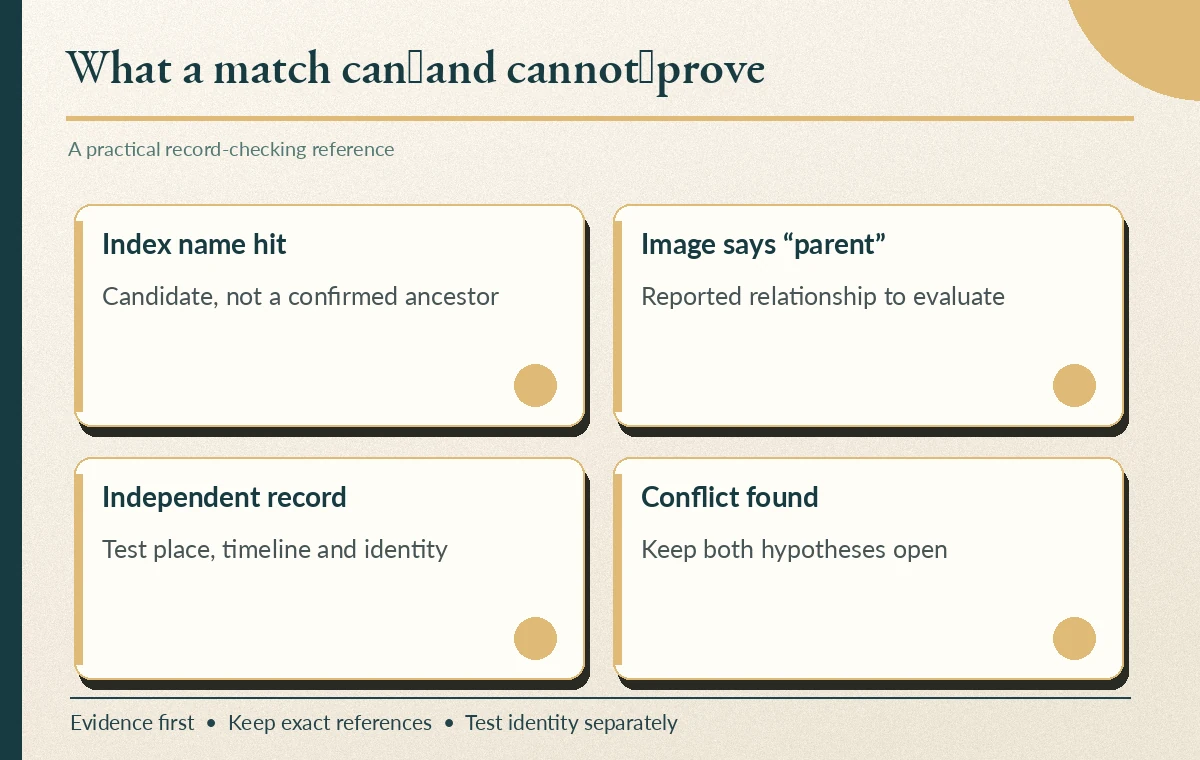
A Victorian historical index entry includes the registration year and number as well as event-related names and other available details. Save the exact number, event category, search date and any relevant locality before leaving the page. The number is an address into a registry collection, not an independently established relationship. Compare multiple candidates in a small table when names repeat. If the registry’s summary contradicts your original hypothesis, preserve the contradiction. It may indicate a namesake, a mistaken family note or a registration entered substantially later than the event. Our guide “Western Australia Historical BDM” adds more detail on this.

Know what an image purchase actually provides
The Registry offers instantly downloadable historical PDF images and mailed certificates for different purposes. A historical image is intended for family-history research; it is not the same as a legal certificate suitable for proving identity. Fees and transaction instructions can change, so review the government checkout page before ordering. Decide in advance which unresolved question the image might answer—perhaps a reported parent, a residence, or the name of an informant—and whether that information is expected on this type and period of record. Buying a document without a question often produces another isolated name.
Read the registration and its informant separately
When an image is available, transcribe its exact wording before summarizing. Separate the event being recorded from the informant’s recollections, the registrar’s administrative dates and any later annotations. A death record may report a birthplace or parents supplied by someone who never knew them firsthand; the official registration of a death does not transform every reported family detail into firsthand evidence. Compare stated ages with other dated documents as a range rather than assuming precision. Note illegible words with an uncertainty marker instead of silently inventing plausible letters.
Worked example: two similar marriage candidates
Imagine a fictional researcher seeking a marriage for Eliza Morgan near the middle of the nineteenth century. One result is a church marriage before 1853; another is a civil registration several years later. They are not interchangeable hits. The researcher logs each reference, checks the known spouse and place in an independent household record, then obtains the image of the most promising entry. If both remain plausible, the conclusion is ‘not yet distinguished,’ not ‘married twice.’ This hypothetical demonstrates the method without presenting invented people as historical archive entries.
What to do when the index is silent
Test a different event jurisdiction first: the family might have married in New South Wales, arrived through another port, or moved shortly before a child’s birth. Search an adjacent time span and review known locations; do not assume today’s state boundaries describe an older event perfectly. For the years before civil registration, prioritize surviving church books and their custodians. For later periods, consider newspaper notices, cemetery registers, probate files and electoral rolls as independently created leads. Document both the collection searched and the dates it claims to cover; a negative result has meaning only within those limits.
| Document | Establishes directly | Needs another test |
|---|---|---|
| Historical index | A registration reference exists | Identity of the named ancestor |
| Registration image | The text of this recorded event | Accuracy of reported family facts |
| Independent dated source | A separate place or relationship claim | Consistency across the timeline |
Turn one registration into a defensible conclusion
Write a claim that is narrower than the document: for example, ‘a marriage was registered under these two names in this district and year.’ Then distinguish that claim from ‘these are my great-grandparents.’ To connect the two, compare addresses, occupations, relatives or other facts with independent, dated records. Keep citations to both the index and the image, including access date and registration reference. If evidence conflicts, explain the conflict and which further source could resolve it. A reasoned unresolved finding is stronger genealogy than a confident but unsupported branch.
How We Research
This guide was developed by comparing official registry or archival descriptions with the public search process and testing each recommended inference against its stated record type. Dates, jurisdiction boundaries and access restrictions are attributed to the relevant custodian; examples are expressly fictional. We distinguish a source’s literal statement from an interpretation and a question needing corroboration. Online coverage, fee rules, and search interfaces can change, so recheck the authority’s current guidance before paying or concluding that a record is absent.
More Records and Archives Guides
Primary sources and archive guides
Registry search rules, event-at-sea index, coverage dates and restrictions (www.bdm.vic.gov.au).
Official distinction between downloadable historical images and legal certificates (www.bdm.vic.gov.au).
State Library advice on obtaining a registration number and record types (guides.slv.vic.gov.au).
Disclosure and research limits: This is independent educational genealogy writing, not legal advice or an archive endorsement. This guide contains no affiliate links. Historical records may contain harmful colonial terminology, erroneous claims, and information that should not be exposed about living people. Respect current archival restrictions; see GenHis affiliate disclosure.
No. The index locates registration entries; a separately obtained image or certificate shows the underlying document in greater detail.
The earlier indexed material includes church baptisms, marriages and burials; the later index is for civil registrations.
The Victorian registry currently uses a 60-year restriction, measured from registration date.
Yes. The Victorian registry describes a separate events-at-sea index for births, deaths and marriages between 1853 and 1920.
No. Examine the record image and independently corroborate identity and the specific relationship.