
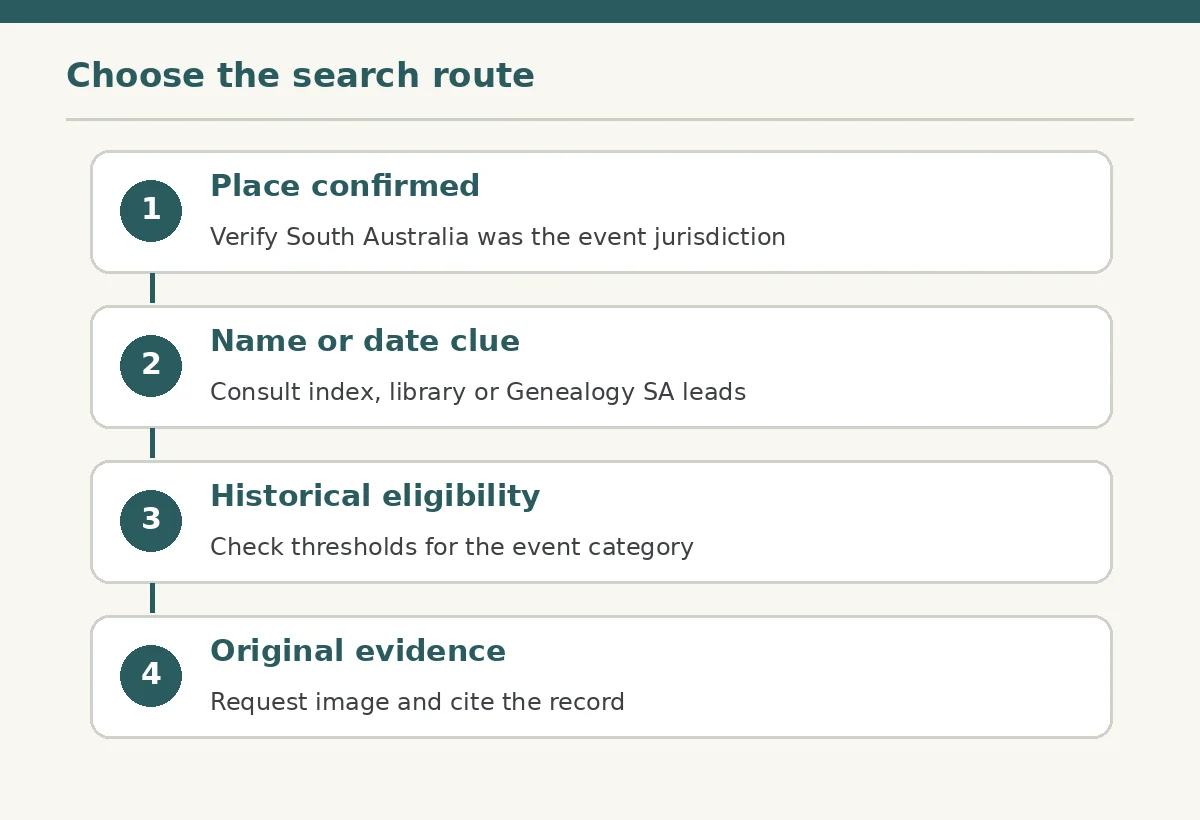
Searching South Australian family events begins with a jurisdiction decision, not a paid certificate order. The state government says its Births, Deaths and Marriages Registry does not offer an ordinary online historical-name search. Genealogy SA and other research sources may supply an index clue, while the government can search a submitted historical-image request. This guide sets out what each route establishes, when a document becomes eligible for access, and how to keep a plausible name from becoming an unsupported family relationship. A fictional research example is used; no real family’s private information appears here.
Identify the event and the responsible South Australian jurisdiction
Start with one question: whose birth, marriage or death do you need to establish, where did it probably occur, and within which years? South Australia has its own civil-registration history, so a birth listed in another Australian state belongs in that state’s system even if the person later lived in Adelaide. Make a one-line hypothesis with name variants, event type, place and a realistic date interval. Keep household documents and newspaper notices separate from official registration. A notice can help narrow the interval, but may have been placed by someone who did not see the event. If the event location is uncertain, look for the earliest reliable contemporary address before contacting a registry.
Understand what the South Australian government offers online
The state’s historical certificate page explicitly says Births, Deaths and Marriages does not provide an online search facility; some historical material can instead be found through Genealogy SA. That makes a web search result or genealogy index a finding aid rather than the certificate itself. The government accepts applications for a historical certificate image and looks up the supplied details. Save an index entry with its collection title, not just a name and date copied into a tree. If a surname has several spellings, document the exact form shown in each index; an unsuccessful spelling-specific search is not evidence that a registration was never created.
Check the three historical-image access thresholds
South Australia identifies different public-age thresholds: births more than 100 years old, deaths more than 30 years old, and marriages more than 75 years old. These are eligibility rules for the historical-image service, not claims that all certificates from those years are digitised, complete or already indexed. Calculate eligibility from the actual event date and check the official page again before ordering because access policies may change. When an event is outside the public threshold, avoid searching for restricted information about a living person through a workaround. Instead pursue lawful alternatives, such as a family-held certified copy or older records not subject to the same limits.
Extract an index reference before paying for an image
Use any available Genealogy SA discovery tool, a local library catalogue, church register or archived notice to assemble the minimum identifying details requested for a certificate search. Record the source name, transcription, possible registration number, place, approximate date and uncertainty. Search under maiden surnames for marriages or births where a later surname may be different. Compare nearby events in a plausible family cluster, but do not infer that two identical surnames establish kinship. If a record is not found, revise the question—could the event have happened in Victoria, at sea or before a church register?—before repeating the same query and paying unnecessarily. Our guide “Trove Australian Newspapers for Family History” goes into more detail.
Use historical certificate details without overstating precision
The government’s guidance notes that the level of detail printed on certificates changed over time. Do not assume a nineteenth-century record contains the same parental, occupational or address fields as a later one. Transcribe exactly what the image says, including abbreviated names, unexplained blanks and corrections; put your interpretation in a separate research note. Treat an informant’s statement on a death entry as information supplied at registration, not automatically personal knowledge of the deceased’s birth. When the clerk used an approximate age, calculate a birth-year range instead of imposing an exact date. A clear citation should name the certificate type, registration or image reference, jurisdiction and access date.
Corroborate a marriage with place and community evidence
A marriage index often supplies a pair of names and a date or location, but that pairing does not establish which later household they formed. Compare the place of ceremony with local directories, passenger lists, birth registrations of children and contemporary newspaper reports. Where religious affiliation is relevant, parish marriage registers may preserve witnesses or a residence absent from a short civil index. Witnesses can be relatives, neighbors or colleagues; mark the connection as a hypothesis until another record explains it. If two same-name couples married within a decade, maintain separate candidate profiles and list exclusion tests. This work makes the eventual certificate useful rather than simply decorative in a family tree. Our guide “Victoria Historical BDM Index” covers a related question.
Search for missing births and deaths through indirect records
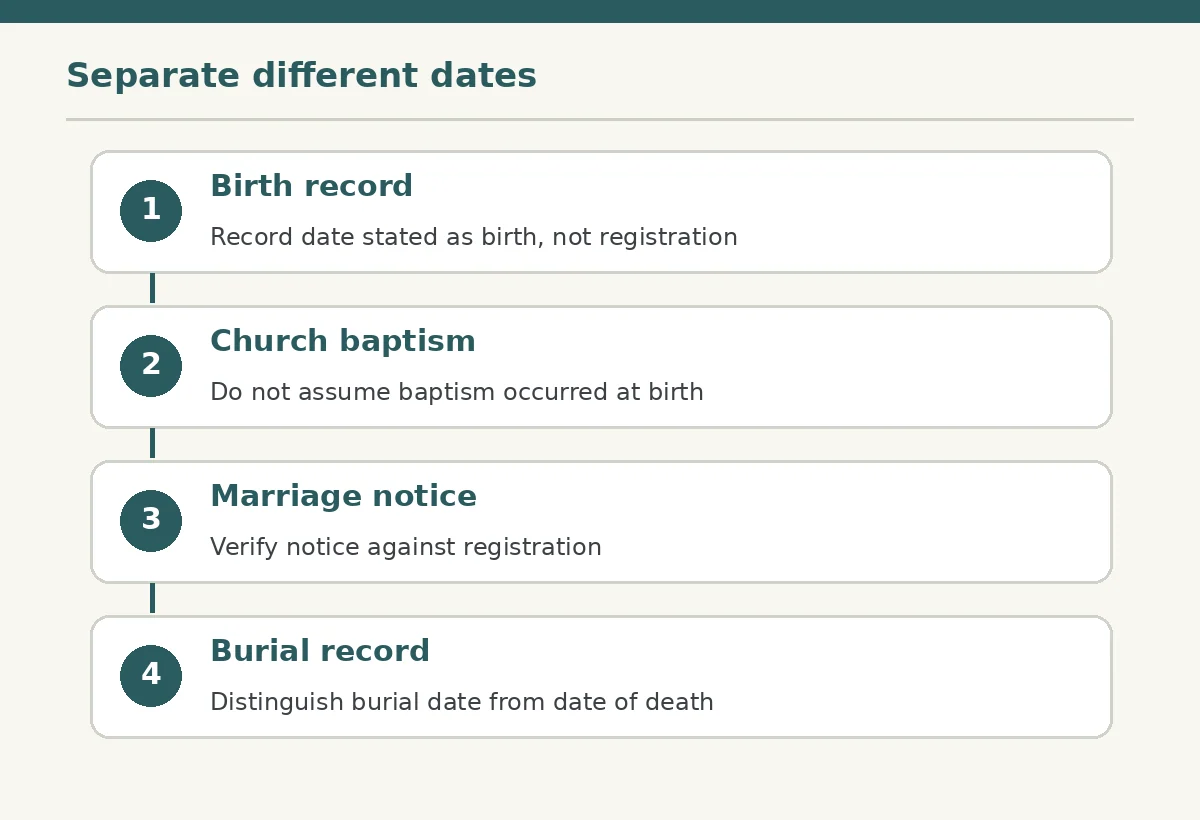
When the registration image cannot be located, look for alternative records created close to the event. Church baptism and burial registers, cemetery registers, probate files, hospital or benevolent-society records, electoral rolls and local newspapers may supply independent dates and places. These series have different reasons for recording an event: a burial can occur days after death, and a baptism is not the date of birth unless the record explicitly says so. Preserve that distinction in your timeline. Search geographically adjoining districts if an address sat near a boundary, and note the specific repositories and date spans actually checked. A negative answer from one index never demonstrates that a person did not exist. Our guide “Queensland Historical BDM Records” goes into more detail.
Build a source comparison table before attaching the fact
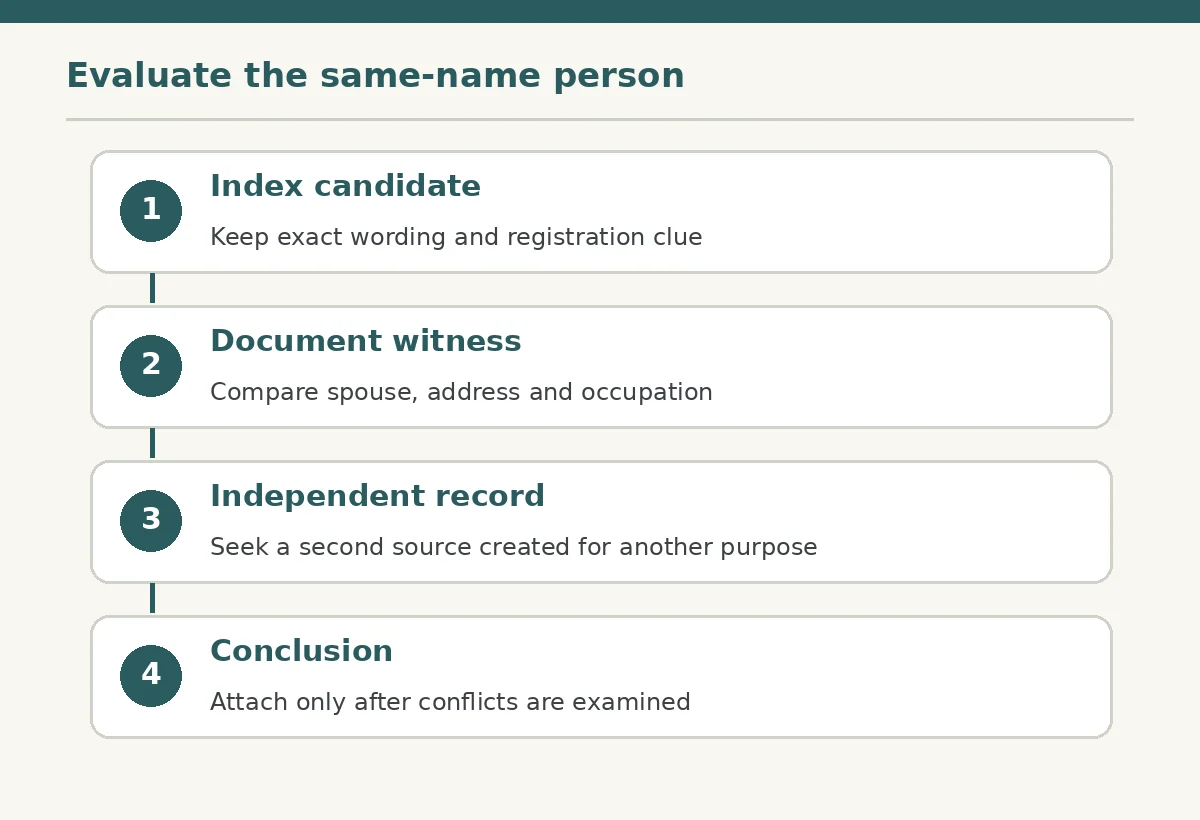
For a hypothetical person called Eleanor Harper, suppose an index suggests a marriage in 1886, a directory shows a household at a nearby address in 1888 and a later death entry names a spouse. Put these in three rows with their original wording, known or inferred date and level of confidence. Ask whether the spouse’s occupation, children’s names and residences agree. An inconsistency may reflect two separate people or an error, not merely a different spelling. Distinguish a proven marriage occurrence from a proposed link between the marriage registration and your ancestor. Only after resolving that identity question should the event be promoted from a research lead to a tree fact. For more detail, our guide “Tasmania Historical Marriage Registers, 1803–1899” looks at indexes and images.
Keep a complete citation and a follow-up queue
Save the original image lawfully where permitted, together with the archive’s item title, issuing registry, date, reference or page, and your access date. Keep a plain text transcription and note difficult handwriting separately. Record unsuccessful searches against the exact source and filters used. Next actions might be to request the image, inspect a parish register, or compare two couples with the same names. Review the registry’s current instructions before paying, since access requirements and delivery processes may change. This small audit trail lets another researcher repeat the work and prevents an attractive certificate from being linked to the wrong person.
Quick Evidence Log to Keep with This Search
| Source | What to save | What remains open |
|---|---|---|
| Index or search result | Name, search settings, record reference | Is this the correct person? |
| Original record image | Series, page, exact wording | Who provided the information? |
| Independent corroboration | Place, date, author, separate citation | Do details and timeline agree? |
How We Research South Australia Historical Bdm Records
This guide follows the specific institution guidance linked below and distinguishes original records from searchable indexes. We checked descriptions of the relevant collections on 2026-10-20. The sample people and scenarios are fictional. We did not interpret absent index results as evidence that an event never happened, and none of the diagrams reproduces a government record. If an access or digitisation rule changes, the current repository instructions take precedence over our summary.
More Records and Archives Guides
Verified Institutional Sources and Further Reading
South Australian government describes no ordinary BDM online search and historical-image access thresholds by event type (www.sa.gov.au).
National Library of Australia outlines separate state and territory BDM jurisdictions and research routes (www.library.gov.au).
National Library of Australia explains combining indexes, libraries and family-history records (www.library.gov.au).
Research and disclosure: these are editorial information guides, not archive endorsements or paid placement. No affiliate offers are used in this article; see GenHis affiliate disclosure. Verify current access conditions and respect privacy restrictions, particularly in records potentially involving living individuals.
The government says it does not provide an ordinary online search facility; use finding aids and the official historical-image application route.
South Australia lists marriages more than 75 years old; verify the current official condition before submitting a request.
No. An index is a pointer; the certificate image may contain additional wording and may need to be requested.
Not necessarily. Treat named parents as an informant statement and verify with independent birth or household evidence.
Test the place and spelling, check another state’s jurisdiction and search contemporary church or newspaper material.