
Historical marriage research in Tasmania is unusually practical when the source series is recorded accurately. Libraries Tasmania lists indexes to marriages for 1803–1838 and 1839–1899, and digitised original marriage registers in corresponding series. That does not mean every record gives a birth date, parents’ names or proof of a later family link. This guide shows how to move from the Tasmanian Names Index to a specific register image, compare clerical and religious details, and keep the date of a marriage distinct from a later certificate or notice. Example couples in this article are entirely fictional.
Locate the event before choosing an index series
Build a date interval from existing evidence such as a child’s baptism, later census-substitute or death notice. Identify whether the marriage plausibly occurred in Van Diemen’s Land or elsewhere: someone buried in Tasmania might have married in England or another Australian colony. Libraries Tasmania has a searchable Tasmanian Names Index that includes a variety of historical life events and other record types. Search surname variants, given names and approximate years before assuming a marriage is absent. Keep the original source label returned by the index. A wedding’s religious ceremony date may match civil recording or may require further comparison, so do not silently replace one with the other. Our guide “Queensland Historical BDM Records” goes into more detail.
Distinguish the two official Tasmanian index periods
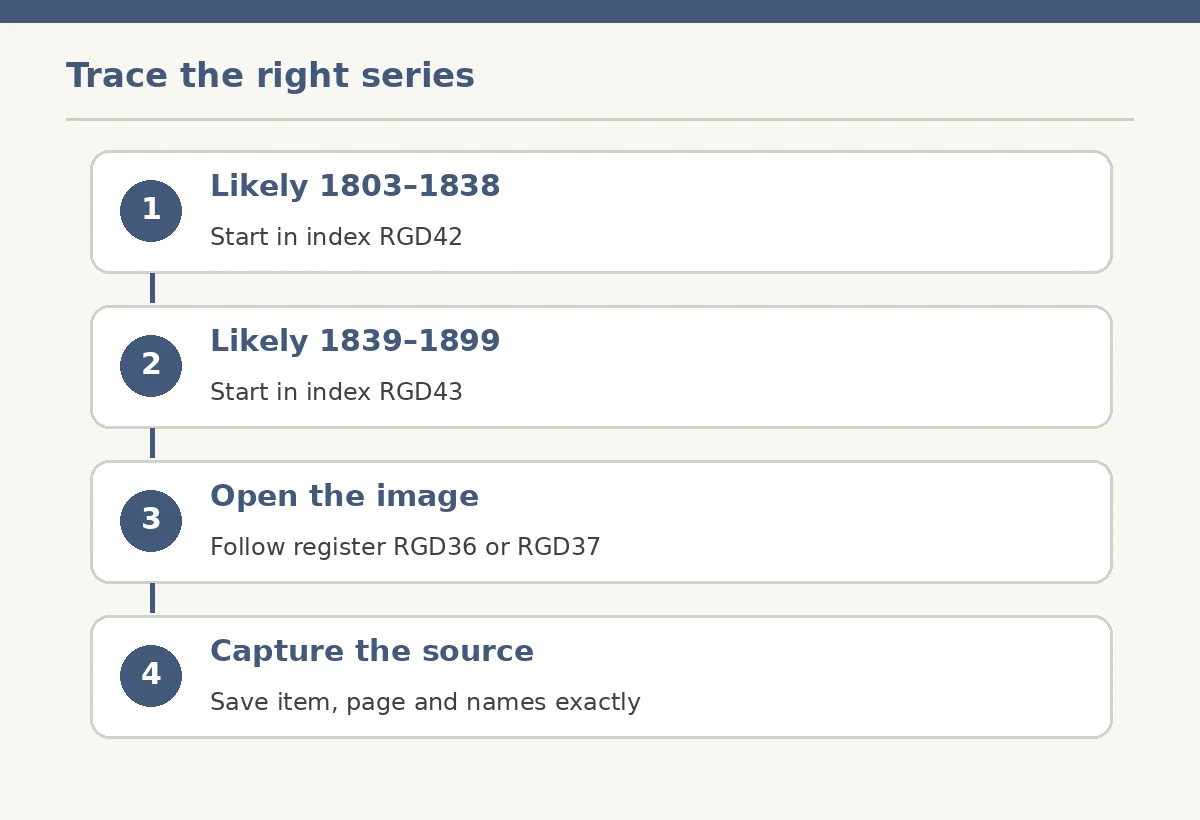
Libraries Tasmania lists Index to Marriages 1803–1838 as RGD42 and Index to Marriages 1839–1899 as RGD43. The division helps you choose the appropriate series when you have a likely date. If an index hit falls close to 1838 or 1839, inspect the date and registration context instead of treating an index range as a legal rule about when people married. Some records may be repeated, transcribed later or recorded differently in associated documents. Note the index number and any place name as a pointer to the actual register. An index entry is not the final authority on witnesses, signatures or other original content.
Open the original marriage-register image
The published online inventory identifies digitised Tasmanian marriages 1803–1838 in RGD36 and those from 1838–1899 in RGD37. The 1838 overlap with the index boundary is a useful reminder to follow the actual catalogue reference for the located item. View the complete page at a readable scale, including column headings, adjacent entries and corrections. Enter the registry volume and image details in your citation. Read the record rather than trusting the short search snippet: handwriting may make a middle name ambiguous, and the form could use the registrar’s vocabulary rather than the family’s preferred designation. Document what the record explicitly says and what remains unstated.
Treat witnesses as clues rather than assumed relatives
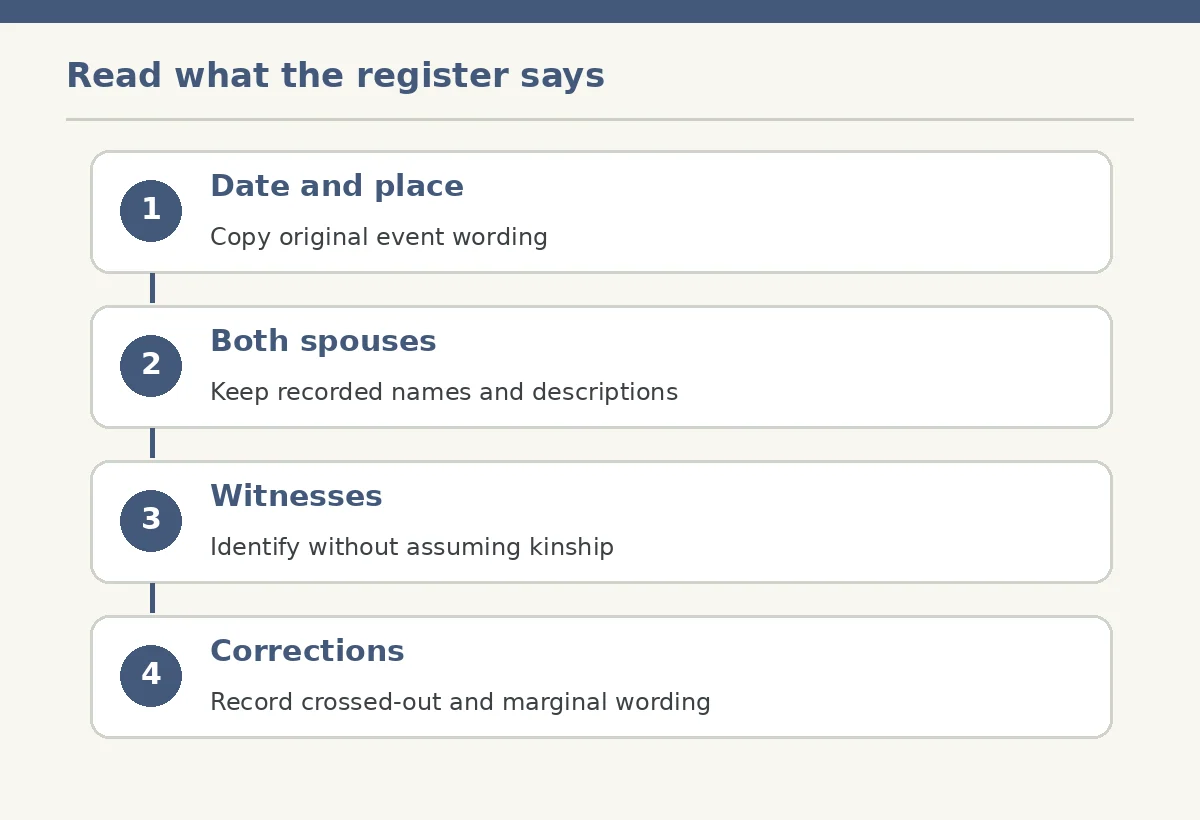
A witness to a marriage may be a sibling, friend, neighbor, fellow worker or official. Record each witness’s name exactly and compare occupation and address clues with later local sources. A witness sharing a surname is a reason to investigate, not proof of a relationship. When the register names no parents, do not invent them from a popular online tree, even when the couple’s later child names seem to fit. Instead seek contemporary baptisms, migration records, will beneficiaries and local directories. If two similarly named couples appear in the same parish, reconstruct each timeline. The useful question is which independent fact links the wedding pair to the later household.
Compare civil and church information carefully
The official Tasmanian family-history inventory lists church records for baptisms, weddings and funerals as well as government registers. These sources may overlap but were created for different purposes. A church entry can offer witnesses or denomination, while a civil register may use a different place description or registration date. Align entries by the people, date, location and minister when possible. Preserve differences and explain which source was copied from another. A later transcript in a family book may simply restate the church register, so two references do not necessarily provide two independent witnesses to the event. Look for records created by different offices before resolving a disputed name.
Know why some district-register searches fail
Libraries Tasmania notes that only some district birth, death and marriage registers reached the archives; its district-register guide is explicitly noncomprehensive. It also says these duplicate district registers include only marriages performed in a marriage registry. This makes a failed search in a district collection especially narrow evidence: a church wedding might never appear there. Use the central Tasmanian Names Index as the principal starting point and district registers for targeted cross-checks where the relevant place and years survive. Do not infer an absent marriage from an online district gap, and do not confuse duplicate copies with independent confirmation of every detail. Our guide “Tasmania Convict Permissions to Marry, 1829–1857” adds more detail on this.
Use associated records to identify the right married couple
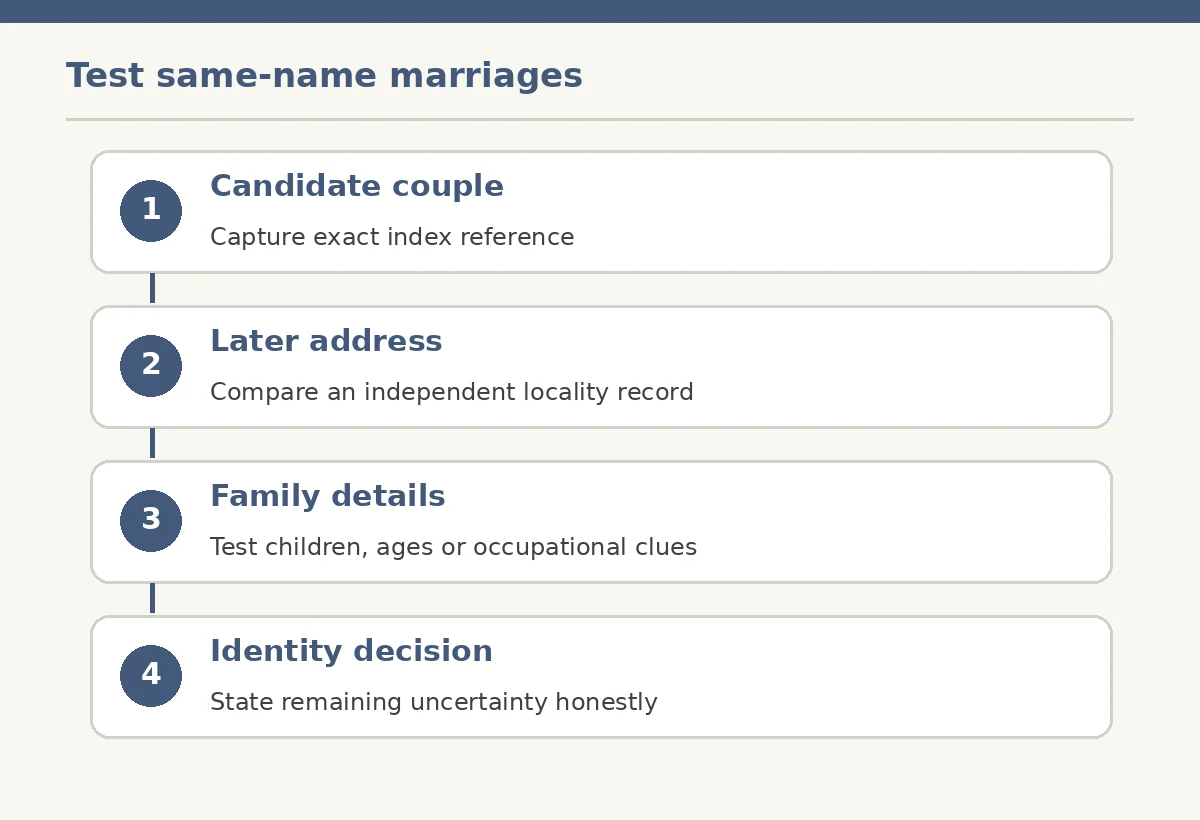
For a hypothetical Mary Allen and William Brown married in the 1860s, find at least one subsequent address, child registration or land transaction that connects the names to a particular locality. Record ages as the source reports them, even if later events suggest a slightly different birth year. Search passenger lists if either spouse arrived in the colony, but do not assume traveling together means they married before migration. Probate records or cemetery records can add useful household context. A coherent chain of dated, independent sources is more persuasive than a matching surname and an index year. Keep separate candidate couples until you can reject one on grounds you can explain.
Transcribe, cite and preserve the original page
Create a citation with Libraries Tasmania as the holding institution, the RGD series and item, names as written, date, register number and image locator. Distinguish an index view from a scanned original in your research notes. If the register has a cross-out or marginal note, document the visible marks before choosing an interpretation. Keep your transcription verbatim and put normalized spelling in brackets or a separate analysis field. A screenshot without catalogue context can be hard to relocate later. Where an image cannot be opened, cite the exact index and record an action to consult the archive rather than pretending the original was personally examined. Our guide “South Australia Historical Birth, Death and Marriage Records” covers a research workflow.
Decide whether the marriage record answers your question
A marriage entry usually supports the occurrence of a ceremony between the named parties, subject to authenticity and identification. It does not automatically prove the later couple in your tree are the same people, nor does it establish biological relationships that the source never states. Summarize each evidentiary claim in three columns: directly recorded fact, plausible inference and unresolved conflict. Search further only for the column that still matters. If the date is uncertain, show a range rather than fabricating precision. Verify current access instructions on the Libraries Tasmania website before relying on older third-party screenshots or a compiled list of RGD numbers. For the fuller picture, see our guide “Trove Australian Newspapers for Family History”.
Quick Evidence Log to Keep with This Search
| Source | What to save | What remains open |
|---|---|---|
| Index or search result | Name, search settings, record reference | Is this the correct person? |
| Original record image | Series, page, exact wording | Who provided the information? |
| Independent corroboration | Place, date, author, separate citation | Do details and timeline agree? |
How We Research Tasmania Historical Marriage Records
This guide follows the specific institution guidance linked below and distinguishes original records from searchable indexes. We checked descriptions of the relevant collections on 2026-10-20. The sample people and scenarios are fictional. We did not interpret absent index results as evidence that an event never happened, and none of the diagrams reproduces a government record. If an access or digitisation rule changes, the current repository instructions take precedence over our summary.
More Records and Archives Guides
Verified Institutional Sources and Further Reading
Libraries Tasmania lists indexes RGD42/RGD43 and digitised marriage registers RGD36/RGD37 (libraries.tas.gov.au).
Libraries Tasmania explains noncomprehensive district duplicates and registry-only marriage coverage (www.libraries.tas.gov.au).
National Library of Australia supplies multi-jurisdiction Australian BDM research context (www.library.gov.au).
Research and disclosure: these are editorial information guides, not archive endorsements or paid placement. No affiliate offers are used in this article; see GenHis affiliate disclosure. Verify current access conditions and respect privacy restrictions, particularly in records potentially involving living individuals.
Start with the Tasmanian Names Index at Libraries Tasmania and follow the archival series reference to the digitised register.
Libraries Tasmania lists index series RGD42 for 1803–1838; the related original registers include series RGD36.
The archive lists digitised RGD37 marriages for 1838–1899, with index series RGD43 covering 1839–1899.
No. Witness identity and relationship require separate supporting records.
Only some district registers survive, and the archive says the district duplicates cover registry-office marriages, not every ceremony.