
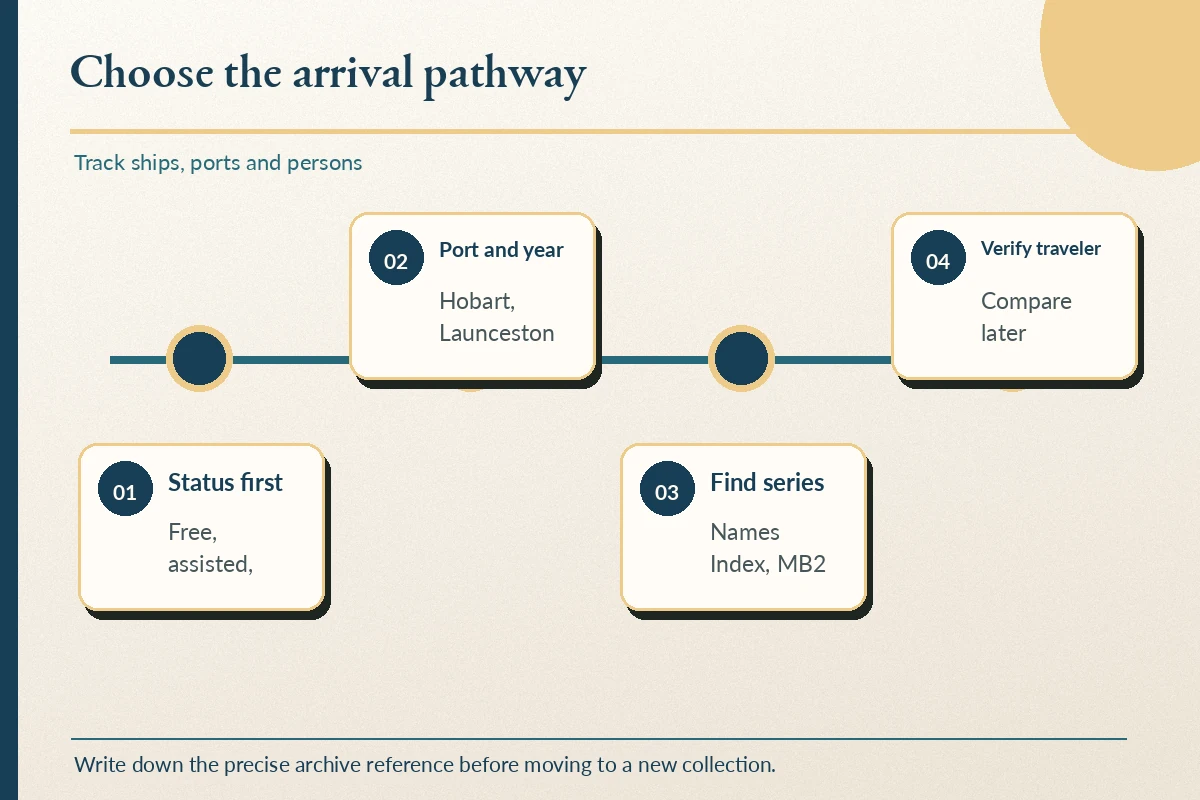
For a historical Tasmania passenger arrival, search the Tasmanian Names Index first, then identify the kind of arrival and the original ship or immigration record. Libraries Tasmania’s primary family-history guide covers arrivals from 1803 through 1900, but there is no single complete passenger list for every ship, person or port. Records may classify travelers as unassisted passengers, assisted immigrants, crew, military personnel or convicts; choosing the correct source category is essential before treating a name hit as evidence.
Choose the passenger category first
The travel route matters as much as the surname. A fare-paying migrant is not necessarily in an assisted-immigration return; an assigned convict is not a free settler; crew and soldiers might appear in separate records. Write one category as the leading hypothesis based on a contemporary document and keep alternatives open if the evidence is weak. Tasmanian Names Index results can include arrivals, departures or different administrative events, so inspect the record type rather than relying on search-result snippets. Families may have changed status over time. Do not describe a named person as a convict or an assisted immigrant unless the relevant record identifies that status.
Know what the archive does and does not hold
Libraries Tasmania describes its family-history arrival and departure guide as covering 1803–1900 and warns that most surviving records concern Hobart. Few lists survive for other ports. That survival pattern is a critical part of a negative search. A family reported at Launceston might not be indexed under the same administrative records as a Hobart arrival. The voyage may have stopped at Adelaide or Melbourne on the way to Tasmania, and a different colony could preserve a relevant entry. The date range on the guide describes the topic, not a continuous person-by-person database for all years.
Begin at the Tasmanian Names Index
Search a documented name, approximate year and variant spelling, then compare any result’s record class, ship, arrival date and port. Capture the archival series or item reference before switching tabs. If the result is an index transcription, look for a linked image and determine whether it shows an original document or another derivative. If the name is too common, lead with ship and date from a dated newspaper or personal paper. Save alternative entries instead of collapsing several passengers into one person. A same-name match on an arrival list must be checked against an independent Tasmanian residence or marriage record.
Use the Marine Board and port record routes
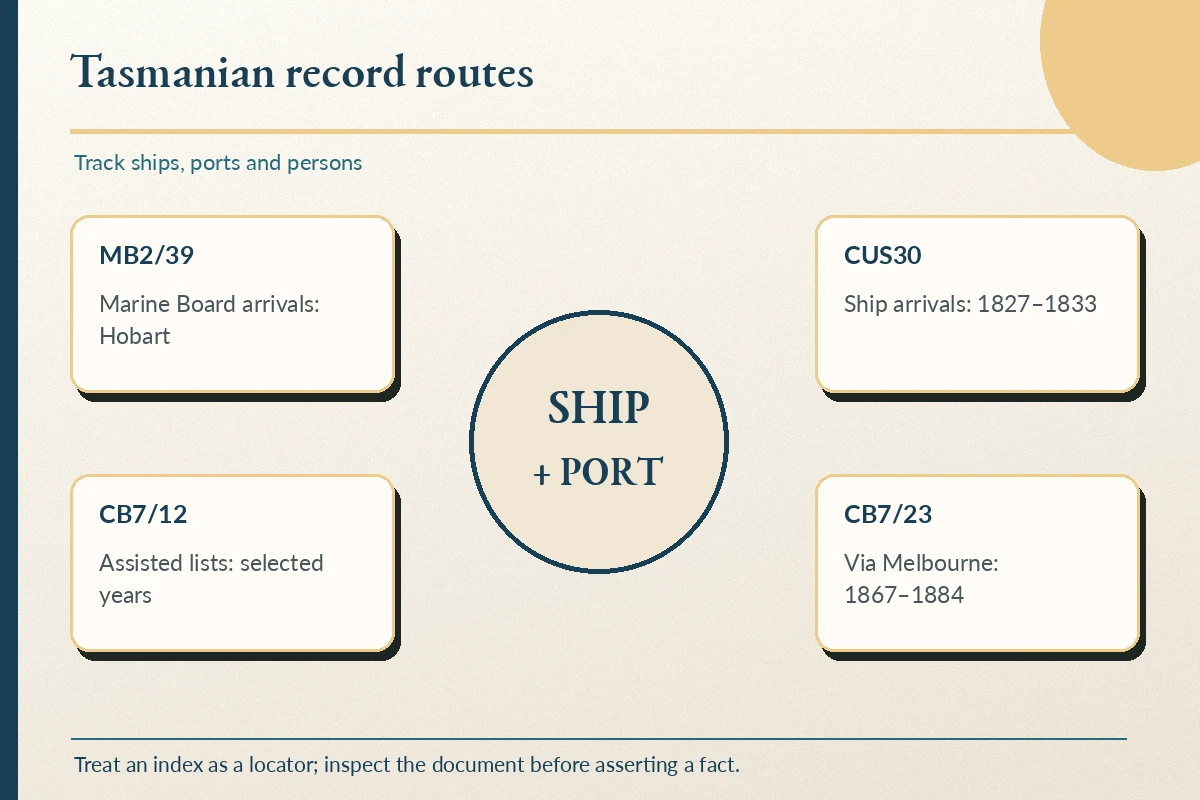
Libraries Tasmania lists Marine Board of Hobart reports of ship arrivals with passenger lists as MB2/39, covering 1829–1970 within that named series. It also identifies CUS30 registers of ships’ arrivals with passengers for 1827–1833 among related holdings. Those broad series spans are not guarantees that each year, passenger or image is complete and searchable. Identify the ship’s arrival date and compare it with the issue or register. A captain, vessel or tonnage line can help establish that you found the correct voyage, but it does not tell you whether your ancestor was aboard unless an applicable passenger record actually names the person.
Route assisted immigrants to their specific files
Some assisted arrivals appear in immigration-board series rather than a universal ship list. Libraries Tasmania’s online guide identifies CB7/12 descriptive lists of immigrants arriving in Hobart and Launceston for 1851–1867 and 1883–1889, and CB7/23 bounty immigrants arriving via Melbourne for 1867–1884. It also identifies an earlier bounty-system register, CB7/9, for 1841–1843. The way immigrants were enumerated and what details were recorded varied by scheme. Find the exact program and period before interpreting any age, occupation or employment notation. Employer or hiring information may be a separate administrative event after landing.
Do not overlook a microfiche or newspaper index
The library’s guide names an 1829–1865 newspaper-based index for arrivals and departures at Launceston and a microfiche index of unassisted and coastal passengers to Hobart. An online name search that misses a free settler could therefore reflect an access route rather than a missing historical voyage. Search the contemporary newspaper for ship arrivals and compare dates with surviving port registers. Newspaper shipping notices may list vessels and perhaps selected passengers, but many notices do not provide complete names. Label a notice as a newspaper source and a government ship report as an archive source, then record their agreement or disagreement.
Check interstate transit before declaring absence
Passenger routes commonly involved multiple Australian colonies. Libraries Tasmania explicitly advises checking South Australian and Victorian passenger records because ships carrying people to Tasmania might call there. Make a route table with departure port, intermediate stop, Tasmania arrival, source and what each record shows. Be especially alert to a person disembarking in Melbourne and taking a coastal vessel later: a UK departure list and an Australian arrival list could refer to separate stages. The presence of a person on one vessel does not prove the final destination. An indexed voyage to “Australia” is not automatically a voyage to Tasmania.

Apply a fictional two-ship identity test
Imagine an ancestor called fictional Elizabeth Ward who appears in a family letter as reaching Hobart around 1856. A Names Index search produces an Elizabeth Ward on two different vessels. For each candidate, check ship arrival month, age if recorded, passenger class and independent evidence of later residence. One result may represent a different woman; the other may lack enough details for a conclusion. A port report proving that a vessel arrived does not automatically identify its passengers. This example is illustrative, not a transcription of a real record. Keep both possibilities open until a separate dated source supports a particular traveler.
| Record route | Best for | Main limitation |
|---|---|---|
| Tasmanian Names Index | Finding nominal candidates | Not all people or ports indexed |
| MB2/39 ship reports | Checking Hobart arrivals | Not a full statewide list |
| CB7 assisted lists | Scheme-linked migrants | Only particular schemes / years |
| Launceston newspapers | Ship dates and leads | Passenger names often incomplete |
Record where the coverage stops
For each attempted search, identify whether you inspected a nominal passenger list, an index, a newspaper mention, a shipping report or a catalog description. A guide may list records through 1970 for one port series, while the broader 1803–1900 research route has different record selection and access. Do not interpret this as continuous whole-island coverage. If you have a family tradition without a ship name, work backward from the earliest verified Tasmanian residence and focus on a realistic arrival interval. A negative result is meaningful only within the exact surviving collection, port, period and query strategy you checked.
Cite an actual voyage and a later event
A careful citation includes traveler as recorded, original record class, ship, arrival date, port, series identifier, page or item number, Libraries Tasmania as custodian and where the image or index was viewed. Compare a later marriage, occupation, residence or other dated family record to show that the arrival candidate belongs to your person. A ship name and surname by themselves do not establish migration or parentage. Note if the image shows administrative language from the colonial period. Keep historical terminology in quotations when necessary but write the conclusion in clear, non-stigmatizing modern prose.
How We Research
We compared Libraries Tasmania’s introductory 1803–1900 family-history guide with its online-series inventory, physical/microfiche holdings and external-source recommendations. The guide explicitly warns that Hobart dominates surviving records and mentions Victorian and South Australian transit. We treat the record dates for MB2/39 and CB7 schemes as series-specific, not promises of complete coverage. Elizabeth Ward and the two ships are a fictional identity-test illustration. Researchers should consult the current archive item descriptions for access and reuse before treating a name transcription as original evidence.
More Records and Archives Guides
Primary sources and official archival guidance
Libraries Tasmania defines the 1803–1900 research scope, categories and Hobart-centered survival gaps (libraries.tas.gov.au).
Libraries Tasmania lists online port, ship, and immigration administrative series (libraries.tas.gov.au).
Libraries Tasmania describes early arrivals microfiche and CUS30 ship registers (libraries.tas.gov.au).
Libraries Tasmania points to additional Commonwealth and on-site records (libraries.tas.gov.au).
This guide contains no affiliate links. Historical passenger records can encode coercive migration and colonial classifications, which must be described carefully. Avoid disclosing sensitive living-person information. See GenHis affiliate disclosure.
No. Libraries Tasmania points to several overlapping series and warns of substantial gaps outside Hobart.
Start with the Tasmanian Names Index, then verify the record type and locate a linked original image or archive series.
It is a Marine Board of Hobart series of ship arrival reports with passenger lists, with its own date range and survival limits.
Use the Victorian arrival source for that leg and look for a separate coastal or assisted movement to Tasmania.
Different classes may appear in different registers; investigate free passengers, crew, assisted immigrants and convicts via the correct source route.