
For arrivals at Australian ports beginning in 1924, the National Archives of Australia (NAA) is a central starting point, but its Passenger Arrivals Index is not a complete name index to every manifest in federal custody. First determine the arrival port, calendar year and whether the traveler arrived by ship or air. Then search RecordSearch and, if the index does not cover the journey, request or locate the appropriate port-and-date file instead of declaring the traveler missing.
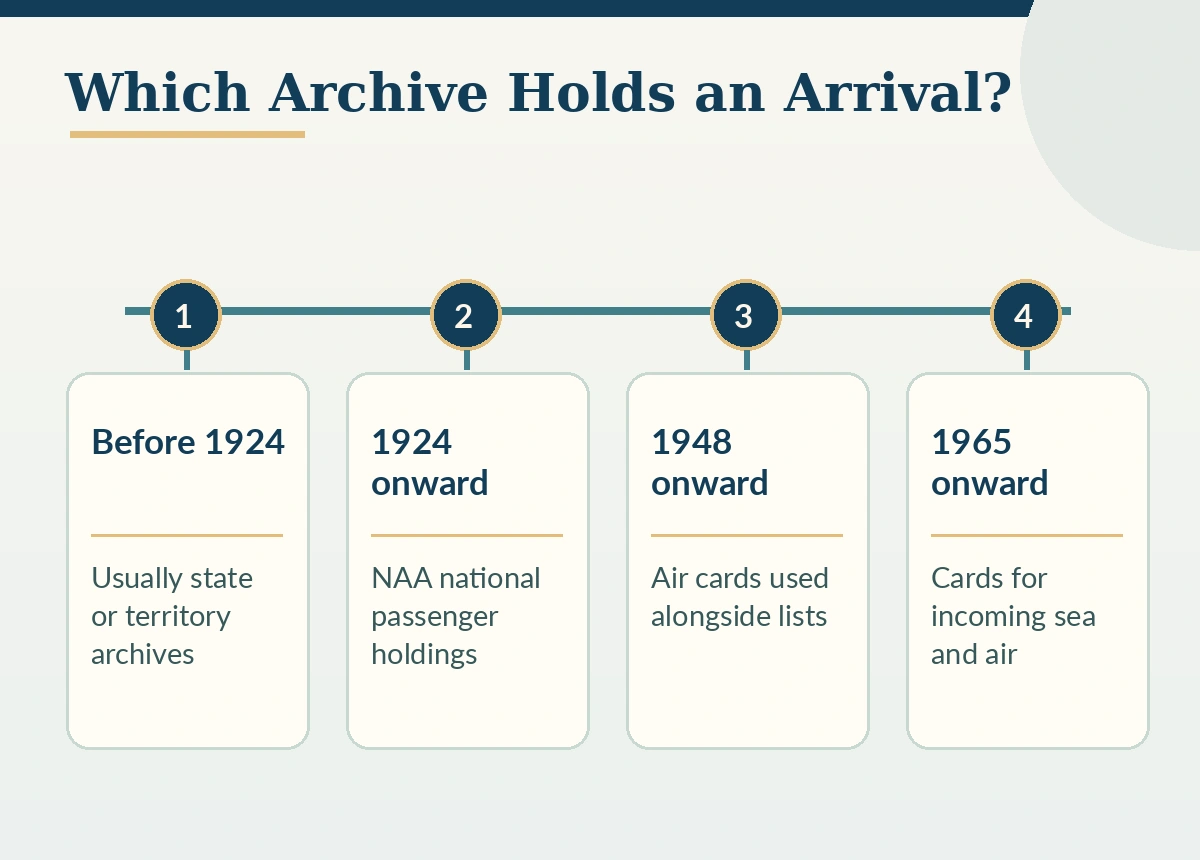
Use 1924 to choose the correct record custodian
Before the Commonwealth assumed broader passenger-record responsibilities in 1924, colonial and state authorities created and retained many arrivals lists. The National Library of Australia directs researchers to the relevant state archives for most earlier passenger sources. NAA holds some pre-1924 exceptions, notably in Western Australia, Tasmania and Queensland, but this should not be mistaken for universal national coverage before that date. For the fuller picture, see our guide “Tasmania Passenger Arrivals, 1803–1900”.
Start a movement worksheet with the earliest verified Australian address, a possible ship or flight, expected arrival month and the port the traveler may have used. Label each detail by its source: a family story, a newspaper shipping notice and a passenger arrival entry differ in reliability. If the traveler appears in Fremantle but intended Sydney, do not automatically assume Fremantle was the final point of disembarkation. If you want the full process, read how to Start Australian genealogy research across state Archives.
Separate original passenger holdings from online index years
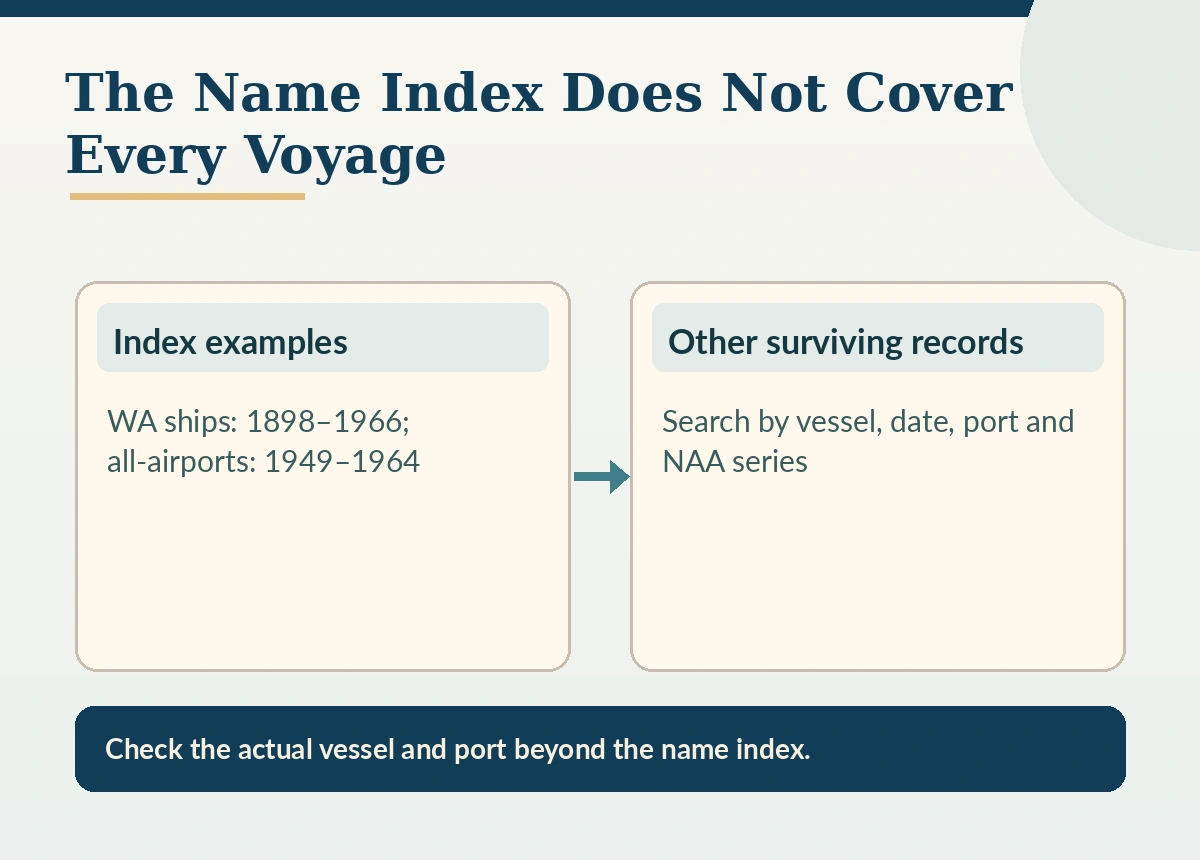
NAA’s passenger arrivals name index spans over ten million records but its indexing windows depend on transport and port. The official guide specifies ships arriving at Western Australian ports from 1898 to 1966, Perth aircraft from 1944 to 1966, all Australian airports for 1949–1964, and all ship or air entry points in 1965–1972. These limits describe a searchable index, not the entire national holdings from 1924.
For a ship arriving in Melbourne in 1930, an empty name-index result cannot establish that no manifest survives. Consult the arrival date and ship in NAA’s relevant capital-city holdings or use the agency’s passenger-arrival enquiry process. RecordSearch sometimes indexes passengers continuing beyond Fremantle, which creates a useful clue but can also be misread as proof they settled in Western Australia. Our guide “Western Australia Passenger Lists” adds more detail on this.
Search RecordSearch using names as actually recorded
Begin with family name and a wide arrival-year range. NAA reports that approximately 41 percent of entries have no given name or only an initial, and married women may be listed under a husband’s forename or initials. Try spelling variants and wildcard characters, particularly for compounded surnames, anglicized forms and names rendered phonetically. Save the precise search fields for repeatability.
Ship names may require exact spelling or wildcards. Compare the boat’s sequence of ports with the reported date: a vessel can arrive at Fremantle near the end of one year and at Sydney in the next. Use a newspaper notice or shipping schedule as independent temporal context, but do not replace an original manifest with a newspaper’s abbreviated passenger paragraph.
Follow the original series for the correct transport
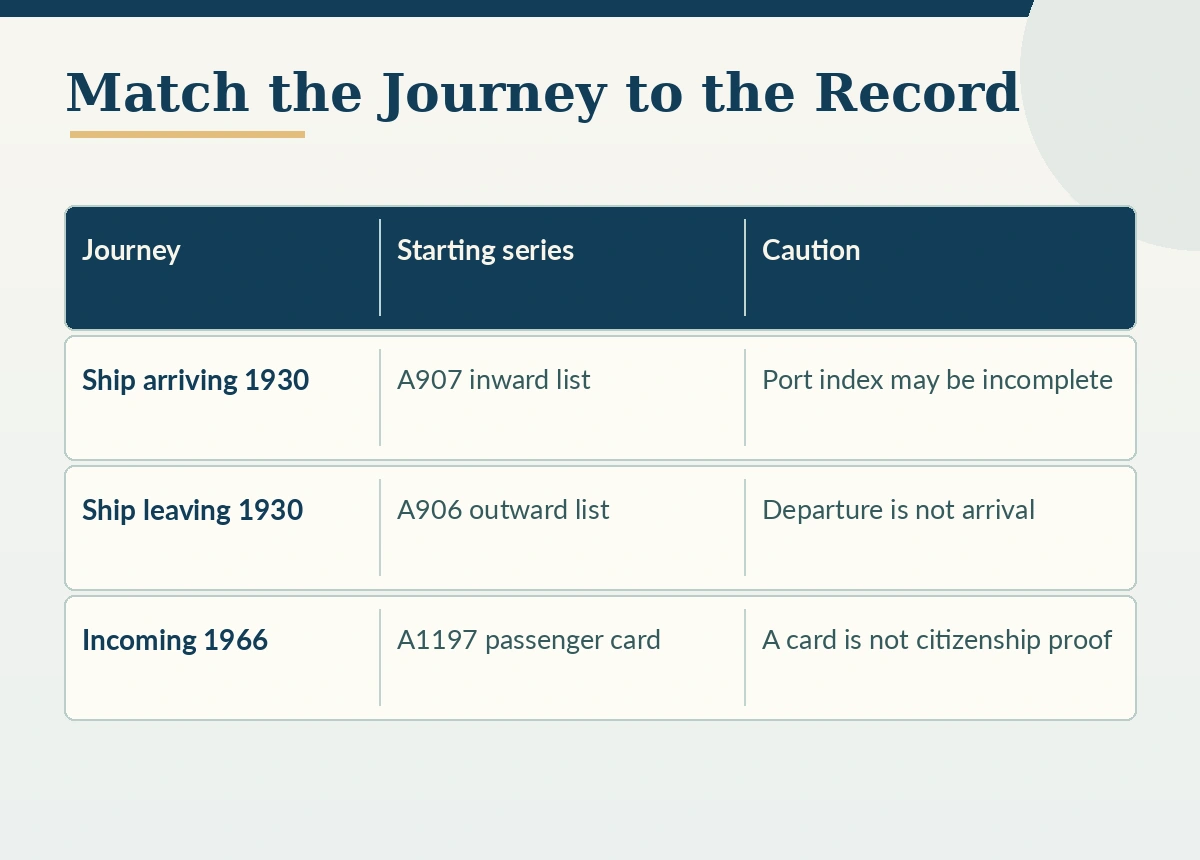
NAA’s Canberra fact sheet identifies inward ships’ passenger lists, Form P2, in A907 for 1924–1964 and outward Form P1 lists in A906. These are different movements, so an outward record is not evidence of the person’s first arrival. From 1965, incoming cards for ship and aircraft passengers appear in A1197, while an inward ship-manifest series continues as A1227. Our guide “Ship Passenger Lists” covers the South, 1538–1825: trace each name back to its source.
The shift was gradual: ship lists continued alongside air passenger cards before the 1965 universal card system. A researcher should therefore select the series by port, date, mode of travel and direction, not merely by a surname. When an original list is open for consultation, transcribe the vessel, arrival port, recorded name, occupation and destination without filling unseen fields from later immigration applications. For a comparable plan elsewhere, our guide “St. Albans Border Crossing Records” shows how to find index cards and manifests.
| Record | What it can establish | What it cannot establish alone |
|---|---|---|
| NAA Passenger Arrivals Index | Matches within indexed port and year windows | Complete national name coverage |
| A907 inward passenger list | Ship arrival for its specific date and port | Citizenship or settlement |
| A1197 incoming passenger card | Details supplied on later travel card | Earlier journeys or permanent residence |
Distinguish a passenger from a settled resident
An entry may document travel through a port, not immigrant status, citizenship or the household where someone later lived. A passenger could be in transit, return from overseas, travel under a married name, or be recorded with minimal information. The correct claim is ‘the person with these identifying details appears on this recorded arrival,’ followed by a separate test for whether that person is the intended ancestor.
Build an identity bridge using a dated Australian electoral roll, naturalization file, civil marriage record or an address in a city directory, if those records exist and can lawfully be accessed. A shared surname and ship name are insufficient when many people traveled with similar names. Contradictory ages should be noted rather than silently adjusted to fit the story.
Handle no-hit searches through the archival enquiry route
NAA advises an enquiry when the passenger arrivals index yields no record. The most helpful information includes arrival port or airport, vessel or airline and a month and year, ideally within about two months. If only a broad decade is known, first find a shipping notice, naturalization statement or death registration that narrows the likely arrival period. A carefully bounded enquiry is stronger than claiming a comprehensive index search.
Current access and privacy protections vary for later movement records. NAA directs more recent personal movement questions to other processes; this article focuses on historical family research, not disclosure of living travelers’ protected movement histories. Confirm the latest catalogue visibility, digital availability and copying procedures with the holding office.
Create a reproducible passenger search citation
Cite the archival series, item title or vessel, direction of travel, port, date, the individual’s entry and the catalogue or image reference. In the log, distinguish ‘name-index search completed’ from ‘original list viewed.’ If an archive enquiry is pending, cite the enquiry and its scope separately; that is not a substitute for the passenger record it might locate. For a step-by-step method, see how to search Ellis Island immigration records and verify a passenger.
A balanced conclusion might read: ‘A passenger with this spelling appears on a manifest arriving at Fremantle in this year; whether that traveler continued to Sydney remains to be tested.’ That is a useful finding. The next step is a port-by-port voyage reconstruction and one independent identity record, not a leap from a transit entry to permanent residence.
More Records and Archives Guides
How We Research Australian Records
We checked the National Archives’ passenger-arrival guide, its Canberra series inventory, the National Library’s custody summary and NAA’s movement-record guidance. These distinguish a surviving series from a searchable name index, and place the 1965 transition after a period of mixed list and card systems. We treat all example journeys as hypothetical and flag living-person privacy constraints. We do not promote a paid passenger database; read our affiliate disclosure for the site’s general policy.
No. National holdings are broader than the RecordSearch passenger-arrivals index. Coverage depends on port, transport and years; search a known vessel and date when the name index fails.
Ships commonly called at Fremantle before traveling east. An index hit can capture someone who remained aboard; confirm the port where the passenger disembarked.
Incoming passenger cards replaced lists as the standard for both air and ship passengers, although other manifest series also exist. Check the appropriate NAA archival series.
No. It records a movement, not citizenship. Check later naturalization or citizenship records separately where accessible.
Provide the most likely port, ship or airline, arrival month and year, plus variant names and supporting evidence. Verify the current enquiry service before sending personal details.