
Ship Passenger Lists: The South, 1538–1825 is a published collection edited by Carl Boyer, not a complete set of original ship manifests for the American South. It brings together names from printed articles, earlier transcriptions and historical accounts selected through Harold Lancour’s bibliography. A surname entry is a useful lead, but its source may be a settlement list, court minute, emigration account or passenger record. Start with the National Archives’ early passenger-list guide before making any claim about an actual arrival.
Identify the exact Southern volume before searching a name
Birmingham Public Library catalogs Boyer’s Ship Passenger Lists, The South, 1538–1825 as a 1979 compilation, distinct from his volumes for New England, New York and New Jersey, or Pennsylvania and Delaware. Editions and reprints may display different pagination, so record publisher, date, edition and page before comparing a web transcription with a physical book. A title’s long range is not continuous annual coverage. To go further, our guide “New York and New Jersey Passenger Lists, 1600–1825” shows how to check the source.
The volume is organized around selected published lists derived from Harold Lancour’s bibliography. NARA links it to Lancour entries 198E–243. This organization matters more than a broad regional label: a particular item might concern Virginia, Maryland or a southern colony at a specific date, but the book should not be described as if every ship and arrival for every southern port were recorded.
Follow the surname index back to the individual item
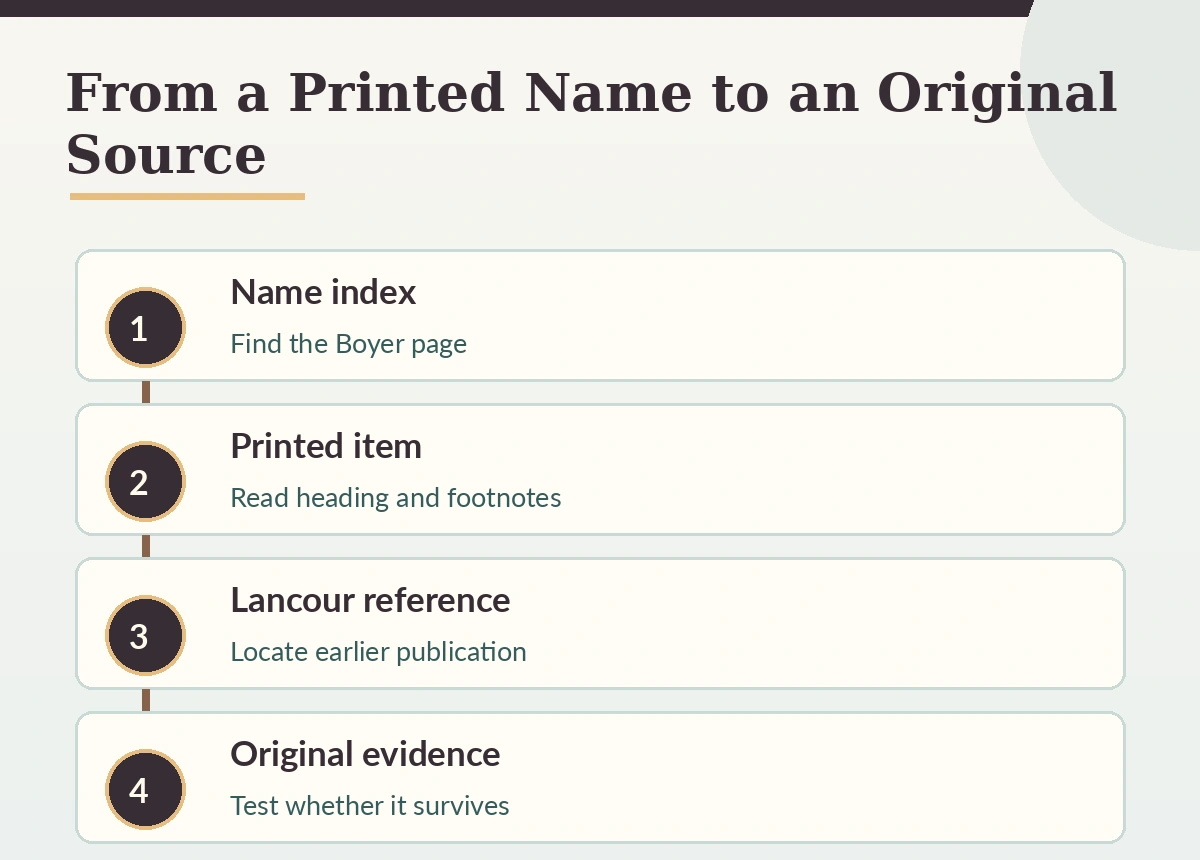
Search the personal-name index for original spelling, variants, prefixes and obvious transcription alternatives. Copy the indexed page number, then read the whole printed entry and its heading. A list title, editor’s note or footnote may name a different underlying publication or reveal that the date is not an arrival date. Record any numbered Lancour reference rather than citing only the book’s alphabetical index.
Inspect neighboring lines for context: a paragraph may describe people embarking overseas, settlers receiving land, or passengers mentioned indirectly in proceedings. Those are not interchangeable events. If the text is abridged, do not restore missing relationships from an unrelated online tree; mark what was omitted and seek the cited source publication or an independent contemporary record.
Distinguish a colonial compilation from a federal manifest
The U.S. National Archives says that before January 1, 1820 federal law generally did not require captains to deliver passenger manifests, with specific early exceptions at Philadelphia and New Orleans. Consequently a seventeenth-century entry in a printed Southern list should not automatically receive a federal manifest citation. It may derive from colonial records, a printed historical journal or another fragmentary publication.
The same NARA guide covers ordinary federal passenger-arrival records beginning about 1820, subject to losses and port coverage. For an 1823 southern arrival, first determine whether a federal customs list exists for that port and date; for a 1680 claim, look for source-specific colonial evidence. This date-and-repository separation helps prevent the common mistake of searching one national database for centuries it does not cover.
Reconstruct the source chain for a printed passenger entry
Use a four-column source ledger: Boyer page, cited earlier publication, original record if identified, and what each actually asserts. If Boyer reproduces a historical journal extract, that journal is a derivative presentation. If the journal quotes a colonial court document, the court document is the possible primary source. Verify the chain rather than citing the most convenient screen as though it were the first recording.
Not every earlier manuscript survives or is practically accessible. When the original cannot be recovered, a carefully identified published edition still supplies a documented clue, but confidence must account for its age, editing and fidelity. Describe missing links explicitly: ‘Boyer prints a name under this source heading; the original document has not been examined.’ This is more accurate than inventing an archival box number.
| Record | What it can establish | What it cannot establish alone |
|---|---|---|
| Boyer surname index | Location of name in printed compilation | Direct access to original manuscript |
| Lancour-listed earlier source | Published context for particular list | Presence on every voyage |
| Port or colonial original | Contemporary observation if extant | Kinship of a later namesake |
Separate an appearance in a list from actual residence
One listed person may have traveled and then returned overseas; another may appear in a secondary list prepared decades after settlement. A record of embarkation is not necessarily proof of arrival at the named port, and a claim to land is not necessarily a passenger declaration. Transcribe the verb and event in the source before placing the name on a migration timeline.
Test an identification with dated deeds, parish registers, probate cases or tax lists in the supposed destination. A later family could contain two same-name individuals from different generations. Use a jurisdiction-by-date table to avoid transferring a name from a seventeenth-century Virginia record to a nineteenth-century Carolina family merely because the surnames match. Our guide “Overwharton Parish Register, 1720–1760” goes into more detail.

Check geography and chronological claims independently
Historical terms for colonies, provinces, ports and counties change over time. A modern state border is not a faithful guide to eighteenth-century administrative records. Identify the jurisdiction named in the original work and track subsequent boundary changes separately. If Boyer’s item cites a colonial place, use that place as the research target rather than forcing it into a modern county without evidence.
The 1538–1825 date span describes the scope of the compilation’s source selections, not a promise of regular passenger traffic lists for every year. For an unindexed family, consult the Lancour bibliography directly and examine alternate compilations or local court and port records. Keep negative searches limited to the actual book, pages or period inspected.
Write a citation that reveals the derivative layers
Your citation should identify Boyer, full title, edition, page, quoted list heading and the older publication or Lancour item noted there. If you then view an original manuscript, cite it separately by repository and reference. Do not silently replace the book citation with a fictional ship-manifest number, and do not state parentage unless the underlying source explicitly supplies a link.
A sound conclusion is ‘This published excerpt contains the name and a possible migration context, but the original has not yet been verified.’ The next search should target the named earlier source and a dated record in the proposed destination. A printed list is evidence for what its compiler published; it is not automatically independent proof of an ancestor’s crossing.

More Research Method Guides
How We Research Ship Records
We checked the National Archives’ passenger-arrival guidance, which explicitly names Carl Boyer’s Southern volume and the Lancour item sequence, against library catalog descriptions and a later-edition bibliography. This prevents the text from treating sixteenth- and seventeenth-century published lists as uniform federal manifests. Examples describe hypothetical names without inventing ships or documents. We provide no paid bookstore links. Our general policy appears at affiliate disclosure.
No. It compiles selected published sources; many movements were not recorded and others were never printed in the sources Boyer selected.
No. Check the entry heading and its original publication. It may quote a different type of colonial document or refer to departure rather than arrival.
Record the exact edition and page, inspect the item’s heading and source note, and follow any Lancour or earlier-publication reference.
No. NARA explains the general U.S. federal passenger-list requirement began in 1820; pre-1820 evidence is fragmented, with certain port exceptions.
Not by itself. Establish identity using the source context and independently dated records in the claimed destination, checking competing namesakes.