
Search New Zealand arrival records by name first, then switch to the ship and port if the index misses your traveler. Archives New Zealand describes preserved ship passenger lists dating from the late 1830s through 1973. But warns that before 1910 not all lists were collected. Its digitised holdings connect to FamilySearch, with older publicly viewable images handled differently from some more recent material. This guide shows how to search by name, browse by ship and arrival port, evaluate blank results, and separate a vessel’s recorded passengers from assumptions about family ties or permanent settlement.
Start with the official Archives New Zealand finding guide
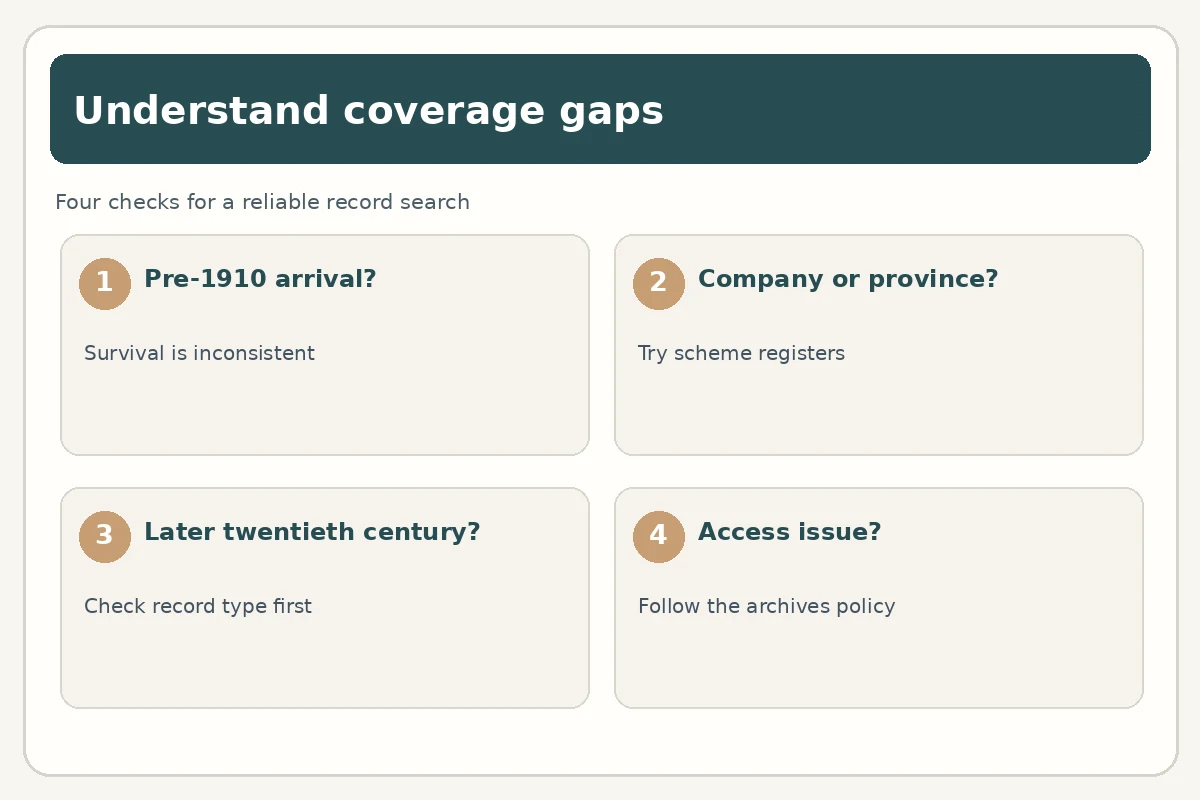
Use the Archives New Zealand “Searching passenger lists” guide to determine the relevant collection and access route. It identifies passenger lists for arrivals from 1838 to 1973, while the well-known online FamilySearch collection is commonly titled for 1839–1973. The slight difference in how a range is described should not be used to declare that every year has equal coverage. The archive stresses that lists were not consistently collected before 1910 and sometimes originated as shipping-company accounting records rather than modern immigration applications. Gather the earliest confirmed New Zealand address, likely arrival decade and any ship name before searching. Those clues give a check on competing index results and reduce the temptation to identify a stranger based only on matching surnames. For the same kind of choice in another place, see our guide “Castle Garden Records”.
Run a name search with initials and phonetic variants
Archives New Zealand recommends searching the digitised FamilySearch collection by full name, approximate year or place. First try the given name and surname, then the surname with an initial, alternate spelling or shortened first name. A clerk may have written a name as it sounded; an indexer may have interpreted faded handwriting differently from you. If you find a promising hit, open the image rather than accepting the short transcript. Inspect the ship, port, time period and listed travel companions. A person described as “J. Thompson” may be one of several relatives or unrelated migrants, so do not force an identity match with a later marriage certificate unless other evidence supports it. Keep the names rejected and why they failed.

Browse all images by port and vessel when names fail
The official archive guide gives a second method: browse the FamilySearch images by port, year and ship instead of relying on the search index. Port folders may appear more than once, and a ship could visit several ports on one voyage. If you know “Wellington, 1884” from a family letter, scan the relevant ship images and date range rather than inventing a surname transcription that returns a hit. If the ship is known but the listed landing port differs, investigate the voyage itinerary and whether the traveler could have disembarked elsewhere. Record a folder path, ship name and image number so the discovery is repeatable. A blank name search is not proof that an image contains no relevant traveler.
Distinguish a travel party from verified relatives
A passenger list may record age, occupation, prior residence, marital status or names of fellow travelers. But Archives New Zealand cautions that detail varies. Sharing a ship does not prove kinship, and a surname in one cabin or family group can still require independent confirmation. Create a source matrix comparing the recorded arrival details with marriage, cemetery, directory, land or census-substitute records from New Zealand. Preserve original place spellings, and do not silently convert last residence into birthplace. For a fictional family story of three siblings, finding one indexed name and two nearby initials is promising context rather than a proven sibling group. Seek records that explicitly state a relationship and verify chronology.
Apply the correct rules for digitised image access
Archives New Zealand states that all passenger lists it holds have been digitised, while records over one hundred years old are available online through FamilySearch. The archive’s broader guidance distinguishes passenger lists from immigration case files, some of which are restricted for one hundred years after closure. Those are not the same records or restrictions. Do not assume an undigitised page because a particular FamilySearch name search fails. Instead use the ship-and-port browsing route and the archive’s Collections search. For twentieth-century records that are not accessible through the same public image route, read the holding institution’s access instructions rather than trying to circumvent restrictions or disclosing living travelers’ details. Always document the date when access was checked. For the same kind of choice in another place, see our guide “South Australia Passenger Lists, 1836–1940”.
Identify early provincial and company immigration schemes
Early New Zealand immigration was organized through varying companies and provincial authorities. Archives New Zealand describes New Zealand Company embarkation registers, some Canterbury material and later assisted immigration schemes. These records can be helpful when ordinary passenger lists are absent, but their administrative purposes differ. An embarkation register may name someone who departed, not necessarily a completed arrival. A scheme application can record intended rather than realized travel. Record the series title and date before concluding what an item proves. Regional sources may also document settlers through land, employment and local newspapers. Avoid treating any single scheme as a universal list for all migrants, especially during decades when official collection was uneven.
Corroborate the vessel and person from a second source
Try independent historical newspapers, port reports or family letters to establish a ship’s itinerary and the name or date used at the time. National Library of New Zealand guidance points to ship and embarkation resources that can complement the official list. A newspaper advertisement for a vessel establishes context but might not name a passenger. Conversely, an arrival list naming a traveler does not prove the traveler remained permanently or is the later person with the same name. Compare place of residence, occupation, family members and subsequent dated records before assigning the ship to your lineage. If the evidence allows only “candidate aboard this vessel,” make that uncertainty explicit. Do not transform it into an asserted family fact. If you want the full process, read how to Start New Zealand genealogy with BDM and passenger records.
Cite the ship list and its exact image location
Capture “Archives New Zealand” as custodian where appropriate, the collection or series, name as actually recorded, ship, arrival date and port, and the FamilySearch image or archive item identifier. When the online record is a volunteer-indexed transcription, cite the underlying scanned page separately. Retain any uncertainty about dates, initials or handwriting. Note the access date, especially for a twentieth-century image whose availability may differ from earlier lists. Include negative searches, alternative ports and ship spellings in the research log. A precise citation lets another genealogist revisit the source and test whether a proposed family relationship is supported by the same details, rather than inheriting an unsupported tree entry.

How We Research Historical Passenger Records
We used Archives New Zealand’s current passenger search, migration, and access pages and checked the National Library’s separate family-history guide. Coverage before 1910 is explicitly described as incomplete. We do not portray the 1839–1973 FamilySearch collection title as guaranteed image survival for every voyage. All sample passenger scenarios are fictional. The diagrams provide methods rather than reproductions of official manifests.
More Records and Archives Guides
Official Record Collections and Research Sources
Archives New Zealand describes its ship passenger lists for 1838–1973, incomplete collection before 1910 and FamilySearch digitisation route (www.archives.govt.nz).
It also explains immigration series, provincial schemes, port-based browsing and the limitations of surviving historic lists (www.archives.govt.nz).
Archives New Zealand distinguishes historical passenger lists from restricted immigration case files and explains the digital access route (www.archives.govt.nz).
National Library of New Zealand identifies the passenger-list collection and additional vessel and embarkation resources for cross-checking a voyage (natlib.govt.nz).
Coverage limitations before 1910 and any current limits on twentieth-century image access must be checked at Archives New Zealand. The graphics are newly drawn educational workflows, not individual travelers or government records. No New Zealand archive endorses this article. For site-wide disclosures see the GenHis affiliate disclosure.
Archives New Zealand describes holdings from the late 1830s to 1973, with significant collection gaps before 1910.
Yes. The archive recommends browsing digitised images by port, year and ship on FamilySearch.
The archive notes that digitised lists over a century old are available on FamilySearch; check current access for more recent material.
No. It documents an aspect of travel; permanent settlement requires additional evidence.
Look at company or provincial scheme records, period newspapers and dated local records, while documenting collection gaps.