
The title Ship Passenger Lists: New York and New Jersey (1600–1825) refers to Carl Boyer’s 1978 compilation of published early-arrival material, not a complete government register of everyone who entered those colonies or states during 225 years. The U.S. National Archives explains that regular federal passenger-list requirements began in 1820, with limited exceptions for earlier records at Philadelphia and New Orleans. For a seventeenth- or eighteenth-century immigrant, a name in a published abstract must be traced back to the original article, manuscript or register it represents. Begin with the compilation, but finish with a source-specific proof question. See the official archive research guidance for collection scope.
Identify exactly what Boyer’s 1600–1825 book is
Boyer’s book is a printed compilation drawing on Harold Lancour’s bibliography of early passenger lists. The National Archives lists it among reference works for pre-1820 arrivals, and Birmingham Public Library identifies the New York and New Jersey volume as a selection of material rather than a census of all passengers. The dates in its title mark the historical span addressed by source material; they are not a promise of continuous port-by-port manifests. Treat it as a finding aid for scattered earlier publications.
Locate a library catalog record for the volume and record the correct title, editor, publication year and page of any entry. If you use a name index, note the indexed spelling separately from the source entry. An extract reproduced on a genealogy website may omit bibliographic citations essential to identifying the original record. Search for the printed work through libraries before assuming that a commercial database has reproduced all its contexts.
Use the 1820 boundary to avoid searching for nonexistent manifests
Before January 1820, the U.S. federal government generally did not require ships’ masters to submit passenger lists to officials. NARA describes exceptions for arrivals at Philadelphia between 1800 and 1819 and at New Orleans between 1813 and 1819, not a comprehensive system covering New York and New Jersey. For the colonial era, surviving names may instead come from private correspondence, settlement accounts, naturalization documents, church registers and published transcriptions.
A successful search begins by asking which authority created the record in that year and port. Do not search the NARA series M237 for a named New York arrival in 1750: it covers a later period. Equally, do not claim that a passenger never arrived because no federal manifest exists before the reporting requirement. The lack of a systematic surviving list describes a record system, not the movements of a specific person.

Read a published entry for its citation, not just its names
When an index lists an early immigrant, capture the exact entry, date wording, ship or place if given, page, and citation to the earlier published or archival source. One entry may concern departure rather than arrival; another could describe a land grant, service contract or resident of a colony rather than a passenger who stepped off a particular ship. Check the original article’s introduction for how its editor selected and transcribed names.
Distinguish an original contemporary document from a later historical narrative. A nineteenth-century author transcribing a seventeenth-century list may have modernized surnames or assigned a date from context. The abstract may omit uncertainty that the original editor noted. The strongest next step is to identify the underlying manuscript and see it or a faithful reproduction, preserving any headings that explain the person’s role.
Follow Lancour and bibliographies to the underlying publication
Lancour’s bibliography points researchers toward published passenger lists, and Boyer selected and consolidated material from it. Trace a Boyer entry to the cited article or source rather than copying a name from the volume into a pedigree without context. New York State Archives and library bibliographies help identify the relevant reference works. Look for a source title, publication volume, page range, and repository before treating an index hit as evidence of a crossing.
Some periodical lists were originally prepared for another administrative purpose. A set of servants bound overseas, ship officers, colonists receiving supplies, or passengers named in court proceedings may not represent a complete passenger roster. If the earlier source cannot be retrieved, cite the compiled book honestly and label your conclusion provisional. Do not manufacture ship names or ports when the surviving entry does not state them.
| Record pathway | Period or purpose | Research limitation |
|---|---|---|
| Boyer / Lancour | Selected early published lists | Not a comprehensive manifest |
| Colonial parish/land | Presence in a settlement | May not name voyage |
| M237, New York | Federal arrivals from 1820 | Survival and access gaps |
| M261 index | New York 1820–1846 index | Must inspect arrival list |
Separate Dutch colonial names from later English spellings
New Netherland and neighboring settlements produced records in different languages and naming traditions. A patronymic or locative form might look unlike a later hereditary surname. Search for documented variants in a bounded locality, considering the date and language of the original. Beware of assuming that every person bearing a Dutch surname arrived from the Netherlands during the period in question; some were born in the colony, moved between settlements, or appear only in local records.
Create a name-variant column and keep the literal spelling on each document. An assumed English equivalent should be identified as a hypothesis, not silently substituted in a transcription. A same-named person in a colonial church book and a separate immigrant list might be related, but their identity needs a bridge such as occupation, household, landholding, or associates. The broader migration context does not substitute for that documentary connection.
Find arrival clues in colony and port records beyond passenger books
If the compilation yields no convincing result, search the colonial and early state records for the documented settlement: church membership registers, marriages, naturalization or denization materials, land grants, legal petitions, property transfers and port-related correspondence. These records can establish residence or status without recording an actual transatlantic voyage. Pay attention to the historical jurisdiction: a person in the area now called New Jersey might have appeared in colonial records arranged by proprietary or later county authorities.
Local records are not automatic replacements for ship manifests. An adult appearing in a church register in 1710 proves presence at that event, not the ship used or the precise arrival year. A marriage document can reveal a place of origin but still leave the migration route unresolved. Write the narrow claim each substitute supports and reserve a ship-specific arrival statement for an actual passage or arrival document.
Switch to federal port-arrival series for 1820–1825
For New York arrivals beginning in 1820, move from colonial compilations to federal customs arrival records. NARA identifies M237 as passenger lists for New York arrivals from 1820 through 1897, and an M261 index for early New York arrivals from 1820 through 1846. These are different source types from Boyer’s compiled references. A passenger name for 1823 may occur in both sources, but the official manifest offers the better route to ship and arrival details when it survives.
Check the actual port of arrival, not merely the family’s later residence in New Jersey or New York. A traveler might disembark at Philadelphia or elsewhere before moving into the area. Preserve the vessel name, arrival date and page rather than assuming a person was listed at the port closest to their eventual farm. National Archives digitization and partner access vary, so document whether you viewed an original list image or only an index.

Build a proof statement with a visible source hierarchy
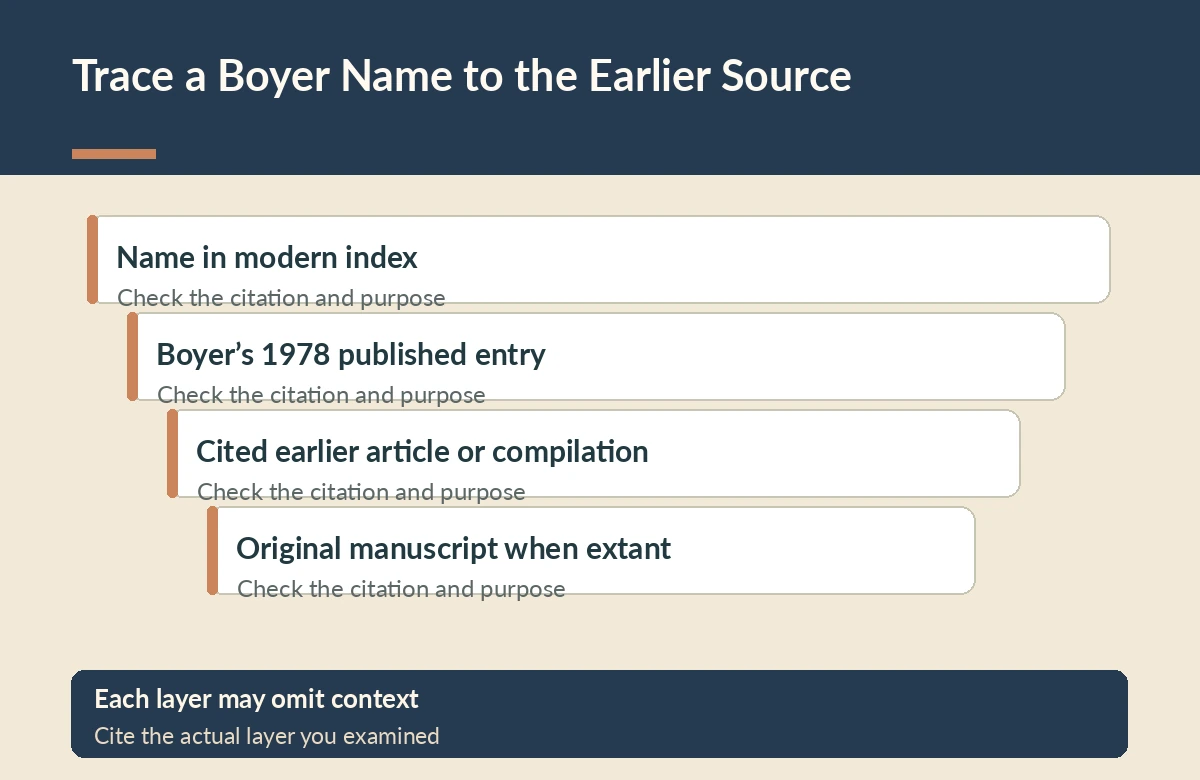
Consider a hypothetical eighteenth-century reference naming Anna de Vries in a published settler list. The proper chain is: name index; Boyer’s page; cited periodical or manuscript; contemporary record and its stated purpose. Only after that should you compare a same-named person with a local baptism, marriage or property record. The fact that a surname appears in a passenger compilation does not mean the listed person is the ancestor, even if dates seem plausible.
Use a source hierarchy with four labels: contemporary document inspected, reliable reproduction, later published abstract, and name-only index. For each, record the exact claim and uncertainties. If a source records only a person’s presence in the colony, state that instead of inventing a ship. An archive research log that describes an unresolved arrival is more useful than a confident but unsupported immigration anecdote. For the fuller picture, see our guide “Castle Garden Records”.
More Records and Archives Guides
How We Research early New York and New Jersey arrivals
We consulted NARA’s passenger-arrival guide for the 1820 requirement and named exceptions, and verified Boyer’s 1978 title through National Archives, New York State Archives and public-library bibliographies. This page is distinct from the GenHis Castle Garden and Ellis Island guides because it concerns published pre-federal fragments and source tracing, not mass-arrival station indexes. The editorial rule is to prove the type of underlying record before using a passenger name as a migration fact. See our affiliate disclosure; these sources do not imply a paid partnership.
Names in the examples are invented and not represented as an archival discovery. We do not claim that every early immigrant was recorded or that Boyer’s compilation exhausts earlier sources. A final conclusion should state whether a true voyage record, a settler list, or an indirect residence document was actually examined.
No. It is a 1978 selected compilation of earlier published sources, not a uniform government manifest series.
There was no general federal reporting requirement before 1820; NARA notes limited exceptions for other ports.
Retrieve the cited page, identify its underlying publication or manuscript, and check what the record actually documented.
Search the actual port where arrival might have occurred and local colonial records; later residence does not prove port of entry.
NARA identifies M237 for New York passenger lists from 1820 and M261 as an early index for 1820–1846.