
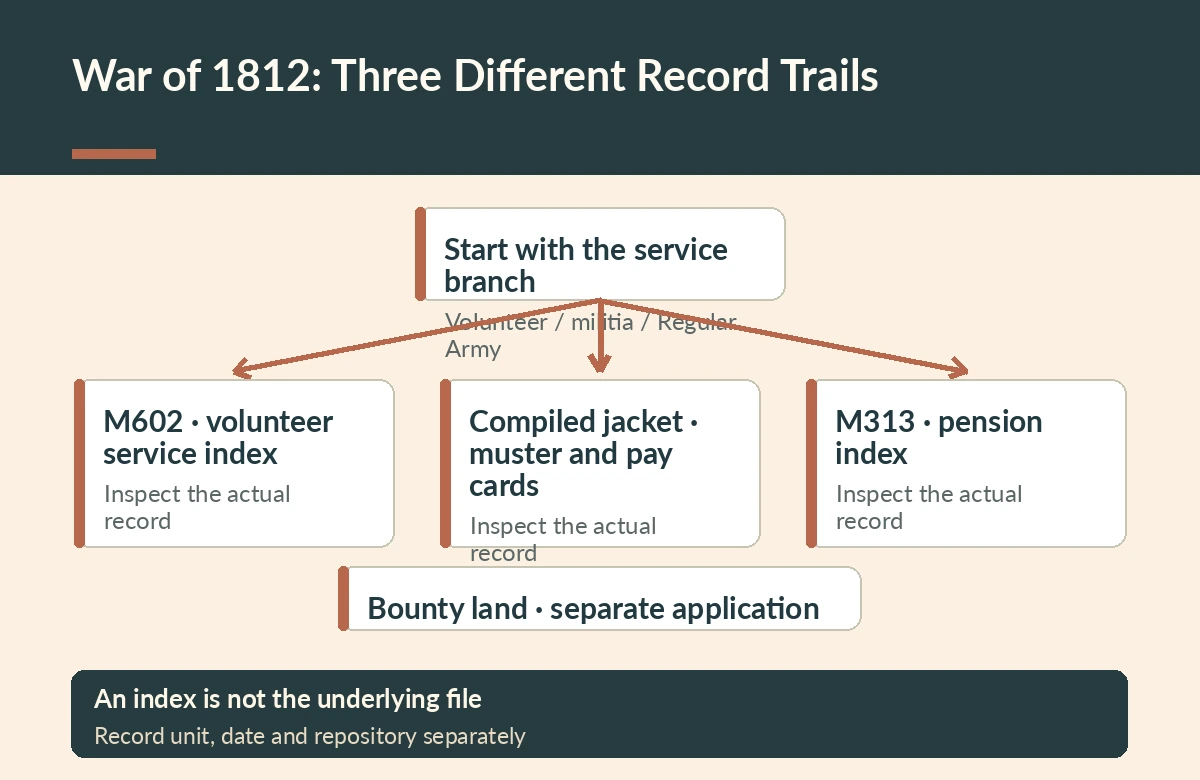
War of 1812 military research works best as three distinct searches: a compiled service record index, the underlying volunteer soldier’s compiled service file, and any later pension or bounty-land application. The National Archives identifies M602 as an index to compiled service records of volunteer soldiers; the index card is not the service jacket itself. The surviving file may document muster periods and a unit without identifying a spouse or parents. Start with the organization and state, retain variant officer names, and never present an index match alone as conclusive proof that a particular ancestor served. See the official archive research guidance for collection scope.
Distinguish volunteer militia records from Regular Army service
Determine whether the family tradition concerns a state volunteer, federally called militia unit, Regular Army soldier, sailor, or marine. These groups may appear in different archival arrangements. The M602 index specifically points to volunteer soldiers’ compiled military service records. A uniform reference to ‘the War of 1812’ is therefore not enough to select the correct filing system. Begin with a hometown, an approximate service window, and a possible unit or commander taken from an independent document.
A pension statement written decades later may name a different regiment than a descendant’s story; keep both forms until you locate muster evidence. Consult a state archive for local militia payrolls and related state-held records. Absence from M602 should prompt a branch and coverage question, not a claim that an ancestor never served. Record whether each search concerned an original roster, a compiled jacket, or an index created after the event.
Read an M602 name and unit entry as a pointer
M602 is a microfilm publication indexing compiled service records of War of 1812 volunteers. Search surname variants and initials; unit labels frequently reflect a commanding officer rather than a permanent regiment name. Copy the state and organization verbatim and save the complete index reference. One soldier may be indexed with spelling differences, and two unrelated soldiers may share a name. Consider dates and home county from local sources before associating the entry with the target family.
Record the repository and access method. Images of an index may be available through digitization partners, but access to a service file is a separate question. Transcribe what the card actually says, rather than assigning the soldier a battle, rank promotion, pension or land grant not shown there. An M602 result supports the existence of a filed record for a service name and unit. It does not establish which same-named person in the civil population it represents.
Request and examine the compiled service jacket itself
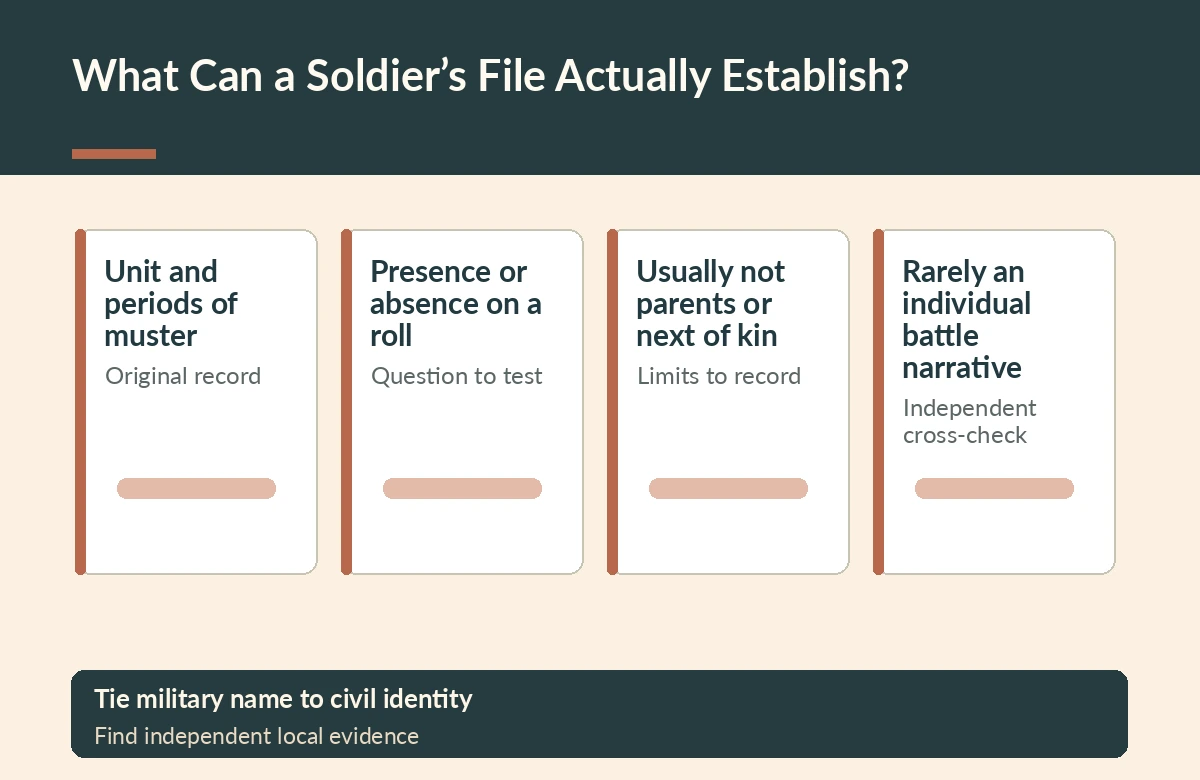
The War Department created compiled military service records from muster rolls, pay rolls, regimental returns and related material. A jacket can hold several cards, each derived from a particular mention of the soldier in an earlier record. Check the state, unit, date of muster, enrollment or discharge, and whether the person was present or absent. Note that a compiled card is a transcription of an earlier record, not the original muster roll itself.
A jacket may contain surprisingly little biographical detail. The National Archives warns that these files generally do not name parents or next of kin, and they rarely list battles. If a researcher claims a named ancestor fought at a particular place because a unit was there, that conclusion needs independent evidence. Cite the jacket and each decisive card, and distinguish unit history from documented individual service. Some files have not been digitized in full.
Compare commander labels and fragmented periods of duty
Volunteer regiments were often identified by commanders whose names appear with various ranks or spellings. A man could have served in multiple short periods, and not every isolated payroll entry represents uninterrupted participation across the war. Construct a dated service table directly from the cards rather than describing a general ‘1812–1815 military career.’ One muster may record a different company, a temporary detachment, or absence without explanation.
Compare the unit with a contemporary state roster when available. A state roster may add residence clues but can also repeat the same transcription or introduce another person of the same name. Treat two compilations based on one original muster as dependent evidence. To prove that the service record belongs to your ancestor, look for an independent local tax list, later application, family correspondence, or the veteran’s own sworn statement.
| Source | Best use | Cannot establish alone |
|---|---|---|
| M602 index | Find volunteer name and unit | Civilian identity |
| Compiled jacket | Muster and pay entries | Parents or individual battles |
| M313 index | Locate possible pension file | Approved claim or full testimony |
| Bounty-land case | Claim history and warrant | Later land occupancy |
Follow M313 into pension files without assuming eligibility
A War of 1812 pension search is not the same as the service-file search. The National Archives identifies M313 as an index to War of 1812 pension application files. Federalized state militia veterans began receiving pensions under later legislation, with widows becoming eligible under another later act; entitlement was not universal at the time of service. Some veterans applied decades after the war, and others did not survive long enough to seek a pension. For the next step, our guide “Revolutionary War Pension Abstracts” explains how to find the complete claim file.
Search a pension index only after the soldier’s name and organizational clues are captured. If an application exists, inspect the full case, not merely the application summary. Statements, marriages, witnesses, and dates may be highly informative but must still be assessed by informant and purpose. A pension file can contain conflicts in ages or service durations precisely because claimants were recalling events from many years earlier.

Keep bounty-land warrant applications in their own lane
Bounty-land arrangements and service pensions followed different laws and record pathways. The NARA pension guide explains that applications may be consolidated if the veteran sought both benefits, while some bounty-land files remain separately arranged. M848 identifies War of 1812 military bounty-land warrants, and related application case files extend across different conflicts and acts. A warrant signals a benefit decision; it is not automatically proof that the veteran settled or owned a particular parcel.
If you find a warrant, trace its application and subsequent disposition before stating that the applicant lived on the land. Check whether the warrant was assigned to another person and whether a federal patent or local deed exists. Record names of claimants and witnesses without treating each as kin. When researching a same-named person, a later residence, age declaration, or widow’s testimony may separate candidates more effectively than the original service index.
Build a conflict test for two soldiers with the same name
Imagine two candidates named James Miller, each indexed to an organization from the same state. List commander, company, period of service, county context, and the postwar location shown in later evidence. If one pension affidavit references a spouse already documented in civil records while the other leads to a different county, the conflict can be tested. But don’t reuse those fictional labels as though they were names in an actual archival file. Our guide “Civil War Draft Enrollment Lists, 1863–1865” shows how to find men without assuming service.
A successful match should show a specific bridge between the military reference and the civilian ancestor. A neighbor serving with the same commander might provide context but cannot by itself prove identity. If the service papers contain no civilian details, keep the conclusion qualified and seek local militia rolls, land claims, pension testimony, or probate papers. More records do not help unless the records contribute independent identification features. For a step-by-step method, see how to find a civil War ancestor using service and pension records.
Cite indexes, compiled cards and later claims separately
An accurate citation records the name as filed, the War of 1812 volunteer unit, M602 index reference if used, and the specific compiled service record or pension file. Do not cite an index card as though it were a full jacket. If you examined a digitized derivative, identify the platform and record’s original National Archives custodian. For the same individual, keep a separate citation to M313 and to the actual pension packet when inspected.
Write a clear bottom-line statement such as ‘A volunteer service file was found under this name and unit; identity with the target resident remains uncertain.’ This is stronger scholarship than assigning unsupported battles or pension payments. Your log should include search date, spelling, unit, coverage, and retrieval method for unsuccessful searches. A missing digitized packet may simply require an archive request rather than a new genealogical hypothesis.
More Records and Archives Guides
How We Research War of 1812 service sources
We compared the National Archives’ War of 1812 overview, compiled service-file guide, pension-and-bounty-land routing page, and military microfilm list. Those sources distinguish M602 from a service jacket and M313 from later applications. We also compared this intent with existing GenHis Civil War and Revolutionary War articles: the distinctive challenge here is the mixed volunteer, Regular Army, pension and land pathways. We do not claim all packets are viewable for free. Read our affiliate disclosure; no affiliate relationship underlies these archive links.
Editorial examples use hypothetical soldiers only. We prioritize independently verifiable dates, organizations and claim evidence, while flagging uncertainty where the record contains a name but no home community. Access terms and digitization vary by collection, so a search should document what was actually examined rather than treating every index as an original military record.
No. M602 indexes volunteer compiled service records. Follow the name and unit reference to the compiled jacket.
Usually not. NARA states that service jackets generally lack parents and next-of-kin information.
Not necessarily. M313 indexes pension applications, while separate case files or consolidated bounty-land claims may exist.
No. Eligibility and applications followed specific laws; even an issued warrant does not establish residence on a parcel.
Compare units and service dates against independent county, marriage, pension, and postwar evidence instead of name alone.