
To find a Civil War ancestor, first identify a plausible soldier’s state, military side, regiment and company, then obtain the relevant compiled service record and compare it with civilian evidence. The National Park Service’s Soldiers and Sailors database is a useful names index, but a name match is not proof of ancestry and the index is not the entire military file. A soldier’s service, any pension application and the evidence of a parent-child link are different research questions; resolve each one separately.
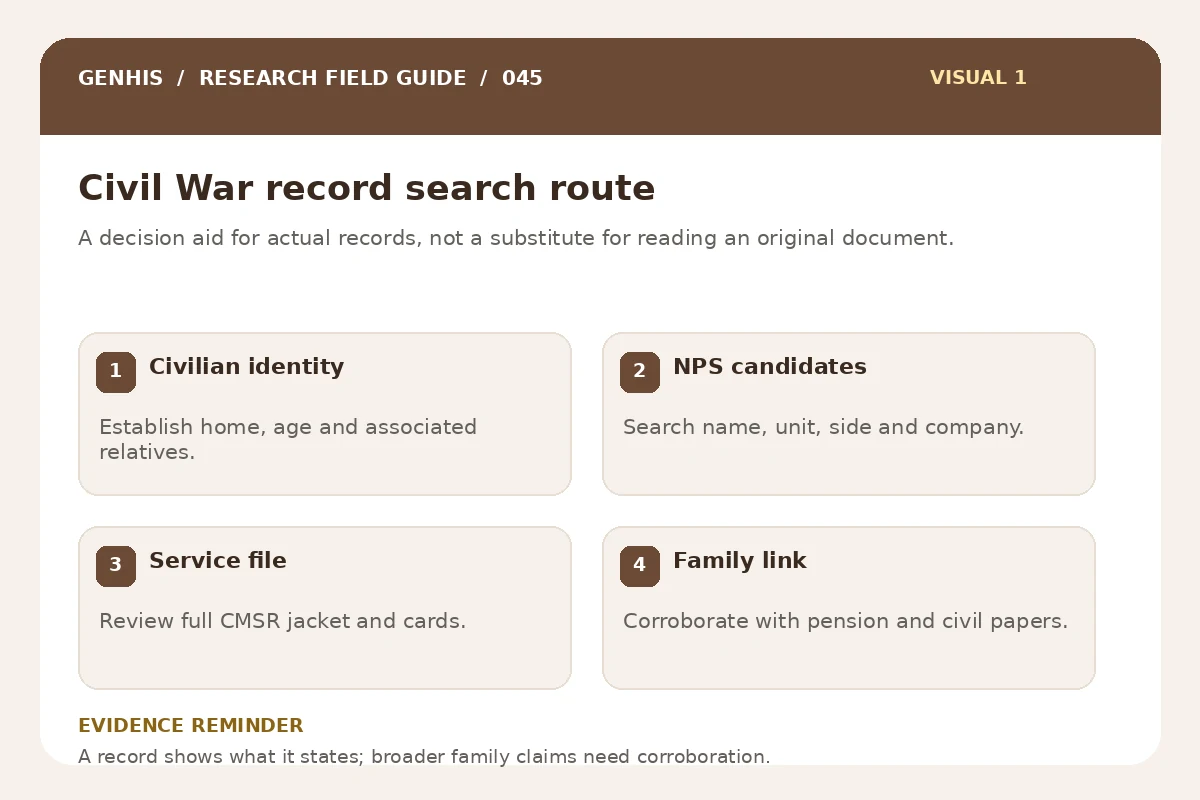
Build a civilian identity profile before matching a uniformed name
Start with a person documented independently: full name and variants, place of residence about 1860–1870, approximate age, occupation, spouse or parents if known, and state where enlistment is plausible. A family story about “a Civil War captain” supplies a question, not a rank or unit. Many men shared a name, moved between states or served in more than one unit. A soldier entry should only enter your candidate table when the geography and chronology remain possible. Keep a list of details that would falsify each match.
Use historical context carefully. Different soldiers served the Union or the Confederacy; their service had different political and social implications, and participation itself does not establish beliefs or conduct of descendants. Enslaved people, Black Union soldiers and sailors, white troops, civilians and refugees can appear in distinct record groups. Do not erase those differences by treating every wartime family story as the same kind of service, and do not assume all women involved in military operations appear in standard soldier indexes.
Search the National Park Service names index by unit
Enter several surname spellings in the NPS Civil War Soldiers and Sailors search, then refine by side, state, regiment or company if those facts are independently supported. The result is chiefly an index derived from service-record general index cards, not a complete military biography. Record the exact spelling used, rank, unit and any alternative entries. If two plausible soldiers appear, keep both in your worksheet; a search interface that returns one prominent result does not decide family identity.
The NPS database is an important discovery tool but its own description says it is not maintained as a continuously updated modern index. A failed search can be caused by transcription variants or limits of the record series. Do not rely on search-result rank alone. Locate the corresponding service-record series in NARA finding aids before seeking a copy. Read the original unit designation precisely: state, regiment, branch and company can distinguish men with otherwise identical names.
Read the compiled military service record as an evidence sequence
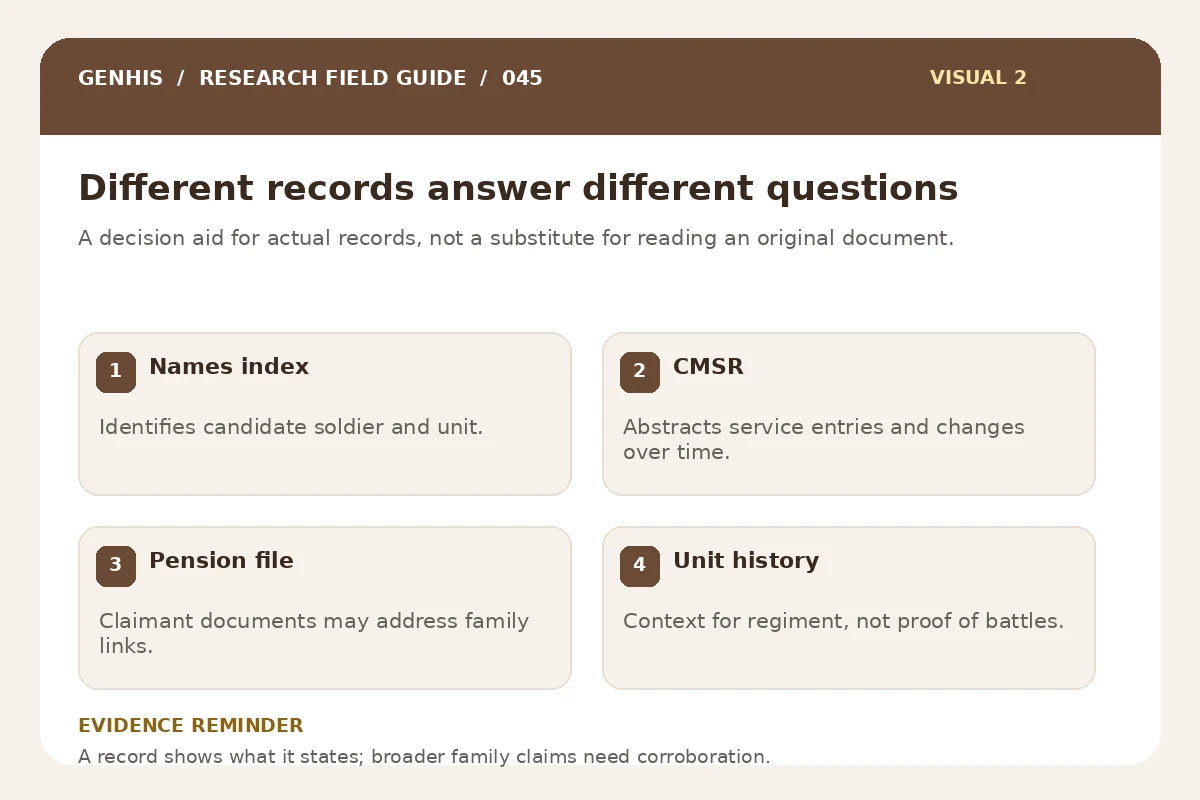
NARA describes a compiled military service record, or CMSR, as a jacket of card abstracts created from muster rolls, returns, pay and other surviving military records. Read the cards in time order to determine enlistment, units, reported presence or absence, discharge and other events when recorded. The existence of a unit’s battle history is not evidence that a particular soldier fought every engagement. Mark any gaps where cards do not establish an individual’s location, and check whether the person transferred or served under another variant.
Some CMSRs can indicate hospitalization, casualty, captivity or illness, but coverage depends on what survived and was abstracted. A service index may contain men who share a name, so the full file is still only one piece of identification. Consider a fictional John Carter recorded in an Ohio company and a different John Carter in a Virginia unit. Identical names are not grounds to combine their service narratives. Compare their civilian residences and family records, keeping each person distinct until evidence supports an identity.
Use pensions without confusing Union and Confederate custody
For a Union veteran or eligible dependent, a federal pension index may point to a pension case that can contain affidavits, dates, marriage information and statements from associates. NARA’s T288 description explains why application and certificate numbers are important identifiers. A pension claim is evidence of a statement and administrative decision, not automatic proof that every reported family detail is correct. Reconcile dates and witness accounts against civilian records instead of copying an online pension transcription into a pedigree. To go further, our guide “Revolutionary War Pension Abstracts” shows how to find the complete claim file.
Confederate pensions followed state systems, not a federal Confederate pension program in NARA. Which state matters can depend on where the veteran or widow lived when applying, not just the regiment’s recruiting state. Consult the relevant state archive’s guide and verify eligibility rules and surviving holdings. If no pension appears, the person may not have applied, could have died earlier, or the records may be lost or indexed differently. Absence of a pension never disproves Civil War service by itself. For the next step, our guide “Civil War Draft Enrollment Lists, 1863–1865” explains how to find men without assuming service.
| Record source | Strong use | Do not conclude |
|---|---|---|
| NPS soldier index | Rank, name, regiment/company candidate | That this is your family member |
| Compiled service record | Surviving muster, hospital or duty evidence | Service in every battle of unit history |
| Union pension file | Claim, affidavits and sometimes family details | Every statement is independently proved |
| Confederate state pension | Eligibility and applicant context in a state | A federal Confederate pension should exist |
Cross-check military identification and write a qualified conclusion
Build a four-column comparison: civilian identity evidence, military candidate, connecting details and contradictions. Useful connections might include a pension widow named in an independent marriage record, a consistent county of residence or a regimental company formed in the person’s neighborhood. Contradictions are just as important: an impossible age, different spouse, or postwar home tied to another same-name man could disqualify a candidate. A family relationship requires an evidence chain through civilian records, not merely enlistment alongside people of the same surname.
Preserve NPS index references, NARA publication or case numbers, exact service-file citations and archive request details. Explain the difference between what a record states, what is inferred and what remains unproved. If you summarize a Civil War-era document that uses racist terminology, quote only when essential with historical attribution and careful context. The completed research should stand even if no soldier can be identified confidently. A responsible unknown is a defensible result when surviving evidence cannot select among candidates.

How We Research: jurisdiction, source provenance, and uncertainty
We compared the NPS Civil War Soldiers and Sailors index description with NARA documentation for compiled military service records, the Union pension index and the state-custody pathway for Confederate pensions. These sources are used to build a stepwise identification method, not to identify a specific soldier or to infer beliefs, regiment, battles or parentage. The two John Carter soldiers in the example are invented candidates. Service records, pension paperwork and independent civilian links have different evidentiary roles and must not be collapsed into one claim.
Authoritative record sources and repository limitations
www.archives.gov — source guide. NARA describes Union and Confederate compiled service records, Union pensions and state Confederate pension custody. This official record guide supports a discovery workflow; it does not show that a particular family member served or received a pension.
www.nps.gov — source guide. NPS presents soldiers’ names index and explains its basic index-only coverage. This official record guide supports a discovery workflow; it does not show that a particular family member served or received a pension.
www.archives.gov — source guide. NARA details creation and typical contents of a compiled military service record. This official record guide supports a discovery workflow; it does not show that a particular family member served or received a pension.
www.archives.gov — source guide. NARA identifies state archives as the principal repositories for Confederate veterans’ pension files. This official record guide supports a discovery workflow; it does not show that a particular family member served or received a pension.
www.archives.gov — source guide. NARA explains index T288, pension-file identifiers and limits including absence of federal Confederate pension files. This official record guide supports a discovery workflow; it does not show that a particular family member served or received a pension.
More Records and Archives Guides
Privacy, disclosure, and the limits of this guide
The Civil War involved slavery, emancipation, military service and violence; this guide avoids invented biographies and distinguishes documented actions from assumptions about individuals. It offers no paid access guarantees, veterans-benefits advice or connection to government archives as a commercial partner. Review the GenHis affiliate disclosure. State custodians and NARA control copying and access; verify their current ordering requirements.
No. It is an index to candidate service information. Compare a complete file, age, residence, relatives and other independent records.
The compiled service record abstracts military entries; a pension file documents a benefits claim and can include family evidence. They are separate records.
NARA does not hold federal Confederate soldier pension files. Confederate pensions were granted by individual states and must be researched through relevant state archives.
No. Unit participation and an individual soldier’s presence are different matters; inspect muster and absence records and preserve uncertainty.
Try spelling and regiment variations and check archive finding aids. The NPS index is a discovery tool, not proof that every relevant record survives or is digitized.