
To research service during Ireland’s revolutionary period, use the Military Archives Military Service Pensions Collection search with a person’s name or known file reference. Distinguish pension applications and decisions from medal applications, organizational files and administrative papers. A submitted claim is evidence that someone asserted service, not a guarantee an authority accepted every detail. The online database offers different kinds of access: many released pension files can be viewed digitally, but not all applications are online, while the medal files described in the current search instructions require a Military Archives Reading Room appointment.
Start with One Person and an Evidence-Based Date Range
Identify the candidate’s name, any alias, known town, approximate age and independent connection to events between 1916 and 1923. The Military Service Pensions Collection concerns claims related to Ireland’s revolutionary period, not a comprehensive roll of all residents or every type of military service.
Applications were prepared under later administrative conditions and may include recollections recorded years after the events. Build a timeline with dated civil, census, newspaper or family papers before searching; otherwise two people with the same surname can be wrongly merged. Keep the archival claimant distinct from any relative whose service story has not been independently established.
Select Pensions, Medals or Organizational Files First
The official search page offers distinct datasets for pensions and awards, medals, membership material and administration. Military Archives also cautions that not all pension applications have been released online; do not assume these datasets mirror each other.
A pension application may contain statements about service and a decision; a medal file concerns eligibility for a particular decoration; organizational papers may establish contextual names or unit activities. Choose the search category that fits your question and record which field or filters you applied. A name hit in one category does not imply that the person has a surviving file in every other category, and a missing pension application does not rule out participation.

Use the Claimant Name and Reference Code Together
Search variant spellings, initials and known surnames used during the period. If a file reference is available, enter it into the reference-code field rather than relying on broad text search. Save the category, displayed claimant name, file reference and description before opening the result.
Multiple files can refer to the same applicant, while identical names may belong to different people. Check organization, county and claimed years where supplied. Avoid interpreting an administrative file number as a service number, a badge number or an independently confirmed unit assignment.
Read a Pension Application as a Historical Assertion
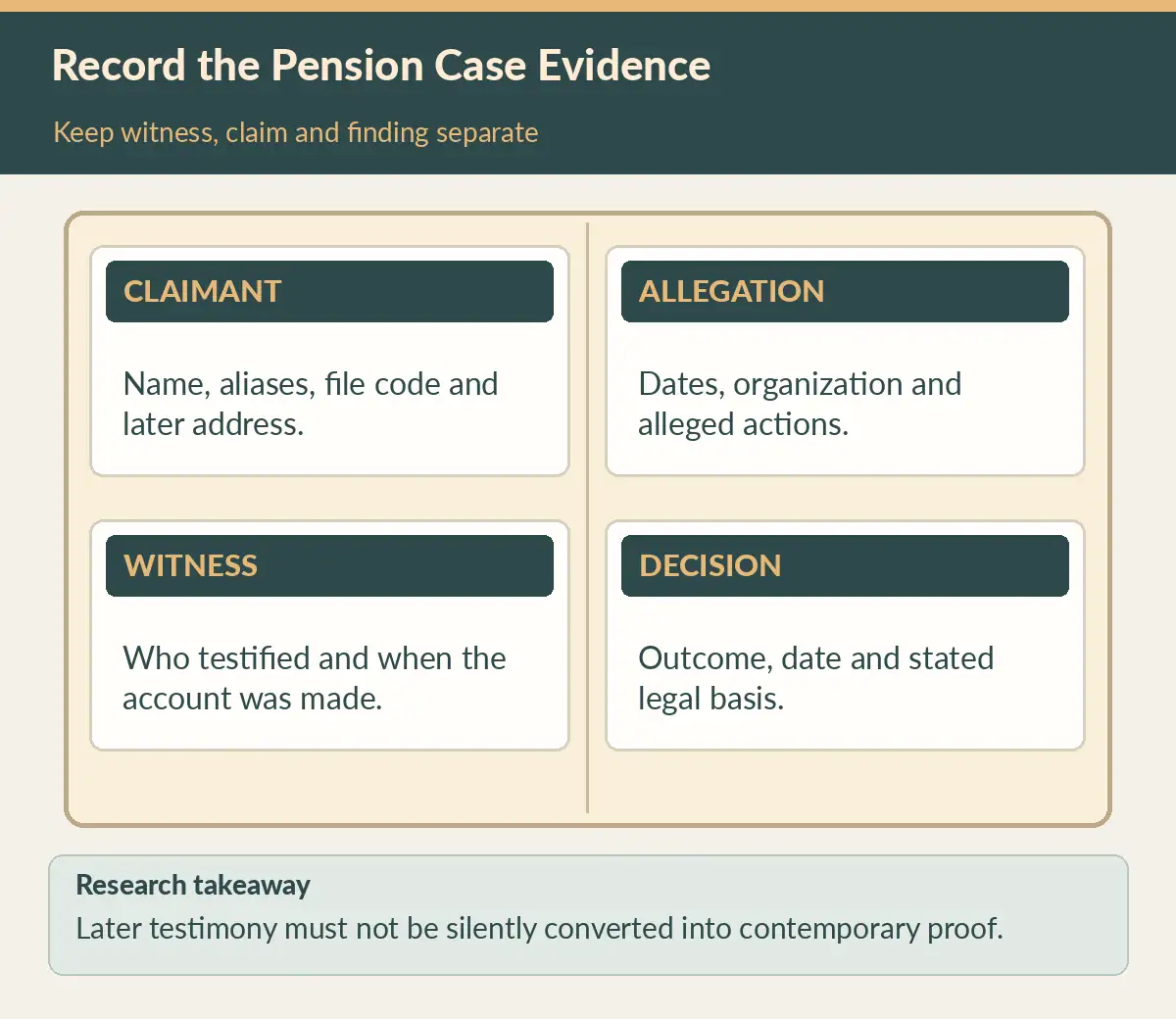
An applicant’s statement may recount membership, deployments, duties, witnesses, periods of activity or injuries. Capture who made each assertion, when it was filed and whether the statement was first-hand, recollected or supplied by someone else. Do not treat the existence of the document as acceptance by the pension authorities.
Compare claims against affidavits, contemporary notices, documented witnesses and other independent historical records. When a file contradicts itself, preserve the different descriptions rather than selecting the most flattering account. Separate what the person said from what the officials later decided to credit.
Find the Administrative Decision and Understand Its Scope
A case may include assessment, inquiries and decision notices. Even an accepted claim need not establish every factual detail exactly as first stated. A rejection likewise may reflect statutory eligibility, documentation or administrative criteria rather than proving the applicant never participated in the events described.
Quote the exact basis where available and distinguish pension entitlement from a judgment about every service claim. Some files may be incomplete or subject to access restrictions. Note decision date separately from the period of alleged service; otherwise a later pension award can be mistakenly dated as a military event.
Treat Medal Search Results as a Separate Access Route
The Military Archives says its medal search records tens of thousands of applicants and distinguishes the medal database from pension PDFs. In the current guidance, medal files must be consulted in person by prior arrangement with the reading room, not assumed instantly downloadable from the web.
Record an MD-style reference if supplied and confirm the archive’s latest request instructions. A medal claim, successful award and associated physical file are not identical facts. Also note the archive explains that some medal entitlements followed an approved pension automatically, so the absence of a separate medal application need not mean no medal was issued.
Look for Organization and Membership Context Carefully
Membership lists, nominal rolls and organization papers may give contextual evidence for the claimant, but a typed roster or later compiled list is not the same as a dated contemporary action report. Track the organization name as used in the specific period and location.
Similar brigade or unit names can change over time. Cross-check a file’s stated affiliation with the actual date of creation and the role described; officers, supporters and witnesses should not automatically be counted as active members. If you find a shared surname in a nearby unit, treat it as a separate candidate rather than immediate kinship.
Test Two Same-Name Applicants with Independent Records
Imagine two men called Patrick Walsh, one linked to Cork and another to Dublin. Set up two rows with application number, address at time of claim, birth or age clue, witnesses, unit name, service dates, decisions and medals. Test each against civil marriage or death registrations, newspaper notices and independently identified associates.
A later residence may differ from the revolutionary-era locality, so do not reject a candidate on address alone. Retain both identities until the documentary chain connects the claimed actions to one known individual. Witness testimony deserves attribution and corroboration, not automatic rejection or unconditional trust.

How We Research an MSPC Case without Overstating Service
We begin with an independently built chronology and use the Military Archives search guide to choose the correct subcollection. We capture the exact reference, review claims and the available pension decision separately, and note witness roles and conflicting dates.
For medals we check the separate access instructions rather than implying the complete file is online. We compare organization names and participants with external contemporary sources before stating a service conclusion. Our affiliate disclosure addresses editorial interests; it does not replace archival verification.
Cite the Exact Claim, Decision and Access Format
Give the Military Archives as custodian, Military Service Pensions Collection, claimant, file and series identifier, document title, date, page or digital image if available, and date of access. Where a medal document was only identified in the search database, cite the database and mark the underlying physical file as uninspected.
Cite each pension award or refusal notice separately from the applicant’s original narrative. A conclusion should use precise wording: “the applicant stated,” “the board recorded,” or “the award was granted,” as appropriate. Do not write a single summary that makes a disputed statement look like an agreed official fact.
More Records and Archives Guides
Plan the Next Inquiry Around a Contested Claim
If the file references a named witness, search for that person’s independently documented association. If it provides a unit and month, seek surviving contemporary reports or correspondence that could confirm a particular action.
If a medal database shows a result but access is on-site, save the reference and identify what question the physical file may answer before contacting the archive. A high-quality research log lists source consulted, purpose, claim, acceptance status and remaining question. This stops an appealing but unsupported story from being repeated as an established service record in the family narrative.
No. Read the application and subsequent administrative decision as separate evidence.
The archive says medal files are consulted in its reading room by appointment; online search entries are not full files.
They overlap but are different collections and filing systems, so absence in one does not decide the other.
No. Rejection may reflect statutory eligibility or the evidence presented; examine the stated reasons.
Record the category, claimant and reference and state clearly that the physical file has not been inspected.