
To find a historical Gloucestershire bastardy bond or related examination, begin with the mother’s parish and approximate birth period, then check the parish Overseers of the Poor records listed by Gloucestershire Archives. A mother’s examination, named alleged father and financial bond are distinct evidence: an allegation was sometimes made under pressure and does not establish biological paternity by itself. The archive illustrates a 1771 bond identified as P114/OV/5/1; that local example should not be mistaken for a countywide name index or a form used in every parish.
Choose the Historical Parish, Not Just the County
Identify where the mother resided when the child was born, baptized or supported, rather than searching all Gloucestershire records by the child’s later surname. Overseers worked at parish level and many documents are filed within parish collections. The father might be associated with another parish or county.
Establish boundaries and possible movements with a baptism, marriage, tax entry or settlement document. Enter the child’s birth estimate and earliest confirmed maternal residence into a location timeline. A missing bond in one parish cannot settle parentage or imply that the mother did not receive help elsewhere.
Understand Why Overseers Created These Records
Parish overseers administered relief and sought to prevent the parish from bearing the cost of supporting children born outside marriage. Gloucestershire Archives explains that they could examine the mother to identify an alleged father and arrange a bond for financial maintenance.
The historical terminology reflects the source and a stigmatizing legal category, not a neutral definition of family. The goal of the paperwork was often fiscal responsibility rather than a complete personal narrative. Read the original date, place, roles and payment terms before using a document to support a genealogical relationship.

Separate a Mother’s Examination from a Bond
A mother’s examination might record a statement of the child’s parentage, residence or circumstances, while a bond could name a man or surety responsible for financial payments. These are different types of evidence created within a legal and economic process. One might survive without the other, or the documents may be in different bundles.
Transcribe the exact wording, especially whether someone was alleged, ordered, examined or bound to pay. The named surety is not automatically the child’s father. A payment obligation can be proof of administrative responsibility without settling biological identity.
Find the 1771 Minchinhampton Example Correctly
Gloucestershire Archives provides a concrete historical illustration: the 1771 bond concerning the child of Makepeace Brown, associated with Minchinhampton, is cataloged P114/OV/5/1. The accompanying explanation names John Pavey of Minchinhampton and describes financial maintenance terms. This is an archive teaching example, not a fictional family or a template for every case.
When citing it, keep the parish reference and original context together. Do not extrapolate its five-year payment schedule to another parish. The archival item shows why the precise local catalog reference matters more than a general web search for a presumed father.
Consult Baptisms Without Treating Their Labels as Proof
A parish baptism may call a child baseborn or use other historical terminology for children born outside marriage. It can identify a mother and date, but the wording, completeness and accuracy vary with the minister and parish.
Compare the baptism with an overseer examination and bond at the same time, not simply the next baptism of a similar name. A child can later adopt a stepfather’s or other household surname, and name continuity alone does not establish kinship. Preserve the baptism’s precise date, original name and wording and record independently whether an alleged father appears in legal paperwork.
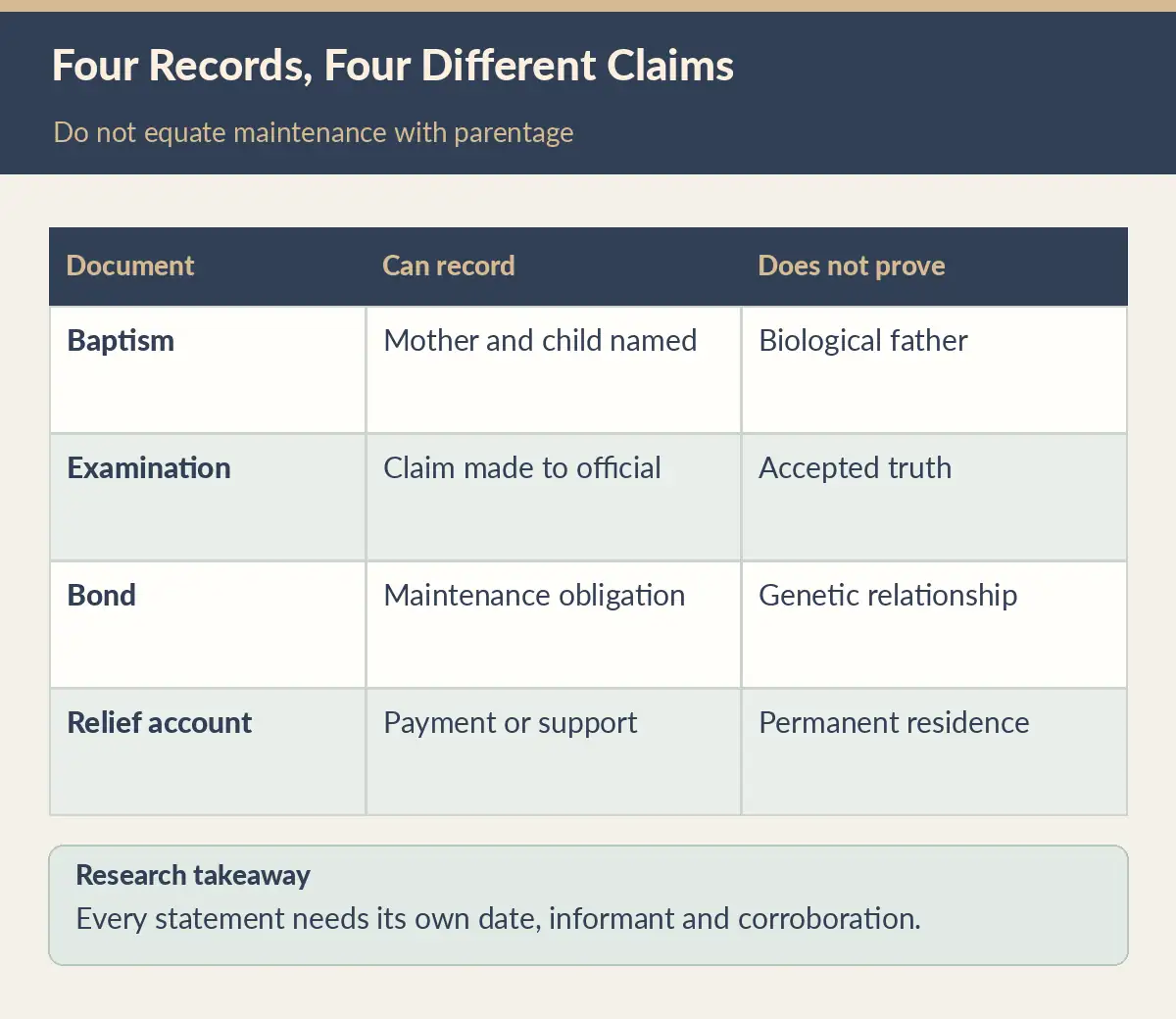
Follow Maintenance, Relief and Settlement Paperwork
Overseers’ records may include receipts, payment accounts, relief lists, settlement examinations and removal orders. These can supply dates and places around a family’s movements. A maintenance receipt may indicate that money was paid toward a child’s support; it cannot prove the biological relationship absent further evidence.
Settlement rules involve entitlement to parish relief rather than automatic residence at a modern mailing address. Study the transaction’s specific beneficiary, parish and date. If another parish is named, search its own holdings for a corresponding examination or relief account, keeping distinct administrative events separate.
Allow for the Poor Law Union Changes in the Nineteenth Century
After the 1834 Poor Law reforms, union guardians gradually became involved in pursuing maintenance cases, so nineteenth-century records need not remain among earlier parish overseer bundles. Gloucestershire Archives explains that Boards of Guardians pursued fathers after 1835.
Check the event date and which local authority was competent at the time, then look for union-level rather than exclusively parish documents if appropriate. Surviving records vary by authority. A family tradition about a case in 1845 cannot be tested by checking only eighteenth-century parish bonds, and missing central indexes are not evidence that no proceeding occurred.
Test an Alleged Father Against Independent Evidence
Imagine a bond names a Thomas Green while a child’s later marriage states the father was William Green. First transcribe both without silently merging the names. Compare the mother’s locality, date of birth, witnesses, occupations, residence, and any follow-up proceedings.
A bond might involve a surety, or an allegation might be disputed, and the marriage informant could be mistaken. Search related baptisms, wills, apprenticeship records or parish settlement material before treating either name as biologically established. The result may remain unresolved, and that is preferable to forcing a tidy paternal line.

How We Research a Gloucestershire Bastardy Case
We establish the child and mother’s probable parish from independent records, then use the Gloucestershire Archives overseer guide to select candidate parish or union series. We identify and transcribe examination, bond and payment documents separately, test people and dates against original baptisms and other sources, and record any discrepancy between an allegation and a later named father.
No financial bond by itself is treated as genetic evidence. The archive’s illustrated case demonstrates source-specific citation. Our affiliate disclosure covers site relationships.
Write the Reference and Evidentiary Role Precisely
Cite Gloucestershire Archives, the parish collection, document category, original date and item reference such as P114/OV/5/1 where applicable, including image or page numbers if actually inspected. Separate the mother’s sworn or reported statement from a bond obligation or order. Use cautious language such as “the examination alleges” or “the bond obliges” rather than “the man was proven to be the father.” When a modern transcription is used to locate a file, include the actual manuscript custodian and identify what was seen. This enables future researchers to revisit difficult handwriting or changed interpretations.
More Records and Archives Guides
Create a Locality-Based Follow-up Plan
After one parish document is located, list the unresolved questions: whether an examination survives, whether a named surety was related to the alleged father, whether payments continued, and whether the child can be followed into apprenticeship or marriage. Search parish account books and neighboring settlements in chronological order rather than assuming that a single bond completes the story. The mother’s name and residence can be the best organizing clues; the child may be recorded under multiple surnames. Keep all evidence in a claim table with original wording, source role, corroboration and conflict so a legally charged allegation is not repeated as a genealogical certainty.
No. They concern parish maintenance liability and may name an alleged father but do not certify a biological relationship.
Start with the mother’s parish and the Overseers of the Poor collection or later union records.
No. The document may name sureties or legally responsible people; interpret the exact roles.
It is Gloucestershire Archives’ documented 1771 Minchinhampton example concerning the child of Makepeace Brown.
Try the mother’s examination, baptism, relief accounts, settlement records and later union holdings.