
Search Library and Archives Canada for a marriage bond using both intended spouses’ surnames, then inspect the original and look separately for the marriage ceremony. Upper Canada bonds are mainly in RG5-B9 and Lower Canada in RG4-B28. A signed bond supported an intended marriage; it is not proof that the wedding took place. For transparency see our affiliate disclosure.
Choose Upper or Lower Canada at the Event Date
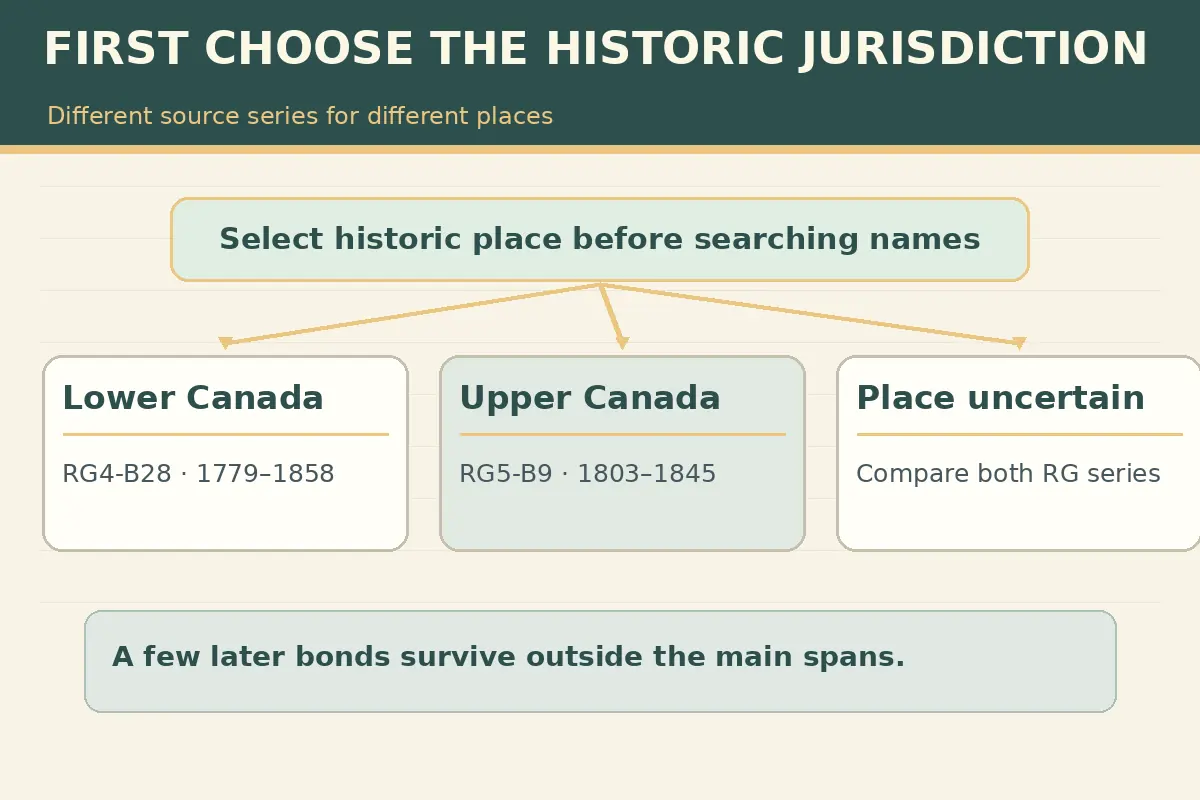
The two records series correspond to historic jurisdictions, not simply modern mailing addresses. Lower Canada and Canada East, roughly present-day Quebec, are represented by RG4-B28, primarily 1779–1858. Upper Canada and Canada West, roughly present-day Ontario, are represented by RG5-B9, primarily 1803–1845. The modern provincial boundary is a starting clue, but older place names and the family’s movements matter. If a couple lived near a border, inspect where the bond was issued rather than assigning the record from one spouse’s later residence. Library and Archives Canada describes both collections on its official birth and marriage guide.
Read the Main Date Ranges and Small Exceptions
For Lower Canada, LAC identifies RG4-B28 volumes 29–41A and microfilms H-1129 to H-1132, with a principal 1779–1858 range and a small group from 1860–1861. For Upper Canada, RG5-B9 volumes 13–44 correspond to microfilms C-6777 through C-6791, principally 1803–1845, with a few later bonds from 1858–1861. These exceptions are not a general continuation of a complete provincial register. Note original issue date before testing a year-based search filter. A bond missing from a popular historical range could still be a surviving exceptional item; the reverse is also true, and no year should be treated as wholly covered without checking holdings.
Search Both Future Spouses, Not Just One Surname
The digitized bonds can be searched in LAC Collection Search. Begin with the surname of either future husband or future wife; then try given-name initials, spelling changes and a wider date range. The legacy marriage-bond interface is being retired in favor of Collection Search, so a bookmark to the older database should not be treated as the only gateway. Read the image, not only the index transcription: fading and difficult handwriting create omissions and errors. Record the full entry, collection reference, volume, image or reel and the spelling seen on paper. Where a woman used a surname before marriage, do not quietly substitute a surname from a later household census.
Keep the Surety Separate From a Witness or Relative
A marriage bond commonly names the intended couple and one or more sureties, who guaranteed that no legal impediment was known. A surety might be a relative, friend, neighbor or associate; the role is not itself proof of kinship, nor necessarily a witness to a completed ceremony. Transcribe names and residences as stated and rank proposed relationships as unproved. A second record such as probate, a deed or baptism naming the same people can test the theory. Do not import the surety into the family tree as a father merely because the surname matches a bride’s. Similarly, the place where the bond was issued need not be the couple’s permanent home.

Distinguish Digitized Bonds From Licence Lists
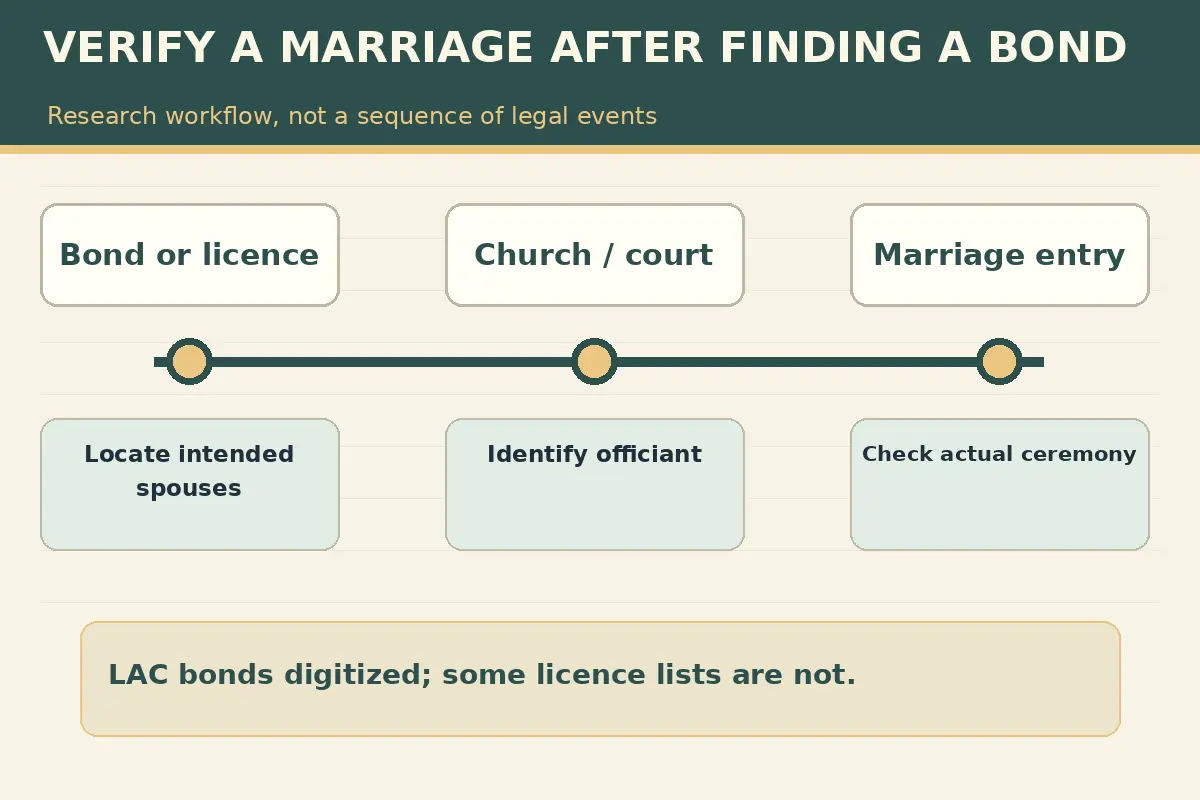
LAC identifies non-digitized marriage licence lists in separate holdings: Lower Canada’s RG4-B28 volume 46 for 1835–1837, and Upper Canada’s RG5-B9 volumes 6–8 for 1803, 1808 and 1819–1841. The lists usually identify a licence issue date and future spouses; they do not replace a bond image or actual ceremony entry. When an online bond is absent, consider whether a licence list is appropriate for the jurisdiction and period. Because the licence lists are not digitized, follow the archive’s consultation or copy instructions instead of claiming every record is available as an image online. An indexed bond and a licence-list entry may be related but should receive separate citations.
Prove the Ceremony in Another Record
The bond was normally prepared before an intended wedding and can indicate a likely approximate date or location. A marriage licence granted permission, also before the event. Neither document establishes that the ceremony actually occurred. Search the register of the church or other authorized celebrant, a contemporary civil record where relevant, or a corroborating newspaper notice. Denomination changes and traveling clergy complicate the search. The archive explains that Anglican and Roman Catholic marriages could occur without these bonds, so absence from the bond database is not evidence that a couple never married. Mark your research ledger ‘intention recorded’ until a ceremony source exists.
Reconcile Two Couples With Similar Names
Imagine a fictional John Fraser and Mary Bell appearing in an Upper Canada bond and a later Quebec marriage register. Do not automatically treat them as one couple. Compare ages and birthplaces from independent records, event places, named sureties, dates and migration possibilities. If the later parish register shows another father’s name, preserve that conflict and test alternative couples. A bond can be especially useful to place a pair together before a scarce church register, but it never substitutes for a proof argument. Keep a rejected-candidate note rather than erasing an inconvenient same-name record; other family researchers may encounter the same problem.
More Records and Archives Guides
How We Research the Two Canadian Bond Series
We establish the historic jurisdiction and probable date before searching LAC Collection Search under both proposed spouses. For each candidate we inspect the original bond, record the exact RG4-B28 or RG5-B9 volume and reel, identify sureties as such, and separate the date of bond issue from any documented marriage date. We check the non-digitized licence-list route when applicable and then seek an independent ceremony record from the correct religious or provincial custodian. Every absent hit is recorded with jurisdiction and range searched. The final report states clearly whether it demonstrates an intention to marry, the actual wedding, or merely an unresolved candidate.
A useful comparison sheet has five fields for a bond: future husband, future wife, sureties, issuing locality and bond date. Add a distinct sixth field for the later marriage event and its own source citation. If the ceremony has not been located, write “not yet independently documented” rather than copying the bond date into the family tree as a wedding date. Where an archival image is barely legible, flag individual uncertain letters and compare another scan or a later certified register. Avoid stating that a bond omission means the family was unmarried or nonreligious.
No. The bond supported an intended marriage; find the ceremony in a separate register or reliable record.
RG5-B9 is the primary Upper Canada/Canada West bond series, mainly 1803–1845 with a few later exceptions.
RG4-B28 is the main Lower Canada/Canada East bond series, principally 1779–1858 with a few later documents.
No. LAC describes separate licence lists in RG4-B28 and RG5-B9 that are not digitized.
No. Sureties are named in a financial/legal role and relationships require independent corroboration.