
For a U.S.-born woman who married a foreign national during the early twentieth century, establish the marriage date and legal context before searching for an oath of repatriation. Restoration documents can be filed among federal, state or county court papers; the 1936 and 1940 laws created different routes, and no missing online hit proves the oath never existed. For transparency see our affiliate disclosure.
Begin With the Date of Marriage, Not a Modern Assumption
The March 2, 1907 expatriation law imposed loss of U.S. citizenship on American women marrying foreigners under the law of that period. The effects were unequal and changed later. Whether one particular woman’s nationality changed depends on the precise dates, marital and national circumstances and potentially other legal facts. Do not apply today’s rules to her 1915 marriage certificate or infer that she always retained citizenship because she was born in the United States. Record her place of birth, marriage date, spouse’s citizenship and subsequent residence with contemporaneous evidence. The NARA historical review provides the legislative background.
Understand What the Cable Act Changed in 1922
The Cable Act of September 22, 1922 ended automatic loss of nationality for many women marrying noncitizens in the future, but it did not automatically restore citizenship already lost under the earlier system. Legal restrictions remained, especially where the husband’s naturalization eligibility or residence circumstances mattered. A researcher who sees ‘married 1918, husband naturalized 1923’ should not assume that the wife regained nationality that day. Individual records could indicate a later naturalization procedure or another lawful route. Construct a timeline showing marriage, possible citizenship change, any earlier petitions, spouse’s status and the later oath. Distinguish legal possibilities from the exact history established in her file.

Route a 1936 Oath to the Right Situation
Under the 1936 legislation described by NARA, certain women who had lost U.S. citizenship through marriage could regain it after a marriage ended by death or divorce, on application and oath. Applications might involve proof of birth, marriage and termination. These are not mere reprints of the earlier marriage record; they are a later administrative proceeding. Identify where the applicant was residing when restoration became possible and investigate courts operating there. Some documents bear a form such as N-415, but actual court filing conventions differed. It is more reliable to search series titles and chronological docket references than to assume every courthouse used identical labels.
Use the 1940 Expansion Without Erasing Conditions
The July 2, 1940 amendment allowed women who had lost citizenship because of marriage to apply for repatriation even while still married. The NARA account also describes a condition of continuous U.S. residence since the marriage for that route. Do not convert this statutory possibility into proof that a particular woman took the oath or satisfied every condition. Compare the date of application, affidavit, oath and a court order when present. A 1940 law does not mean that every restoration proceeding was filed in 1940; historical records can be created later. If overseas residence is known, investigate alternative legal circumstances rather than applying the residence rule carelessly.
Search Federal and Nonfederal Courts as Separate Custodians
NARA stresses that repatriation could be handled in county, state or federal courts. Federal records may survive in Record Group 21, but local courthouse documents may be held by state archives or county clerks. Start with the woman’s address during the likely application years. Search indexes and catalogues for ‘repatriation oaths,’ ‘applications to regain citizenship,’ ‘naturalization repatriation’ and similar series names. Some courts maintained oaths separately; others placed them among general naturalization petitions. When no index exists, ask for docket or chronological volume instructions rather than requesting a single nationwide certificate. The NARA naturalization research page explains custody and the limited meaning of an unsuccessful search.
Use Both Birth and Married Surnames
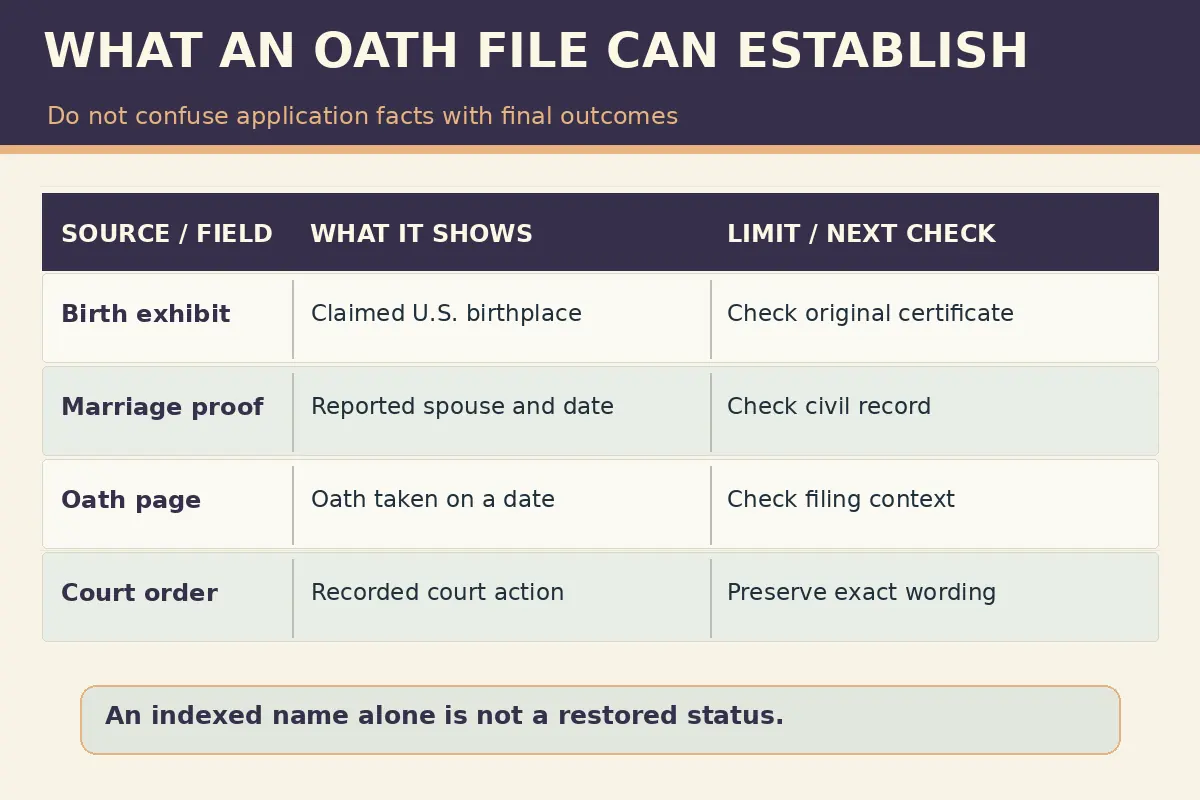
A U.S.-born woman’s repatriation file can appear under her married surname, her surname at birth, a subsequent married surname or a spelling variation. Make a search table with all known forms supported by dated documents. An oath may identify parents or residence, but an indexed name alone is insufficient if several women married men with similar names. Check birthplace, marriage chronology, court location and known spouse before accepting the candidate. If her divorce is mentioned in an application, pursue the original divorce proceeding separately. A citizenship document tells you about the recorded oath and legal claim, not every family relationship in the applicant’s life.
Record Four Possible Search Outcomes Accurately
A fully inspected oath and accompanying court order is stronger evidence than a database label. An index-only entry is a locator until the original can be seen. A catalogued but restricted or unscanned proceeding remains unverified; a complete negative search describes the exact custodian and period searched, not proof that no restoration ever occurred. The court could have moved records, organized them in mixed naturalization volumes or used another title. Cite volume, page, docket or file number, date of oath, exact court name and present holding archive. Keep the law’s consequences separate from family lore about whether the woman felt American.

More Records and Archives Guides
How We Research Women’s Repatriation Proceedings
We date the marriage and establish documentary U.S. birth evidence before considering citizenship consequences. Next we compare the specific chronology with the 1907, 1922, 1936 and 1940 changes described in NARA research guides. We search the likely residence court, testing both federal RG 21 and nonfederal holdings, and note whether the series was separately indexed or interfiled. Every promising original is checked for applicant identity, oath date, court order and supporting exhibits. Conflicting information remains visible. We never pronounce a woman’s citizenship status solely from an online marriage index, a legislative date or the failure of one catalogue search.
A fictional woman born in Ohio who married in 1914 and appears in an Oregon 1942 census record would require more than those two facts to identify a repatriation event. Establish her birth and spouse’s nationality, investigate later residence changes and search the relevant courts for an oath. The absence of an RG 21 file cannot exclude a state or county court action. Preserve the original wording on nationality forms, even when legal terminology is dated, and separate that historical quotation from your own description of the person.
No. Women who had previously lost citizenship could need later naturalization or a specific repatriation process.
Qualifying women whose marriage had ended by death or divorce could apply to regain citizenship by oath under the 1936 law.
Not under the expanded 1940 route described by NARA, although other legal conditions could apply.
No. Federal, state and county courts could handle them; some were filed with other naturalization papers.
No. Search relevant courts, alternate names and unindexed or interfiled series before recording the specific coverage limit.