
The National Archives guide to Record Group 86 lists questionnaires and related records concerning immigrant women in industry in 1925. That is a specific, valuable lead for historians of work, migration, and gender. It does not promise a complete list of immigrant women who were employed in the United States that year. Before searching for an ancestor, establish what the surviving questionnaire files contain, what population or places they actually covered, and whether individual respondents can be identified at all.
The Women’s Bureau was established in the Department of Labor in 1920, and the guide describes its work investigating conditions affecting working women. A federal questionnaire can reveal how a bureau framed questions about labor and migration, but its design and surviving responses require document-level inspection. No census-like completeness should be assumed. Even if a questionnaire has a name, matching that person to a family tree requires an independent address, employer, birth detail, or other distinguishing evidence—not a surname match alone.
Start With the 1925 Questionnaire Description
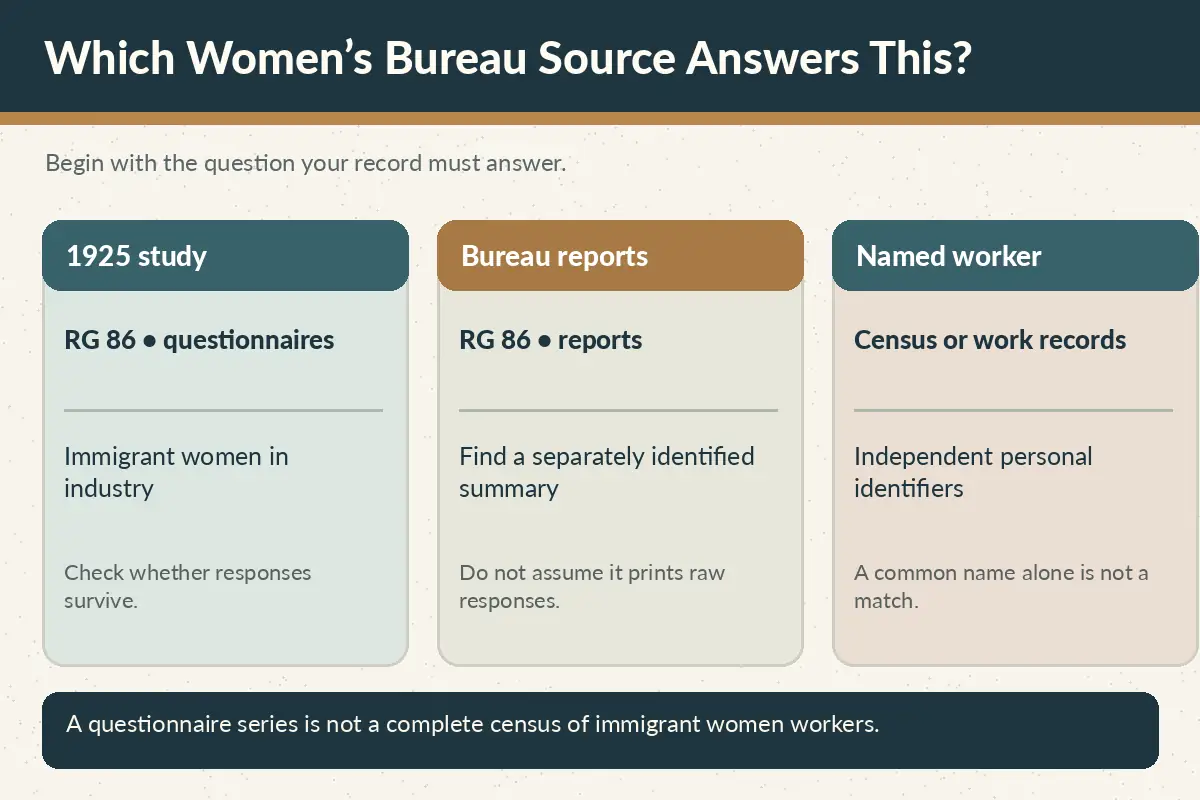
The guide places these questionnaires among Women’s Bureau records and specifies 1925. Use that year to separate them from the Woman-in-Industry Service’s earlier 1918–1920 files and from later studies and bureau publications. The existence of a question set does not prove that all completed forms survive, that every item was answered, or that the underlying survey sampled all occupations. Record the scope and arrangement that the Catalog or original folder actually documents rather than supplying an assumed survey population.
Plan two distinct searches. One asks what questionnaires or accompanying papers exist and whether they are digitized. The other asks whether a separate publication summarizes the study. The NARA guide identifies bureau reports and research bulletins in other portions of RG 86, but it does not state that a particular bulletin reports the 1925 questionnaire findings. Treat a matching title as a lead to verify, not as an automatic replacement for the raw responses. Keep collection provenance visible.
Check Who Was Asked Before Interpreting Answers

When a questionnaire or blank form is available, transcribe the questions and the printed instructions before extracting any responses. Distinguish a blank template, an individual response, a summary table, and editorial notes. They serve different purposes. Do not assert that a field for wage, birthplace, legal status, employer, language, or address exists until you have inspected that version of the form. Small changes in wording can substantially change the meaning of a reported answer.
If the source contains coded values, locate the codebook or instructions if extant and record any unanswered or ambiguous fields. A questionnaire can preserve someone’s reported experience or an interviewer’s transcription, which is not always independent verification of a claim. Treat any statistical result as applying only to the documented sample and time frame. It is particularly risky to infer undocumented immigration status, personal circumstances, or family relationships from an occupational category alone.
Navigate RG 86 Without Presuming Digitization

Use the National Archives Catalog to search the phrase “immigrant women in industry,” 1925, Women’s Bureau, and RG 86. Check whether results are for record groups, series, file units, or items. NARA notes that archival descriptions and digitized images are not the same thing; a series may be searchable while its paper documents are not online. Record the creator, original file title, full dates, and identifier before making an access request.
If there is no item-level image, ask the repository whether the 1925 questionnaire material is available for consultation, how it is arranged, and whether access or reproduction conditions apply. The official NARA copying guide explains the need for precise document citations. An inquiry with only a hypothetical worker’s surname may not be answerable; an office name, date, study label, and item or box reference are more useful. Never promise personal names or searchable answers until the records themselves establish that possibility.
Link a Respondent to a Family Only With Strong Identifiers
If a completed response names someone, create a side-by-side comparison with a contemporary census record, city directory, workplace roster, immigration record, or other independent source appropriate to that person. Use more than one identifier: locality, approximate age, language, occupation, household, employer, or a documented migration event when these details are actually given. A common name and a plausible job do not establish identity. Conversely, a misspelled surname does not necessarily disprove a match when the remaining evidence is strong.
Avoid turning respondents into illustrations of a general theory without attention to context. One answer is one recorded statement, not a representative finding for all immigrant women or all workers in a city. If the questionnaire was anonymous or the response was aggregated, do not attempt to reverse-identify an individual using speculation. The historical benefit may lie in reconstructing questions, workplaces, and official categories rather than finding a specific relative. Report uncertainties about representativeness and survival.
Make a Transparent Source Trail for Labor History
Cite the questionnaire separately from any later bureau report, period newspaper, or family record. For the actual archival document give the National Archives, RG 86, Women’s Bureau, study or series title, 1925, item or folder reference, and page if available. In your notes distinguish what the form asked, what a respondent reportedly answered, and what your outside evidence supports. This prevents the agency’s framing or a printed summary from being mistaken for an unmediated individual life story.
A responsible account could explain how federal labor investigators were seeking information concerning immigrant women in industry in 1925, while stating that the surviving material’s personal coverage remains to be checked. Add the particular worker only when source citations support the connection. Respect any access restrictions and avoid unnecessary disclosure of sensitive details about possibly living people mentioned elsewhere in related records. Good archival method is as much about leaving unjustified names out as it is about finding them.
More Records and Archives Guides
How We Research These Federal Holdings
Our starting authority is the National Archives RG guide, especially section 86.3, which supports the specific dates and record categories described above. We then use NARA’s Catalog instructions to distinguish record-group, series, file-unit and item descriptions, and consult its reproduction guidance if an item is not available online. The guide is an inventory, not a complete transcript, digitization guarantee, individual name index or certification of a family connection. Each statement about a named person needs independent support and a traceable document citation. The site’s affiliate disclosure explains our editorial and relationship policy; the public archive links here are not claimed as paid partnerships.
No. The guide identifies questionnaires and related records, not a comprehensive count or name index.
No. Whether identifiers or completed responses survive must be checked in the specific material.
No. Publications and individual questionnaires are different evidence forms; verify any direct relationship between them.
No. Employment or questionnaire categories cannot establish a person’s legal or migration status without separate evidence.
Give RG 86, the Women’s Bureau, questionnaires concerning immigrant women in industry, 1925, and any exact catalog or folder reference.