
Decide Whether You Need a Mine Statistic or a Person
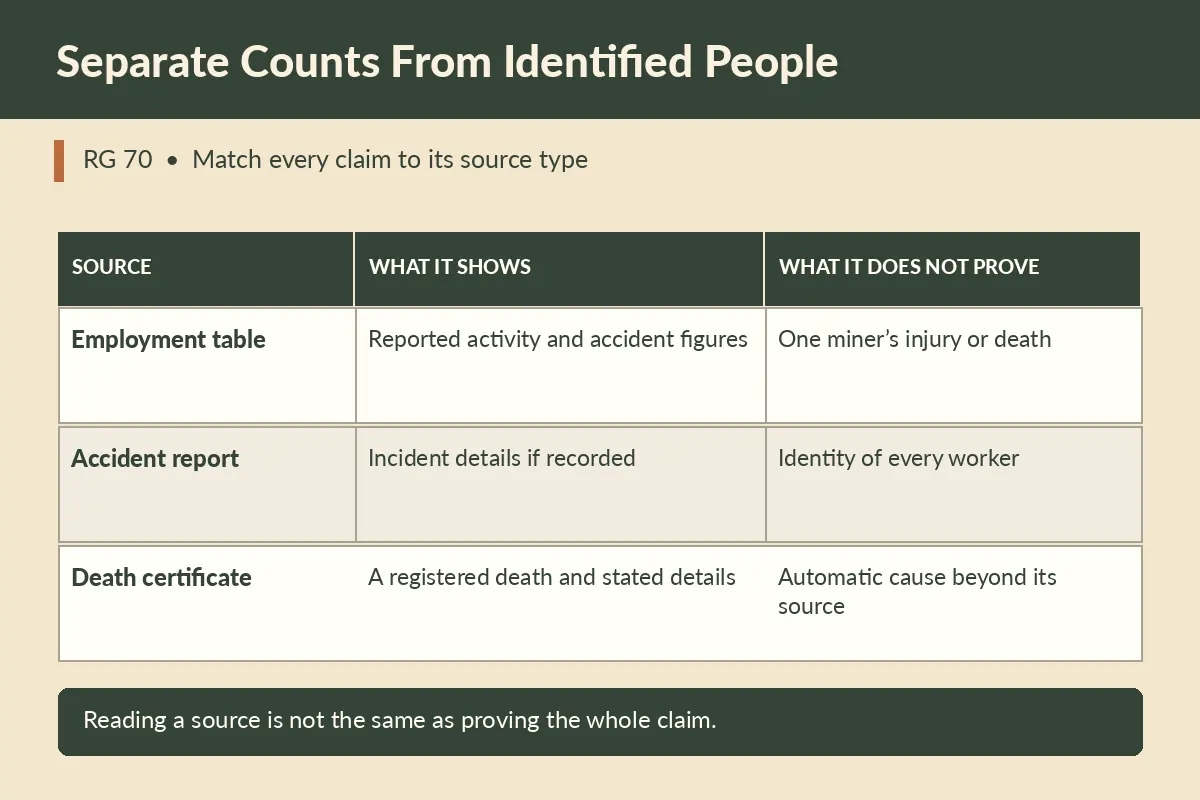
Record Group 70 contains records of the United States Bureau of Mines. In section 70.4.2, the National Archives guide identifies employment and accident tables for metal mines, coal mines, coke ovens, quarries and metallurgical plants for 1910–1940. These are useful historical measurements of industrial conditions, but a table entry for ten injuries in a district is not evidence that one named relative was injured there. Start by writing the actual question at the top of your research log.
A different RG 70 series consists of microfilm copies of accident reports for 1930–1935, while reports on coal mine fatalities cover 1933–1942. The overlapping dates do not mean the sources always duplicate each other. Each record type may classify events differently, and their descriptions do not promise named lists for every mine. Choose by place, year, operation type and the kind of fact sought before treating an online search as comprehensive.
For a family story about a miner’s death, collect the worker’s documented name variants, employer if known, mine name, locality and estimated event interval. Separate whether relatives remembered an accident, an illness or a death in service. Without that distinction, an industrial injury statistic can be used to support an event it never reported. A person-level death or hospital record may ultimately be necessary to connect the worker to the incident.

Interpret the Employment and Accident Tables in Context
The RG 70 description identifies 129 volumes of employment and accident tables for 1910–1940. When consulting a particular volume, look for its unit of measurement, reporting year, geography, mine type and definitions. An occupational group can be counted by employees, days worked, accident cases or fatalities, depending on the specific form. Do not compare totals until the headings and collection methods in both years have been checked.
The term accident may include disabling injuries, nonfatal incidents or fatal events according to the reporting practice. If you have not seen the table’s key or footnotes, do not translate a statistic into an exact risk rate. A change between two years might reflect reporting rules, industrial production, jurisdictional boundaries or incomplete returns rather than an immediately obvious improvement or decline in safety. Keep the original wording and any caveat in your notes.
A mine or district sometimes appears under an operator name that changed over time. Establish the historical corporate name and location from a dated directory, report or local source. Compare the mine’s production and employment periods before interpreting an apparent gap in the statistical tables. No entry found can mean that the classification did not cover the operation, not necessarily that the operation closed or that no injury occurred.
Use Microfilmed Reports for a Particular Incident
NARA describes 230 rolls of microfilm copies of accident reports for 1930–1935 within the Mineral Resources and Statistics Division material. This published inventory tells you that a specific report series exists, not which individual case appears on a particular reel. Ask for its arrangement, geographic or date indexes and any associated reel list. Record the complete reel and frame reference when consulting images, not just the general phrase “Bureau of Mines report.”
When an incident report is located, transcribe its actual identifying fields rather than assuming it contains a victim name, exact death certificate data or a judicial verdict. Some administrative reports summarize technical hazards, equipment or response procedures. A reported cause may be provisional or attributed to an investigator at a particular stage. Mark whether the explanation is observed evidence, a witness report, a technical interpretation or an official conclusion.
If several incidents happened at similarly named mines, compare county, operator, shaft or site name and precise date before selecting a match. A family’s recollection of an explosion in one decade can be mistaken for a separate fire in a neighboring operation. Newspapers and state mine inspector reports may help identify a candidate, but cite those as independent records. Do not force the documents to agree by silently changing the date.
Reconcile Fatality Reports and Civil Death Evidence
The National Archives guide lists reports on coal mine fatalities for 1933–1942 in the same subsection as the statistics and accident-report microfilm. That coverage is specific to the described reports, not a claim about every mine nationwide or the date of every death. Check whether a report concerns an event date, reporting date or later accounting year. Also distinguish an injury that later proved fatal from an immediately recorded fatal accident.
An individual death claim should be supported with a civil death registration, medical examiner file, burial register or other competent record where available. Such documents can disagree about causes, occupations and the precise location. Record their informants and dates rather than treating all documents as equally firsthand. A death certificate may identify the deceased and a cause, while an industrial report may better describe the physical sequence at the workplace.
Family historians should not infer that every worker at an accident site was killed or that everyone in a district workforce table was present on the day. Employment rosters, wage records, union material and local newspapers can provide distinct kinds of participation evidence when they survive. A name in a payroll list on one date is still not proof of presence during a later explosion; each link requires its own dated source.

Document the Limits of the Mine-History Finding
A complete citation names National Archives Record Group 70, the relevant division or section, the table, report or film series, the mine or geographical unit, year, volume or reel and exact page or frame inspected. Distinguish the official catalog description from the original record. If only the RG 70 inventory has been reviewed, do not write that a particular report identifies a person or describes a particular mine accident.
A useful research sheet has columns for reported event, exact documentary wording, source date, identity evidence and an unresolved alternative. For a negative search, log the mine name variants, operator, coverage years and reels or volumes actually consulted. Because the guide describes selected surviving series, absence from an index does not establish that no mine accident occurred. It may instead be a question for a state archive or local repository.
The final narrative should say whether the evidence supports industrial conditions at a mine, a documented reported incident or an individually verified injury or death. These are three distinct levels of certainty. A responsible account may confirm a tragedy’s wider context without proving that a particular ancestor was among the victims. Publishing that limit plainly is more useful to readers than transforming an aggregate count into a fictional personal biography.
More Records and Archives Guides
How We Research and Check Archive Claims
We checked the National Archives record-group description for RG 70, specifically subsection 70.4.2, and consulted the relevant National Archives research guidance. Our date ranges, categories and holdings statements come from those official descriptions. They do not imply that the same details are present in every individual item, that a specific named ancestor appears in the material, or that all related records have been digitized.
For each claim we distinguish the catalog or finding-aid description from the actual document, then check the reported identity, place, period and competing interpretations against an independent source. An unsuccessful search is recorded with its date scope and search terms, not described as evidence that an event never happened. You can read the site’s affiliate disclosure; the research links in this article are informational rather than evidence of a paid partnership.
No. NARA describes employment and accident tables, which do not automatically identify every individual.
The RG 70 guide describes microfilm copies of accident reports for 1930–1935.
Only if the specific record identifies that person and independent identity evidence supports the match.
No. Check the relevant series scope, mine identifiers and state or local records.
Use a civil death or burial record and, where surviving, mine employment or contemporary local material.