
The U.S. Bureau of Mines photographed work sites, equipment, experiments, personnel, housing, and safety techniques across much of the twentieth century. NARA describes approximately 95,000 photographs in RG 70 G, dating about 1910–1978, and a related GP set of approximately 1,800 general photographic prints. A rescue demonstration in either set can tell you how federal safety work was presented. It does not, by itself, identify the pictured miners, document an actual emergency, or establish that a particular family member worked there.
The most useful distinction is between a photographed activity and the records that would prove it occurred as a specific incident. NARA also lists a GS shelflist and a GX index for the G and GP series. Those finding aids are a stronger starting point than guessing an event from helmets, stretchers, or mine structures in an isolated online reproduction. Follow the source code and original caption first, then open independent employment and incident evidence only if your question requires it.
Choose G, GP, and the Finding Aids for the Actual Research Question

The G code describes a very large general photographic file, not a single book of accident portraits. Its stated subjects cover mining activities, different minerals, machinery, experiments, personnel, and safety. GP is a smaller group of prints with broadly related content. These are separate descriptive groupings; a GP print should not be assigned a G negative number unless the archival documentation explicitly connects them. Likewise, a photograph from RG 70 H, which relates to helium plants, belongs to a different subject series and should not be silently folded into G or GP.
Begin with the RG 70 guide at section 70.21. Write down the exact wording of the series and which code your item bears. Ask NARA about the GS shelflist and GX index when an online title or thumbnail is too vague. An index entry may provide a subject heading, cross-reference, or starting identifier, but it is not an eyewitness account. If the index points to a photograph, inspect the print or negative description and its original marks before promoting the index wording to a precise claim.
Treat the archive’s approximately 1910–1978 span as the coverage of the general file, not the exposure date of every image. Some photographs may have been copied from earlier materials or assembled for publicity. Record date statements exactly: an estimated decade, an inclusive filing range, a captioned event date, and an exposure date are different fields. If none survives, label the pictured scene undated rather than picking a year to match your family story.
Separate a Training Scene From a Mine Accident

A row of rescuers wearing breathing apparatus may depict a planned exercise, an equipment trial, publicity, a classroom scene, or an emergency response. Visual drama is not a substitute for a dated caption. Look for the phrase used by the creating agency: demonstration, drill, test, inspection, rescue, or investigation. When that wording is absent, describe visible activity without assigning an event. For instance, “workers wearing mine rescue equipment” is supportable from an image; “survivors of the 1920 explosion” is not without independent documentation.
Check equipment identity carefully. A prototype breathing set can resemble a field-issued apparatus, and personnel may wear safety gear to demonstrate its operation rather than to enter a dangerous mine. A photographed railcar or laboratory building establishes a setting only if the location has been verified. Do not extrapolate from an employer logo or government label to the payroll status of every person in the picture. Visitors, instructors, local volunteers, and journalists can appear in federal agency images.
For a claimed disaster, identify the mine name, town, state, and date in a separate accident report, inspection file, local newspaper, or other contemporary record with provenance. Compare the report’s conditions with the item’s confirmed caption and date. A photo copied for a later safety campaign can show equipment from one period while illustrating text about another. Preserve those dates separately rather than building a false timeline.
Test Personal Identity With Independent Named Evidence
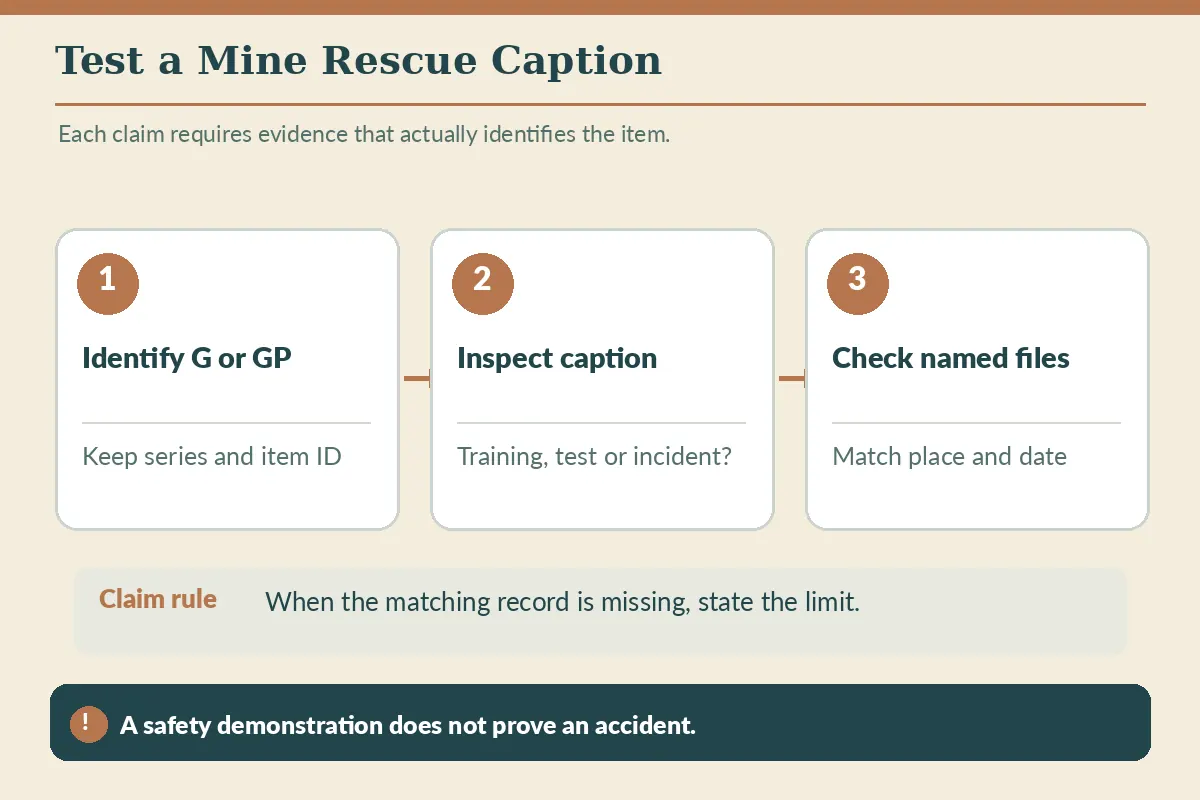
Family researchers should create distinct statements for a mine, a person, and an event. The photographic claim concerns what is visibly shown and where the picture was filed; the personnel claim concerns a named worker’s documented employment or role; the event claim concerns a confirmed incident. No single generic G or GP scene establishes all three. If a handwritten caption gives a surname, compare the full name, locality, occupation, and approximate date with an independent source before attaching the image to a family tree.
Use payrolls, company personnel documents, census occupations, city directories, union or local records, and relevant named accident reports as separate evidence streams where they survive. The presence of a mining surname in a district directory does not identify an anonymous person in a photograph. Conversely, lack of a name on an image does not mean the person had no documentary history. Record uncertainty explicitly, especially where multiple miners shared a surname or worked in adjacent coal camps.
Use a ledger with columns for archival identifier, original caption, visible equipment, proposed place, date confidence, source for each proposed fact, and alternate interpretation. If one piece is missing, keep a neutral caption and an open research question. This is more useful than choosing the first attractive image and trying to make a relative fit it.
Cite and Reuse a Safety Photograph Without Adding a False Story
A reliable citation includes National Archives, RG 70, G or GP as applicable, the item identifier, title or caption, and a stable catalog reference if one exists. Note whether you examined an original print, a reproduction, or a website thumbnail. Request a higher-resolution image or clarification of reverse-side marks when an uncertain word matters. A crop removing the caption card may also remove the only evidence of place and date, so preserve the full reproduction with your notes.
If you publish an interpretive illustration rather than an archival scan, label it clearly as an illustration. Never copy an imagined helmet number, invent an employee name, or describe a stylized scene as an authentic Bureau of Mines photograph. For a factual article, the proper result might be a modest statement: “Bureau of Mines image of safety equipment; no incident or individuals identified.” The surrounding history can still explain changes in safety training and public education without falsely claiming that a disaster was photographed.
The collection count is a holdings estimate, not a guarantee that each image is digitized or can be searched by a miner’s name. Use the National Archives Catalog and staff finding aids for item-level confirmation. When you cannot find the original after a good-faith search, disclose the limits and cite the series guide instead of manufacturing an image number.
More Research Method Guides
How We Research These Archival Photographs and Claims
We checked the official RG 70 description for the G and GP photographic groupings, their approximate dates and the GS/GX finding aids. We used NARA’s Still Picture Branch guide and still-picture research instructions for retrieval and citation. These sources do not verify a particular miner or rescue event. A sample scene discussed here is an analytical example, not a claimed identified photograph. Our affiliate disclosure is provided for transparency, not because NARA endorses this article.
G is the extensive general photographic file; GP is a smaller general photographic print grouping. Do not assume they share identical item numbers.
No. Find the original caption and a separate dated accident or training record before assigning an event.
NARA describes GS as a shelflist and GX as an index to the G and GP photographic series.
No. Agency images can depict private-company workers, visitors, instructors and others.
The guide gives an approximate archival extent, not a count of digitized item files.