
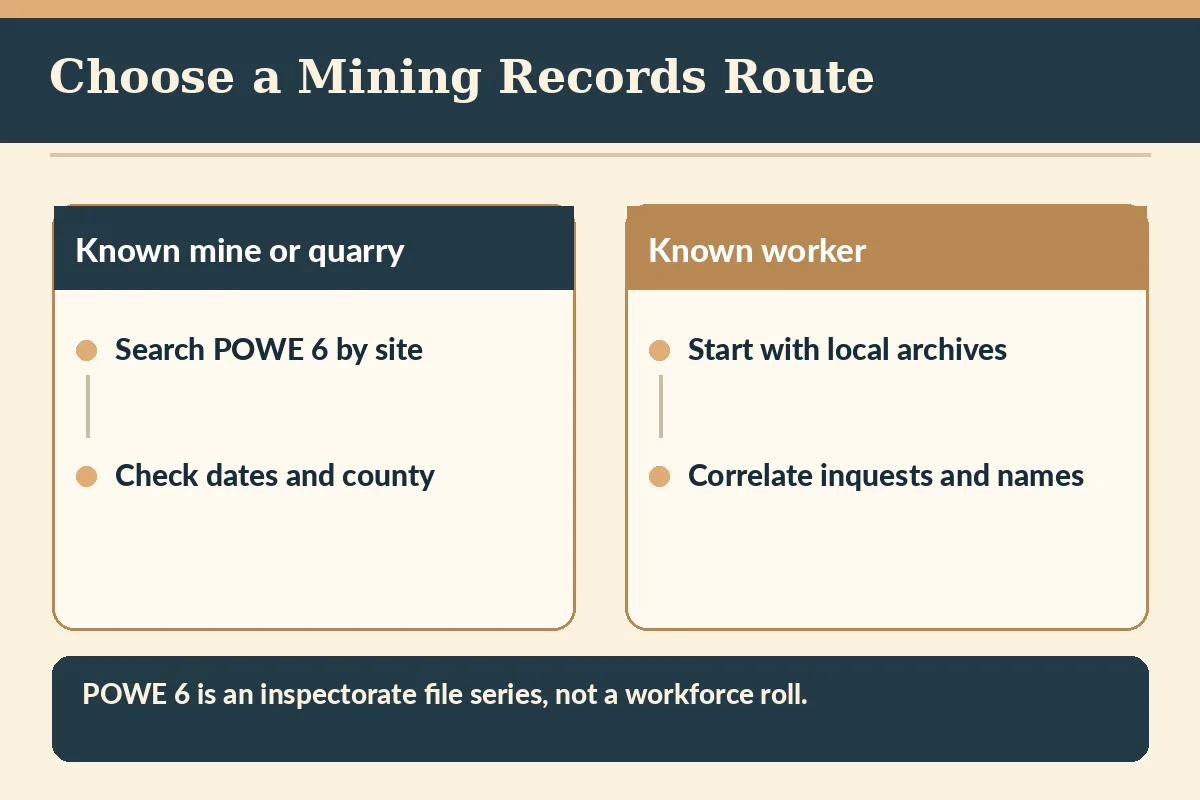
POWE 6 holds registered papers about mines and quarries rather than a continuous register of all miners. The National Archives identifies the series for 1887–1920 and specifically notes accident-related files from 1889–1919. Begin with the mine or quarry, its county, and the approximate date, then ask what sort of official attention the incident attracted. An accident report, a complaint, an inspection and a confirmed finding are not interchangeable. A surname in an inspectorate file does not establish a miner’s full career or family relationship.
Most family searches start with a person; an inspectorate file is more likely to be located through an establishment, a district, a type of hazard or a date. Write down every known variant of the colliery name, including the company, shaft or pit where relevant. Separate the accident date from the date a letter was written or filed. Those dates can differ significantly when an investigation or appeal continued after the event. Preserve that distinction even if a catalogue summary compresses the whole case into one year.
Find an accident within the inspectorate period
Search The National Archives catalogue within POWE 6 using the colliery, quarry, county and words such as accident, explosion, inspection or safety. The mining guide also points to POWE 4 for mines-and-quarries out-letters, HO 45 for some explosion and accident material, and POWE 7 for inspectors’ reports. These are complementary routes, not a promised sequence of files for every incident. If one code produces no result, try the historic district or company name; a missing result is not proof that an accident was never reported.
Record the full POWE 6 piece reference, document title, catalogue date span, creator and holding repository. The Archives warns that its mining material is normally not available online; readers may need to visit Kew or order copies. Do not describe a catalogue entry as if you have read a signed inspector’s report. When a file contains several enclosures, make a miniature inventory by sender, date, recipient and purpose. The original pagination or folio numbers matter if the papers are later rearranged or quoted in a newspaper.
Separate a reported event from official findings
An initial letter might repeat an operator’s account, an employee complaint, or a third party’s description. Attribute each claim. For instance, write ‘the manager reported a roof fall’ rather than ‘the official inquiry proved that a roof fall was the cause.’ The inspector’s observations may be stronger evidence about conditions actually examined, but an inspector can still distinguish what was seen from what witnesses said. Use a table with columns for the assertion, named source, observation date, corroboration and unresolved questions.
Keep a findings column separate from correspondence. A government reply might acknowledge a report, request repairs or refer a matter for further action; none of those actions is automatically a criminal conviction or a conclusive causal finding. Note whether a later document explicitly supersedes an earlier account. In older files, spelling and occupational labels can change. Quote important uncertainty rather than silently harmonizing every description into a single neat narrative that the archive does not support.

Rebuild the mine or quarry context
The physical site matters to the interpretation. A historic pit name may designate a group of shafts rather than one opening; a quarry can change operators, boundaries or extraction methods. Identify the parish, neighbouring settlement, mine name and operating company independently, if possible. An official record may refer to a works or lease rather than a residential address. Never infer from a miner’s apparent surname that the family owned the mine, lived beside the workings, or retained employment throughout the period under examination.
Maps can help place a shaft or haulage route, but date the map and determine what it depicts. The National Archives notes that some historic maps show a surface entrance rather than the underground workings. A map produced years before or after an accident may not show a dangerous section as it existed on the day. Keep separate labels for mapped location, engineering inference and documented incident point. Attach a full map citation, scale and edition instead of marking an exact modern coordinate unsupported by the source.
Search for people beyond the inspectorate file
The mining guide explicitly says The National Archives is not the main repository for individual miner personnel records. Local record offices and surviving company collections are usually better for workforce evidence. Search local newspapers, inquest materials where they survive, parish or civil registration records, memorials and local mining collections. Distinguish a named casualty from a person merely employed at a mine with a similar name. Check ages, addresses, occupations and household associates before identifying any worker.
A death certificate might establish a death and stated cause, while an inspectorate file may establish that an inquiry happened. Neither document necessarily explains the whole chain of responsibility. If the same incident appears in a parliamentary report or newspaper, check whether that publication copied the company’s original statement. Multiple reprints of the same account are not independent confirmations. An absence from a later published list can reflect reporting thresholds, jurisdiction or survival rather than an absence of injury.

Imagine a file titled with a pit and a year that contains a worker’s complaint, an inspector’s visit and a letter requesting ventilation changes. The file documents a safety concern and an administrative response. It may not establish who caused a later injury or whether every recommendation was carried out. To make a defensible statement, cite the complaint as an allegation, the visit as an inspection and any dated follow-up as a separate action. State explicitly which outcome remains unverified.
Close the research with an event ledger: incident date; first report; investigator; evidence considered; finding, if any; and independent person-level records. Label undated and later-copied documents. Keep a negative-search log that records the actual keywords and series tried. That allows another researcher to reproduce the search without confusing no result with a historical negative. A cautious claim is more useful than a dramatic reconstruction unsupported by the surviving papers.
More Records and Archives Guides
How We Research Mining Accident Evidence
We used The National Archives’ mines and mining guide to check POWE 6’s date range, the 1889–1919 accident-file reference, the alternative government record series, and the warning about personal miner records. Its land records overview is a separate route for testing site ownership rather than worker identity. Neither guidance page proves the cause of an unexamined accident.
Our method begins at the correct archive series, classifies each statement by its creator and date, and adds independent documents only for claims they can actually support. We avoid invented quotations, verdicts, injuries and relatives. When exact findings cannot be confirmed, we leave them unresolved. Read the site’s affiliate disclosure for transparency; this research guide does not assume any paid archival access or commercial relationship.
The Archives identifies registered files about mines and quarries for 1887–1920, with accident-related files from 1889–1919.
No. It is an administrative collection; surviving local and company records are more suitable for many individual employees.
Not necessarily. Distinguish a reported concern, an observation, an administrative instruction and a formal finding.
Check relevant HO 45 material, POWE 4 out-letters, POWE 7 inspector reports and locally held newspapers or inquest records.
No. The National Archives warns that much of its mining material must be consulted at Kew or ordered as a copy.