
WO 129 includes Imperial Yeomanry registers and casualty books associated with the South African War of 1899–1902. The National Archives directs researchers to look for them by regimental number and to use related WO 128 attestation and discharge papers. A casualty annotation can be valuable, but the word casualty does not automatically mean killed, and a soldier with the same surname is not necessarily the man in another record. Start with his number, unit and dates; then read the exact notation before describing what happened.
The Imperial Yeomanry was raised in 1899, drawing volunteer mounted infantry into British operations in South Africa. Its records should not be conflated with those for regular regiments or locally raised South African forces. A later family story may shorten all of them to ‘Boer War soldier.’ That phrase is a research lead, not a unit identification. Record the service context that each source actually provides and do not project a modern unit name back onto a wartime entry.
Use the regimental number before the surname
First seek a regimental number and the man’s company, battalion or contingent where available. The Archives’ volunteers guide explicitly makes regimental number the access point for WO 129 registers and casualty books. A number in a period newspaper or commemorative roll needs verification, because transcription mistakes and repeated surnames can send you to the wrong soldier. Keep the exact spelling of the name and the full archival reference beside the number; do not treat a number alone as a universal identity across all formations.
Search WO 129 by reference and appropriate unit information; note whether the particular item is an index, a register or a casualty book. The Archives’ African forces guide describes WO 129 as an index route to WO 128. Not every WO 129 entry carries the same type or depth of information. If a page points elsewhere, follow that reference rather than building a complete career from the index alone. Record the date and page of each entry, including any later corrections written in a different hand.

Read registers and casualty notations cautiously
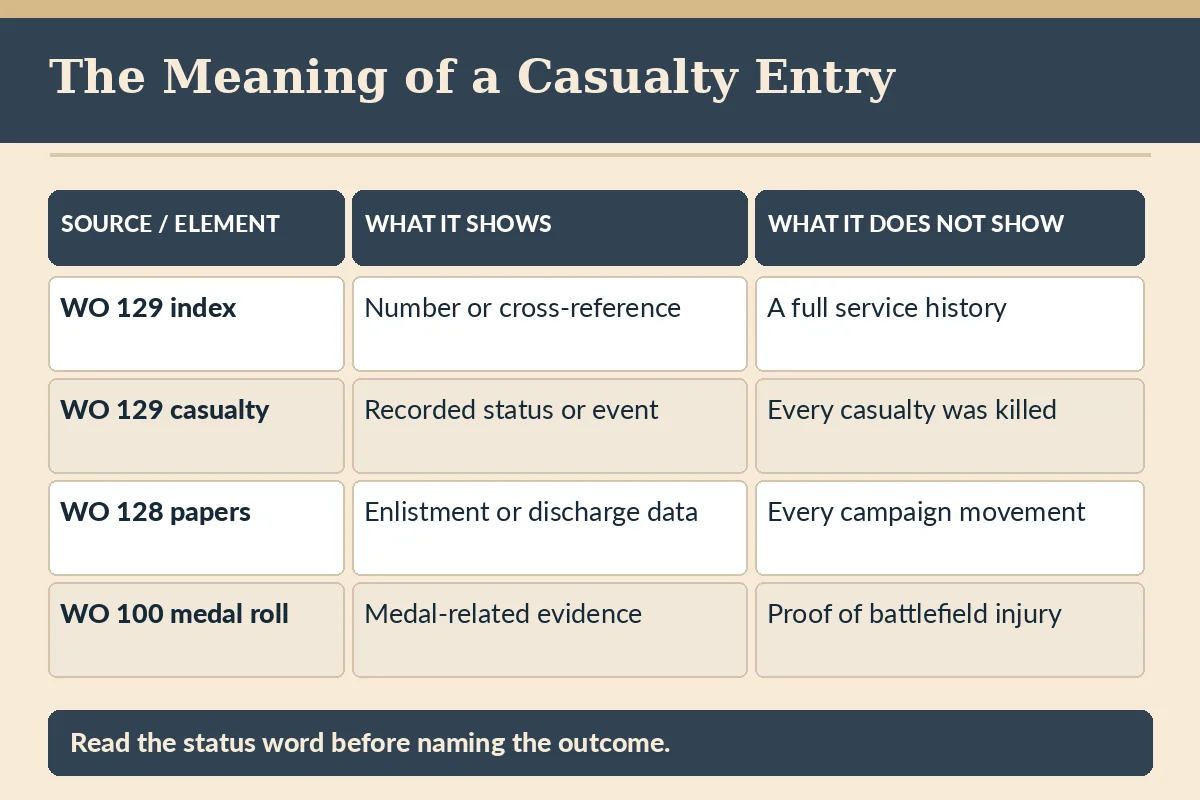
Casualty can describe a range of wartime outcomes; use the original abbreviation and any key or heading before expanding it. Distinguish wounded, sick, missing, prisoner, died and discharged where the source allows, and never silently replace an unclear entry with ‘killed in action.’ A later report may revise a provisional status. If you encounter an abbreviated place name, check whether it marks a hospital, a camp, a battle or an administrative headquarters. A register’s location is not necessarily where an injury occurred.
An index does not always provide the underlying event evidence. A man named with a number in WO 129 might have paperwork in WO 128, which comprises attestation and discharge documents. Compare the full name, number, age, next-of-kin or address if actually stated, and the unit designation. Do not assume that the documents are complete or that they establish every posting. If a WO 128 item differs from a register, record the conflict and assess which document is closer in time to the event.
Correlate WO 129 with WO 128 service files
WO 128 can help with enlistment and discharge, but its end date should not automatically be treated as the date a man left South Africa. Service periods may include travel, administrative processing and time after an injury. Different sources may use the date of occurrence, receipt of news or later entry in a book. Make three fields in your notes: event date, record date and later reporting date. If one is unknown, leave it blank rather than copying another date to fill the gap.
The Archives lists campaign medal rolls in WO 100 and other sources for Imperial Yeomanry service. A medal entry can support participation or qualification according to the roll’s terms, but it does not independently prove injury, a specific location or every campaign movement. A printed honour roll or regimental history may help find spelling variants. Distinguish contemporary rosters from later compilations and maintain citations for both; they are different evidentiary objects.
Keep South African units distinct
The Archives separately lists WO 126 enrolment forms and WO 127 nominal rolls for forces raised locally in South Africa. Their presence in the same war does not make them interchangeable with Imperial Yeomanry WO 128 and WO 129 records. Verify the formation before switching series. A man might have served in different forces at different times, but such a sequence must be established by actual records. Never join two identical names without matching identifiers and plausible chronology.
For an individual casualty claim, seek military documentation and independent personal evidence, such as contemporary casualty reports, local notices and civil death registration when appropriate. A newspaper may copy an official casualty list, so it is not automatically an independent confirmation. If the family story says a soldier died in battle, establish the official status and date first. Where the archive offers only an uncertain notation, write that the register records a reported status rather than declaring a fully resolved death.

Imagine a WO 129 register entry for a common surname and a number, followed by a WO 128 document naming a recruit of the same age and unit. The records may support identifying the recruit; if the register merely says ‘sick,’ they do not support a statement that he was wounded in combat. A later discharge could arise from a different cause. Separate the successful identity match from any unresolved outcome. A precise, narrow conclusion is more useful than a dramatic but unsupported war story.
Build a four-part citation chain: WO 129 reference and page, exact regimental number, corresponding WO 128 reference, and any independent dated source needed for the final claim. Keep a note of spelling variants and reassignments, not just positive matches. If the WO 128 file cannot be found, do not automatically call it destroyed or prove the index wrong. Describe the limit of the search performed and retain the next verification step for another researcher.
More Records and Archives Guides
How We Research Imperial Yeomanry Evidence
We checked The National Archives’ volunteers and territorials guide, its African forces research guide, and its British Army soldiers guide. Together they support the WO 129-to-WO 128 route and its distinction from South African local units, not a claim about an unseen soldier.
Our method treats a wartime register as a defined source, not a biography. We identify which line supports a number, a casualty annotation or a later discharge, then seek independent evidence only when needed. Uncertain dates and outcomes remain visible. See the affiliate disclosure for site transparency; no record-provider subscription or commercial relationship is asserted.
It contains Imperial Yeomanry registers, indexes and casualty material, which the Archives advises searching by regimental number.
WO 129 can be used to identify or index the attestation and discharge papers of Imperial Yeomanry soldiers in WO 128.
No. Check the precise annotation and later records before stating whether someone was wounded, ill, missing or dead.
No. WO 126 and WO 127 relate to locally raised South African units rather than the Imperial Yeomanry route.
Not on its own. A medal roll answers a different question and needs separate dated casualty evidence.