
POWE 25 is a National Archives route to records of the Safety in Mines Research Board and related work. Its presence in a search result means a technical or administrative study may survive; it does not demonstrate that an accident happened at a particular colliery or that a named miner took part. To use these records responsibly, begin with the claim you want to test: research into a hazard, an actual incident, or a person’s employment. Those questions lead to different source sets.
Decide Whether the Question Is Technical or Personal
The government’s mining records are arranged primarily around departments, oversight and policies. The National Archives explicitly warns that it does not hold the personnel records of miners as a general collection. If a family story says that a grandfather worked underground, a POWE 25 record about ventilation is not a substitute for a company employment register. Start instead with a colliery name, town, approximate years, union records, pay books or local archives for the person-level question.
If the question concerns how a safety problem was investigated, POWE 25 is a plausible lead. Write the hazard in the vocabulary of the period and modern terms: ventilation, dust, gases, lighting, explosives, machinery or rescue equipment. Do not assume any specific experiment occurred until you read the record. The National Archives’ mining guide advises searching POWE 25 with keyword “4”, reflecting one way its research material was indexed. The term is a catalogue aid, not a scientific classification of all items.
Keep three hypotheses in the notebook: a general experimental study, a report about a particular place, and documentation of an actual injury. They may meet in one research project, but they are different claims. A technical recommendation might be circulated widely without being adopted everywhere, and the lack of a named pit in a report cannot be transformed into proof that the technology was or was not used there.
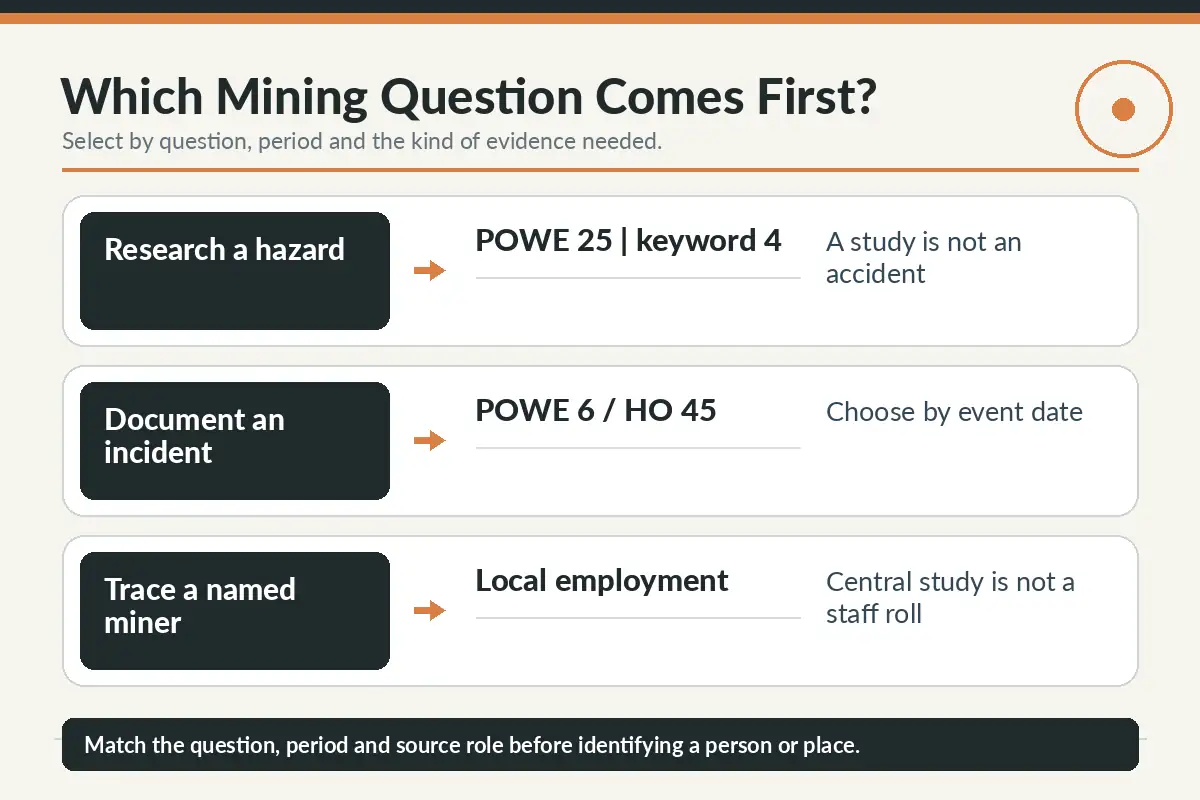
Match the Department and Period to the Record
Government oversight of mining changed substantially after the Mines Act 1842. The National Archives mining guide follows the Home Office Mines Inspectorate in the nineteenth and early twentieth centuries, the Board of Trade Mines Department from 1920, and later Ministry of Fuel and Power bodies. This administrative context explains why one event may generate files in different departments and why a later series can preserve historical reports. The date on a file does not necessarily equal the date of an experiment it discusses.
For a suspected accident, POWE 6 contains some files on mine and quarry accidents during 1889–1919; HO 45 includes nineteenth-century reports on explosions and accidents; POWE 8 includes accident prevention and Royal Commission material. These are conditional alternatives for an event question, not a sequence that every case must follow. Select by incident date, topic and known administrative body. A search result with the word “accident” in a policy file still may not name casualties.
For compensation or a named injured worker, another branch is needed. The guide points to LAB 56 registers of industrial diseases, HO 157 workmen’s compensation entry books and later PIN records. Their existence does not guarantee that an individual claim or medical finding is retained. Before opening those avenues, document why the person, workplace and time are consistent with the record’s scope; avoid turning an occupational risk into a diagnosis.

Extract Research Claims Without Overreading a Diagram
Create a paper-level transcription with the full reference, original title, creator, date range, stated purpose, and the exact scientific or administrative observation. A measured value, a proposed precaution and a practical order are different kinds of evidence. Some illustrations reproduce a test rig rather than the equipment installed in a particular mine. If the source is a retrospective summary, record whether it cites an original experiment or restates an earlier recommendation.
An illustration can be especially misleading in local history. A schematic ventilation circuit describes a technical possibility; a mine plan locates shafts and workings; an accident inquiry addresses an occurrence. Do not overlay a generic study diagram on a local map without checking scale, provenance, date and relevance. If two records use the same place name, confirm it is the same colliery and not a neighbouring operation or an administrative district with a similar name.
Imagine a fictional newspaper describing a 1932 underground incident. A POWE 25 report on dust control from an overlapping period may be important context, but does not establish the cause. A contemporaneous inquiry, company record, local paper and relevant official statistics would be needed before making causal claims. Note any disagreement: a company report might call an event a stoppage while a local witness describes an injury. Both statements must remain attributed.

Plan Access, Citations and a Credible Next Search
Use Discovery’s advanced reference search with POWE 25 and relevant hazard terms, then browse neighbouring entries if names or words are absent from titles. Discovery indexes descriptions, not the complete text of undigitized files, so “no results” rarely means a research subject never existed. Save the catalogue series description and each piece reference. Record the “Held by” field: searches can bring in other archives rather than just documents at Kew.
For a place-specific project, cross-check the local colliery’s operating name and dates in regional archives, historic mining plans and records of the companies concerned. The National Archives says local archives are normally better sources for individual mines and quarries, and the Coal Authority holds abandonment plans. Neither plan nor technical study proves an identified worker’s presence. Every link in a family story needs an independent personal record.
In the final write-up use precise verbs. A study “examined” a hazard; a committee “recommended” a measure; a documented authority “ordered” a change; a separate dated local source may show implementation. Leave unknown what remains unproved. Cite the page, drawing or file reference rather than relying on a broad series name, and state if you saw only a catalogue entry rather than the record itself.
More Records and Archives Guides
How We Research Historical Mine Safety
We follow the National Archives mining guide for POWE 25 and the different accident, health and compensation series. We use Discovery search guidance and its result-interpretation guidance to distinguish catalogue metadata, an available piece and its actual contents.
This guide does not describe a specific undisclosed experiment as fact, or reconstruct a real accident from a general engineering drawing. Examples are explicitly hypothetical and no medical or family claim is made about an identified miner. See our affiliate disclosure for editorial relationship information.
It includes Safety in Mines Research Board material; inspect specific file descriptions to see their scope and dates.
No. A study or recommendation does not establish a particular incident or injury.
The National Archives mining guide points to HO 45 and, for some later cases, POWE 6, as conditional searches.
Not on its own. Try local company and personnel sources that identify the individual.
Many series are sparsely described and may require browsing by period, topic and full reference.