
POWE 45 contains Ministry of Power photographs from the development and deployment of PLUTO—Pipe Line Under The Ocean—during 1942–1946. The National Archives specifically lists them as photographs scattered among files. They are useful for reconstructing wartime engineering stages, but a picture of a drum or a pipeline section does not by itself establish how much fuel was delivered or name the people who built it. This guide gives a precise source route, identifies what the archive can and cannot show, and names the independent documents needed before a personal or geographic conclusion becomes defensible.
Identify the Photograph’s Project Phase Before Its People
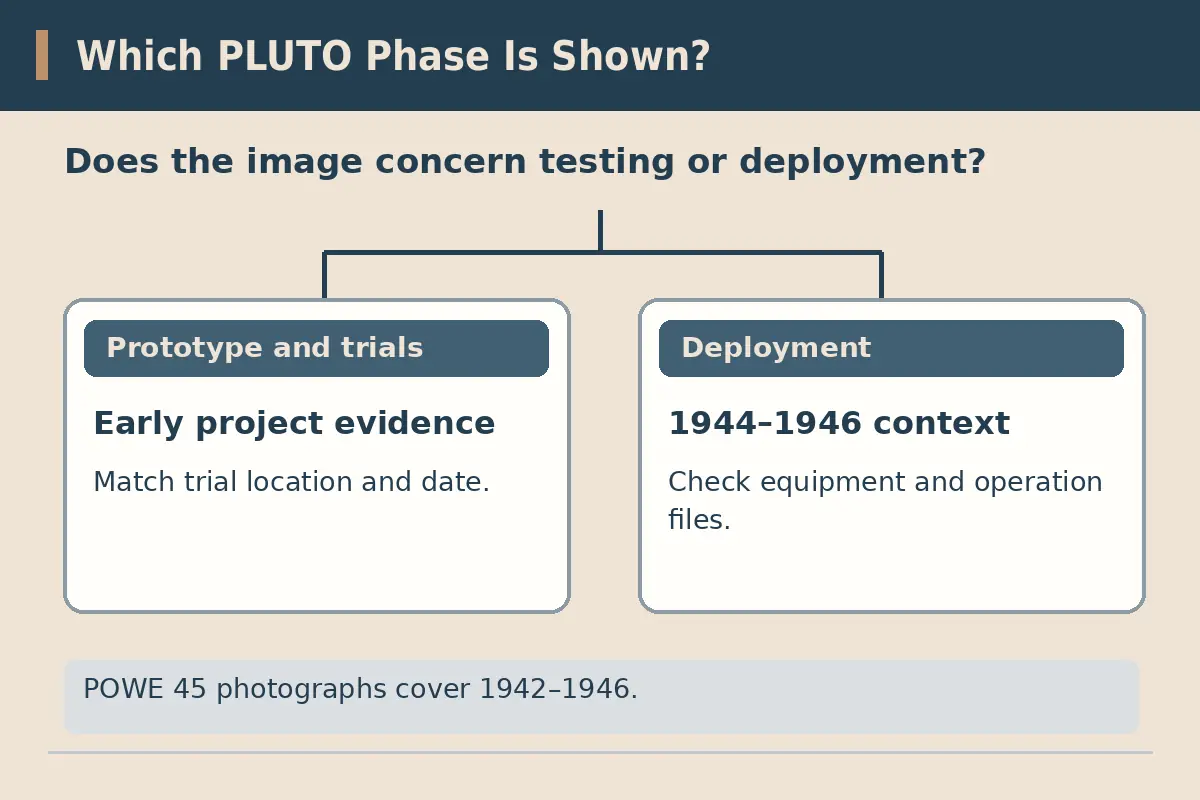
PLUTO was a wartime engineering project whose recorded stages include experimentation, manufacture, testing and deployment. The National Archives places PLUTO photographs in POWE 45, dated 1942–1946, under the Ministry of Power. A piece may contain photographs among engineering papers rather than a freestanding album. Begin with a technical question such as “Which kind of pipe-laying drum is shown?” or “Does this image show a trial installation or operational equipment?” Search within the series using both “PLUTO” and equipment or location terms, then write down every full piece reference and caption you locate.
Do not assume a striking image represents the final operational stage. Tests can use similar equipment to later deployments, and a large drum pictured on a quay may document manufacture, preparation or an experimental operation. The official photographic guide describes the construction of the Conun drum in 1943 at POWE 45/61, making it a useful reference example; it does not make that item a complete history of the project. Distinguish what the photograph directly shows from a later caption or historian’s interpretation of its purpose.
Use Dates to Separate the South Wales Trial from the Channel
A surviving museum object helps illustrate why phase matters. The Whipple Museum describes an experimental PLUTO pipe section connected with a 1942 trial from South Wales to North Devon. This early trial is not interchangeable with the later English Channel pipeline deployments. An image of pipe or winding equipment from 1942 should not automatically be described as fuel already flowing to armies in continental Europe. Record the reported test place and date, the specific technical object pictured and any corroborating engineering documents.
Build a chronology with distinct columns for prototype construction, trial, deployment and operational output. A single photograph may support one visible stage but not all four. A museum label attached decades later is evidence about the object’s present interpretation, while a dated engineering memorandum may offer more direct evidence for an historical action. If sources disagree, show both dates and explain whether they refer to an initial test, a successful crossing, a later adaptation or simply the file’s overall date range.
Hypothetical example: a family album labels a picture “PLUTO 1944,” showing a reel and two unidentified people. Compare the machinery with a traceable POWE 45 file, but do not infer the place or workers from the label alone. The family caption may reflect later knowledge, and the equipment could belong to a test or production stage. Seek a dated job record before identifying a person.

Read Equipment Photographs Without Overclaiming Performance
Photographs can reveal the size or design features of equipment, protective structures, handling arrangements and relationships among objects visible at one place. But perspective makes exact scale uncertain, and unlabelled prints may conceal differences between proposed and produced machinery. If describing a type of pipe, avoid assigning its materials or specifications based on appearance alone; seek a technical drawing, manufacturing report or object description. Do not treat a photographed assembly as proof that it was deployed at the Channel crossing or used continuously.
Claims of fuel quantities, pumping duration, speed or success belong to contemporary operating returns or carefully sourced technical histories, not to an engineering photograph. If a file includes text and images, cite each part separately. A report about a trial can explain an image’s purpose, but may still be incomplete, preliminary or revised. Maintain a source-to-claim matrix: image shows equipment; trial memorandum describes an experiment; operational record supports a quantity or event. Never let a visually persuasive illustration substitute for the right record type.
Verify the Site and the Workforce Independently
Equipment might have been photographed during tests, assembly, transport or deployment. To identify a site, compare the caption with distinctive infrastructure, historic maps, site plans and other dated photographs. A generic shoreline or workshop can resemble several locations. When the photograph is poorly catalogued, mark the location uncertain and keep competing candidate sites open. A caption naming a county does not alone identify the exact address or prove that a surviving installation is the one in the photograph.
Workforce history requires a different route. A person pictured next to a pipe is not identified by their overalls or by knowledge of a family member’s wartime work. Contractors, service personnel, engineers and visitors could appear together. Seek a personnel record, employment list, named engineering correspondence or other appropriate evidence before assigning a particular worker or duty. If the identity cannot be corroborated, an honest caption says “unidentified personnel” rather than converting a family tradition into a documented person in the frame.

Cite the Original Ministry of Power Context
The National Archives advises that much of its photographic material remains unavailable online, even where catalogue titles can be searched. For POWE 45, consult the original piece or a properly identified reproduction; note the image position, official caption if present and any linked papers. Record whether the text was written at the time of the project or supplied later. Avoid presenting a newly drawn pipeline diagram as a faithful scan of an archival technical drawing, and label hypothetical reconstructions unmistakably.
A useful final citation distinguishes the POWE 45 file from a museum artifact and from independent operational reporting. If you use the Whipple Museum’s pipe section to understand an engineering trial, cite its museum record without implying it was pictured in the archival frame. Negative searches require caution: a missing workers’ list or deployment photograph in this collection does not mean that the trial or the worker did not exist. The photographic archive is a selective window into a complicated project, not the whole wartime record.
One strong outcome of a POWE 45 search is a narrow statement such as “this pictured apparatus was part of recorded development work,” with a citation. Stronger claims about fuel flowing across the Channel, a named factory employee or the completion of a specific line need records designed to document those facts. Stating the limit preserves the photograph’s actual historical value.
More Records and Archives Guides
How We Research This Archive Series
This guide starts with the documented evidence in an authoritative source, not a claim that we have inspected a particular person’s private file or a specific original piece. The archival statements here concern the series or research method. A hypothetical example is labelled as such; it is not a newly discovered historical event. We use the Discovery search guidance to distinguish keyword matches from archive holdings and document contents, because catalogue descriptions do not transcribe every word of an original.
For every real candidate, record its historical place or person’s name, the creator, document type, date, full POWE 45 piece or item reference, access restrictions, and the exact claim being tested. The official citation guide explains how to document those references so another researcher can retrace them. An unread document remains a catalogue lead, never proof of imagined details. If a record is missing, preserve the searched terms and dates and examine survival and alternate custodians before interpreting the gap.
Before sharing a conclusion, audit the difference between original source wording and your interpretation. Require independent evidence for any further claim about an individual, property owner, legal effect, or completed action. Respect archival access limits and living people’s privacy. This website also provides an affiliate disclosure; no paid partnership or commercial access is implied by these archival references.
The National Archives identifies POWE 45 as Ministry of Power files containing photographs of PLUTO development and deployment dated 1942–1946.
No. The photographic guide describes photographs scattered among files; check the particular piece and its contents.
Yes. The Whipple Museum documents an experimental pipe section associated with a 1942 South Wales-to-North Devon trial.
No. An operational return or another source designed to record quantities is required for such a claim.
Only when there is reliable specific identification; otherwise seek independently named employment or personnel evidence.