
The National Archives photographic guide identifies a substantial Mulberry Harbour group in WO 240: 1,388 photographs documenting different stages of construction and movement across the Channel. These images provide unusually detailed views of the logistics behind the Normandy landings, but the broad WO 240 series covers other War Office photographic material too. A photograph of one prefabricated structure is not evidence that the entire harbor was complete or operational. Nor does a picture of workers from a distance establish their names. This guide helps classify construction, transit and installation as different stages and pairs each visual claim with independent operational or personal evidence.
Find Mulberry Photographs Inside the Broader WO 240 Series
Begin in the WO 240 catalogue and keep the full piece reference. The National Archives describes a group of 1,388 Mulberry Harbour photographs, but WO 240 itself is broader than the Normandy project. Search for Mulberry, harbour, component names, construction locations and vessel terms; do not assume every WO 240 image concerns the same operation. Photographs may be grouped by theme or provenance rather than by strict chronological order. A broad file title is only a route to inspect the originals.
Capture the original caption and any image or negative number. An album sequence may mix construction, transport and later views. If a title is generic, compare neighboring plates and documents rather than inventing a location. The archives guide warns that photographs scattered among records may not be individually described in Discovery, making a series-and-piece search more reliable than a single keyword.
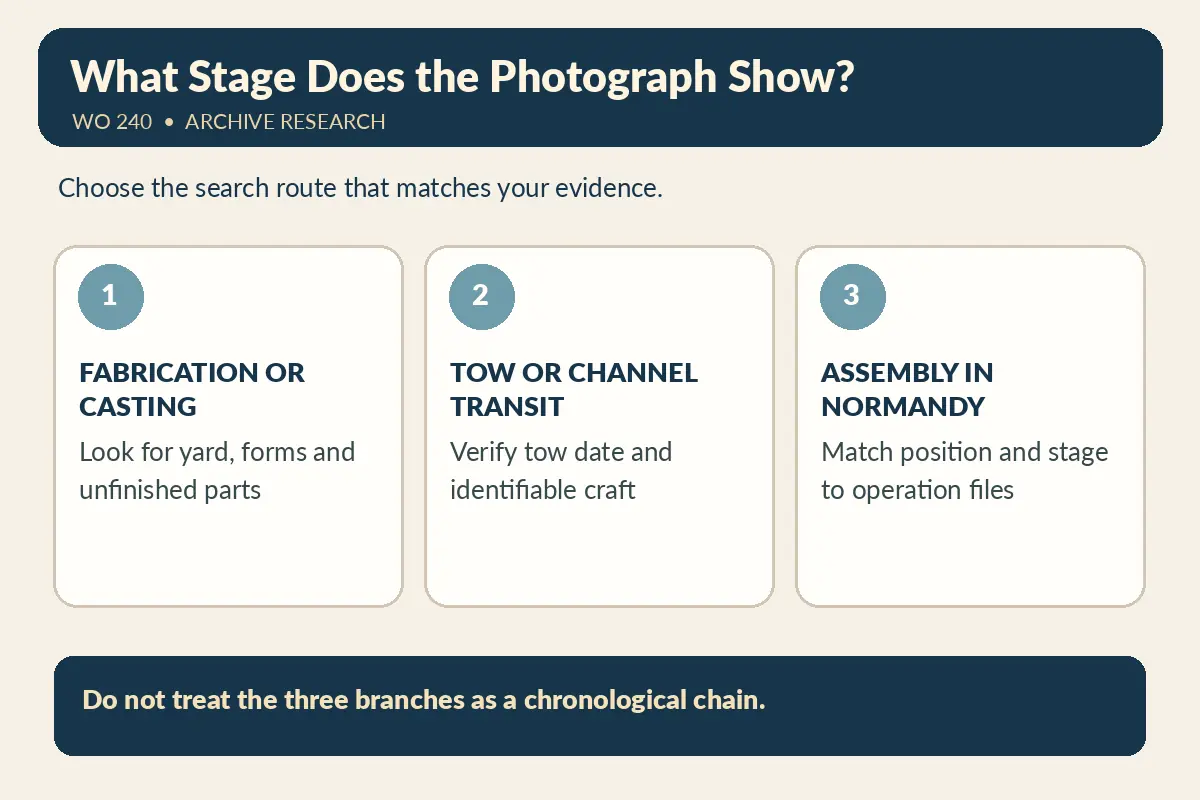
Recognize Prefabrication Without Inventing a Finished Harbour
Mulberry Harbour depended on large prefabricated elements, temporary protection and floating connections assembled into working landing facilities. A construction photograph may show concrete sections in forms, partly complete structures, a shipyard, or preparations for launching or transport. Identify the visible object first. Specialist terms such as caisson, floating roadway or breakwater require a credible caption or engineering cross-check; an ambiguous rectangular structure should not be assigned a precise class merely because it resembles a known component.
Record the fabrication setting and any visible stage: reinforcement, shuttering, completed shell, lifting equipment or waterside staging. Construction and acceptance are different events; a finished-looking object may still await inspection, repair or transport. Photographs showing numerous pieces in one yard do not prove they were all eventually deployed. Match their stated identity or serial information to a separate administrative or engineering record when available.
Keep Channel Transit Separate from Installation
An image of a floating or towed unit may establish that a structure was photographed under tow, but not necessarily the exact route, destination or arrival time. Sea conditions, camera angle and towing craft markings can provide contextual clues, not complete voyage logs. Distinguish a staging harbor in Britain from a final anchorage off Normandy. A tow through the Channel is a logistical stage; it does not mean that the structure was correctly positioned or used on arrival.
To support a transit claim, look for dated shipping or naval records, movement orders, or a reliable contemporary caption identifying craft, location and date. If a photograph is undated, avoid linking it automatically to the most familiar invasion timetable. Place references on separate lines for assembly, tow, arrival and installation rather than presenting one image as evidence of all four.

Check Installation and Operation with Independent Documentation
A photograph may show components aligned near a beach or a floating roadway extending toward land. These are visual clues to installation, but the stage might be temporary, incomplete or under repair. The presence of a structure is not proof that it was carrying vehicles at that moment. A dated engineering report, operation diary or official progress account can establish construction status more reliably than inference from an aerial or oblique photograph alone.
Build a project-stage table. For each view, record the named component, its visible condition, reported place, photo date or date range, and the external document that independently addresses installation or use. If two captions conflict, retain them and investigate whether one concerns a print date or a later compilation. Distinguish a proposed arrangement on a plan from an assembled structure in an original photo.
Do Not Infer a Worker, Unit or Contractor from Scenery
The engineering subject is usually more important than individual identity. People visible on a dockside may be service personnel, civilians, contractors, visitors or specialists from different organizations. Clothing and proximity to a structure do not establish job title, service number or employment date. A family account placing someone on the Mulberry project is a research lead to test against named military records, contractor documents or reliably captioned photographs, not a license to recognize them in any crowded work scene.
The project involved numerous phases and places. Even confirmed work on one component would not prove presence during its Channel journey or installation on the Normandy coast. Construct an evidence chain with person, unit or employer, dated assignment and the specific activity. If one link is missing, say which part of the story remains unverified. An engineering photograph can still enrich family history as contextual material when clearly labelled.

Preserve the Sequence and Cite the Photograph Precisely
For each image record the full WO 240 reference and internal identifier, caption wording, material form and the source of any reproduction. When comparing two pictures, note camera position and visual differences before declaring them “before” and “after.” An apparently damaged component may be a different structure altogether. A careful album audit checks whether neighboring frames, catalogue order and external reports genuinely support the chronology.
A good conclusion is limited but useful: a photographed component at a verified location and a particular phase, supported by independent records for later movement or operation. It will not invent a complete life history for unnamed workers or assert the success of an entire harbor from one dramatic scene. If the piece is not digitized, follow the archive’s access route and keep a transparent research log rather than guessing the unseen detail.
More Records and Archives Guides
How We Research This Archive Collection
The description of WO 240 in The National Archives photographic research guide is our starting point for collection scope, dates and photographic subjects; it does not imply that we have examined every original print. The method in the article uses the official Discovery search guidance, which explains that catalogue descriptions may be sparse and searchable names are not necessarily present in the descriptions. Search or browse the precise series, identify a complete piece reference and assess image-level annotations before stating what a particular picture depicts. Do not confuse an archival series summary with a transcript, caption or negative print that has not yet been viewed.
We distinguish first-hand observations from interpretation. A photograph may support a claim about visible structures, objects, people or terrain, depending on image quality and authentication; a date printed in an album might relate to assembly rather than exposure. The official citation guidance recommends full reference and internal page, folio or other identifier wherever available. For each candidate, retain the picture reference, verbatim caption, the field that supplies the date, how the image was accessed and one alternate interpretation to test. An example described as hypothetical here is not an original archival discovery.
This guidance intentionally avoids claims about named individuals, private employment, specific military actions, completed construction or legal ownership unless independently supported by a fitting record. Where access is limited or an original is undigitized, state that limit instead of inventing image contents. Respect privacy and cultural or historical sensitivities. Our affiliate disclosure describes site transparency; no commercial archive relationship is asserted by these citations.
The National Archives identifies a collection of 1,388 photographs showing Mulberry Harbour construction and movement across the Channel.
No. The wider WO 240 series includes other War Office photographic material.
Not alone. Installation, completion and operational use need dated corroborating records.
Only where reliable captions or other person-level sources support an identification.
They are separate phases; evidence of one does not automatically establish the others.